Where People Are Moving To In Wisconsin In 2026
A wizarding academy and a deep-space office tower sit on the same Verona campus. That is where thousands of Epic employees write medical software every day. Their paychecks have turned a once-quiet Dane County city into one of Wisconsin's fastest-growing addresses. Verona is one of eight towns picking up new residents at a striking clip. Some of them ride the Madison jobs boom into Fitchburg and Sun Prairie. Others tap the Twin Cities economy from River Falls. A few simply have the lakes and the trails that make people stay. Baraboo leans on Devil's Lake bluffs and a real circus history. Lake Geneva turns generations of summer visitors into year-round neighbors. Census Vintage 2025 estimates confirm the trend across all eight. Migration is doing the heavy lifting here. These are the Wisconsin towns worth watching.
Verona

Epic is the most obvious reason Verona keeps growing. The medical software company's Verona campus is one of the state's most unusual employers, its themed buildings styled after deep space, a barn, and a wizarding academy, open to visitors for self-guided tours on select days. That workforce has reshaped the southwest side of the Madison region, and the numbers show it: the Dane County city grew from 13,927 residents in the 2020 base to 16,821 in 2025, a 20.8% increase. New housing has followed as workers and families look for access to Madison with a home in the suburbs.

Downtown gives the city a center beyond the campus. The Sow's Ear pairs a coffee shop with a yarn store and has been a Main Street gathering spot for years. Alice Good pours specialty Colombian coffee a few doors down. Hop Haus Brewing Co. leads the local beer scene with its own taproom. Avanti's Italian Restaurant and Pub handles the sit-down dinner crowd. Outdoors, Badger Prairie County Park gives the city its main stretch of sports fields and open ground. The Military Ridge State Trail cuts right through downtown and links Verona by bike or on foot into the wider Dane County network.
Fitchburg

Fitchburg grew from 30,983 residents in 2020 to 34,615 in 2025, an 11.7% increase. The city sits directly south of Madison, where growth has followed both suburban housing demand and access to the capital region's jobs. There's no single employer behind it; the draw is location and livability, with easy connections to Madison, Verona, and the Beltline plus newer neighborhoods and strong bike infrastructure.

Quivey's Grove has been the city's signature restaurant since 1980, serving scratch-made food inside a 19th-century Italianate fieldstone mansion surrounded by gardens. The Great Dane Pub & Brewing Co. runs a Fitchburg location of the Dane County brewpub, cooking its own beer into dishes down to the cheese curds. Zafferano Ristorante adds an unusual Italian-Indian fusion menu in the heart of the city. For the outdoors, the Lewis Nine Springs E-Way threads trails through wetlands and wildlife habitat with scenic overlooks. The Capital City State Trail passes through the same area as a direct regional cycling route around Madison. McKee Farms Park covers the everyday end of things, with athletic fields, open lawns, a splash pad, and community events.
Sun Prairie

Sun Prairie grew from 35,979 residents in 2020 to 39,227 in 2025, a 9.0% increase, which makes it one of the largest growth centers in Dane County outside Madison. The city sits northeast of the capital, where Highway 151, new housing, schools, and retail development have helped turn a once-smaller community into a major suburban hub. New neighborhoods have expanded around the city while downtown and the east-side retail corridors keep adding restaurants, shops, services, and entertainment.

Much of the city's character sits in the walkable downtown. Full Mile Beer Co. & Kitchen pours its own craft beer there alongside a menu of wood-fired pizzas. Guimo's Mexican Restaurant has held down a Main Street spot for years. J.J. Stitches keeps a longtime quilt shop going among the older storefronts. The city's most distinctive attraction is Angell Park Speedway, a historic dirt track that still runs midget racing and seasonal events. Patrick Marsh Wildlife Area sits on the edge of town for anyone after something quieter, with trails, open water views, and birding.
Oconomowoc

People aren't only moving toward Madison. Lake Country west of Milwaukee is pulling them too, and Oconomowoc is the clearest case. The Waukesha County city grew from 18,175 residents in the 2020 base to 20,119 in 2025, a 10.7% increase, helped by lakes, schools, I-94 commuter access, and a real downtown.

Water shapes much of the appeal. Fowler Lake brings park space, walking routes, and summer events into the middle of town. Lac La Belle and the adjacent City Beach open up swimming, boating, and concerts. The downtown runs along Main Street and Wisconsin Avenue, where Wine Maniacs Bar & Bistro serves scratch-made food and wine. Mantra Indian Bistro adds one of the area's authentic ethnic options a few blocks over. The Etcetera Bar and Grill draws a crowd to rooftop seating that looks out over Fowler Lake.
River Falls

River Falls grew from 16,193 residents in 2020 to 17,916 in 2025, a 10.6% increase. The Pierce and St. Croix county city sits in western Wisconsin, close enough to the Twin Cities region to attract commuters while keeping its own university-town identity. It pulls in households that want access to the Minneapolis-St. Paul economy with a home on the Wisconsin side, helped by regional job access and the University of Wisconsin-River Falls.

The Kinnickinnic River gives the city its defining landscape, running trout water, trails, and protected natural areas straight through the middle of town. Glen Park works as the everyday gathering place, with paths, playgrounds, courts, and pool facilities leading down toward the river corridor. Just outside town, Kinnickinnic State Park opens onto St. Croix River scenery and a larger network of hiking trails. Downtown holds its own on Main Street, where Swinging Bridge Brewing Company pours house beer in a college-town setting. The Table on Main keeps the sit-down dining end covered. Tattersall Distilling runs a River Falls tasting room with cocktail classes and live music.
Eau Claire

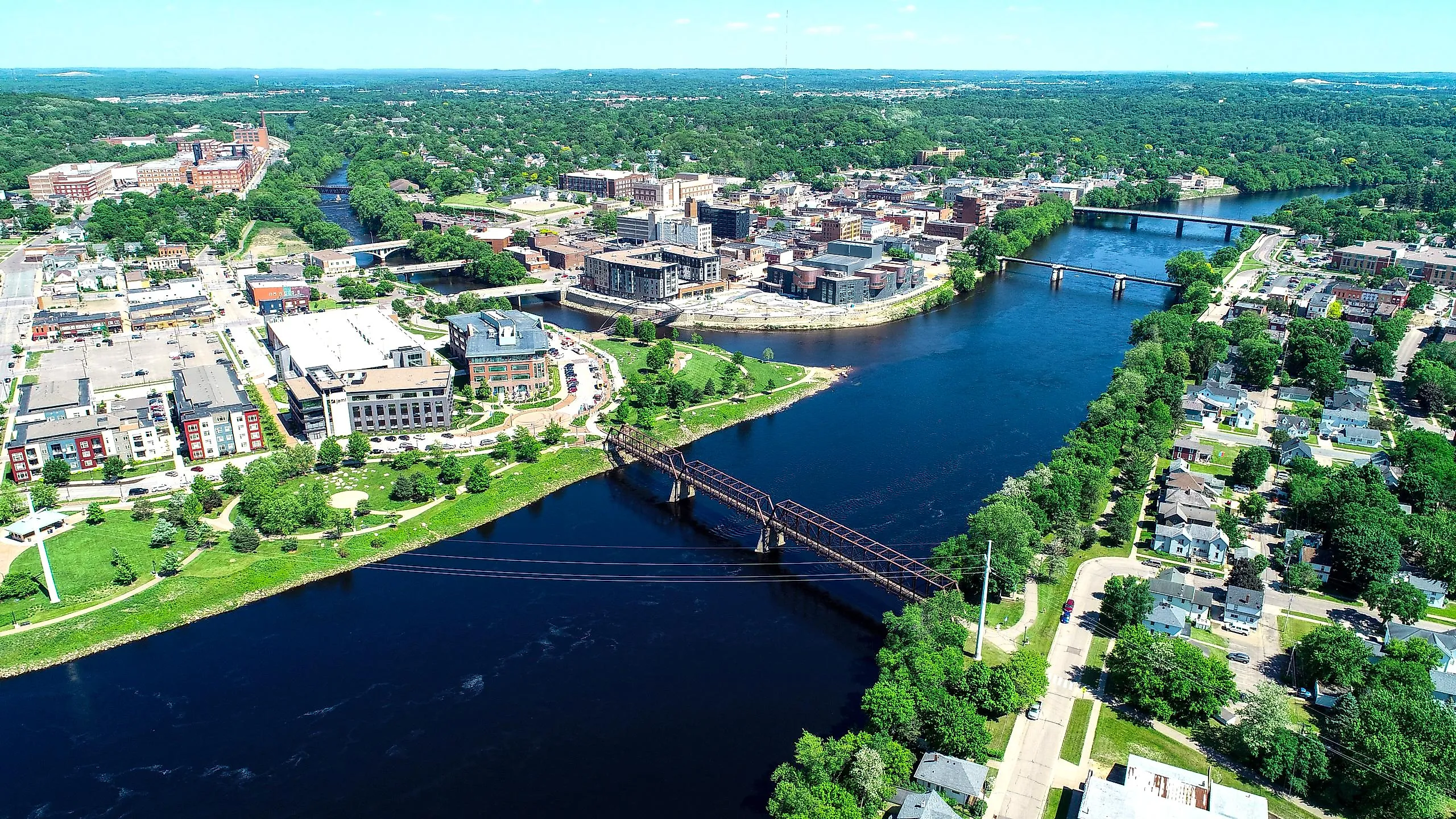
Eau Claire grew from 69,440 residents in 2020 to 72,465 in 2025, a 4.4% increase. The raw gain is meaningful because Eau Claire is already one of western Wisconsin's major population centers, serving the Chippewa Valley as a regional hub for health care, education, arts, and retail. A downtown riverfront, a university, hospitals, and music venues make it a destination in its own right.

Phoenix Park sits at the center of downtown, where the Eau Claire and Chippewa rivers meet, hosting a year-round farmers market along with concerts and riverfront trails. A short walk away, The Brewing Projekt turns out experimental IPAs and fruited sours. Leona's slings retro pizza by the slice from its downtown location. The Phoenix Taproom & Kitchen pours from dozens of self-serve taps right on the Chippewa River. The Pablo Center at the Confluence puts a major arts venue downtown for performances, galleries, and community events. And the Chippewa River State Trail begins at Phoenix Park, carrying cyclists and walkers 30 miles through river bottoms, prairies, sandstone bluffs, and wetlands.
Baraboo

Baraboo isn't keeping pace with Madison's outer suburbs—it grew from 12,552 residents in the 2020 base to 13,224 in 2025, a 5.4% increase—but it earns a place here for a different reason. The Sauk County city pairs steady growth with hotels, visitor infrastructure, and some of Wisconsin's strongest photo spots, sitting near both Wisconsin Dells and Devil's Lake State Park. That gives it resident appeal and tourism support at once, on top of affordability and a history rooted in the circus and the Baraboo Hills.

Devil's Lake State Park is the biggest outdoor name, with quartzite bluffs, beaches, and hiking trails that produce some of the most photographed scenery in Wisconsin. The city's circus history stays visible at Circus World, set on the original Ringling Bros. winter quarters, with exhibits, restored circus wagons, and seasonal performances. Downtown wraps around a courthouse square with more than 40 locally owned businesses. The Al. Ringling Theatre, billed as "America's Prettiest Playhouse," holds down one corner. Jen's Alpine Cafe has been serving Wisconsin comfort food there since the 1930s. The Village Booksmith rounds out the independent storefronts a short walk away.
Lake Geneva

Lake Geneva has been a resort town for generations, and it's adding permanent residents now too—up from a 2020 estimates base of 8,291 residents to 8,818 in 2025, a 6.4% increase. The Walworth County city draws on lake access, second-home demand, retirement appeal, and the pull of a small city carrying a large hospitality base. It has both the infrastructure of a visitor destination and the daily services of a real town.

The Geneva Lake Shore Path is the best-known attraction, following the shoreline past historic estates, gardens, and piers. Riviera Beach gives the city a central summer gathering place close to downtown and the lakefront path. The Cornerstone Shop & Gallery is one of the longtime downtown retailers, stocking gifts, clothing, and home goods. Oakfire serves wood-fired pizza with a view of the lake. Lake City Social keeps things casual a few doors down, with a menu that runs from burgers to brisket.
Where Wisconsin's Growth Is Heading
Wisconsin's growth map points to a few clear destinations. Dane County continues to pull residents into communities such as Verona, Fitchburg, and Sun Prairie, where Madison-area jobs meet new housing and trail-connected neighborhoods. Lake Country and western Wisconsin show another version of this, with Oconomowoc and River Falls attracting households looking for water, commuter access, and smaller-city identity.
Eau Claire, Baraboo, and Lake Geneva show why the list includes more than suburbs. Regional hubs and visitor-friendly towns are also adding residents when they combine jobs, hotels, outdoor recreation, and recognizable downtowns. For people already living in these places, growth will mean more housing demand, busier roads, pressure on schools and public services, and more investment in parks, downtowns, trails, and hospitality districts.