US Towns That Sprang Up in a Gold Rush and Never Went Bust
When the gold ran out, most boomtowns emptied out with it. A few refused to. Placerville had a courthouse and a freight road to fall back on. Grass Valley went underground and mined hard rock for another century. Julian planted apple orchards where the diggings had been. Breckenridge sold its mountains to skiers, and Deadwood sold its own violent legend to tourists. Gold built each of these towns, but a second act is what kept them on the map after the gold rush ended.
Placerville, California

Before Placerville, it was called Hangtown. Before Hangtown, it was called Dry Diggins. Specks of gold were discovered in the tail race of Sutter's Mill on the South Fork of the American River on January 24, 1848. Over 1,000 miners were working the ground by the summer of 1848. The town was known as Dry Diggins because miners had to take loads of dry soil to running water to wash the gold out.
But not all who frequented the area were honest men. Many murders and robberies became common in the camps, with several merchants and miners losing their gold at knifepoint. Vigilante justice became common, and perpetrators were publicly hanged. Thus, Dry Diggins became Hangtown. The settlement was officially incorporated as Placerville in 1854. At the time, it was the third-largest town in California, surpassed only by San Francisco and Sacramento. Placerville was nearly destroyed by fire in 1856, as mining activity was already in decline.
Yet, the town recovered. Placerville became the location of the El Dorado County seat, bringing government offices, courts, and businesses, which remain today. Placerville's position on the main route between Sacramento and the Sierra Nevada allowed merchants, freight wagons, and travelers to pass through town, which developed it into the region's commercial center that it remains today.
Grass Valley, California

Grass Valley stopped mining gold. It did not stop mining. It certainly did not forget its mining heritage. Grass Valley was home to two of the most lucrative gold mines in all of California: the Empire Mine and the North Star Mine. Prospectors searched the Sierra Nevada foothills for gold in the late 1840s, although the real boom did not begin until 1850 when a settler discovered gold in a quartz rock. By 1851, thousands of people were living in Grass Valley.
Despite extensive fire damage in 1855, the town rebuilt itself and began to grow. Miners and prospectors learned that the real riches were in underground quartz. Underground mines were developed, and skilled hard-rock miners from Ireland and Cornwall, England, arrived. Over the next century, the Empire Mine alone produced roughly 5.8 million ounces of gold, making Grass Valley the richest gold-mining district in California. These massive industrial mining operations supported a strong economy throughout the Great Depression and World War II before the hard-rock mines were closed in the 1950s.
Today, the Cornish heritage permeates throughout the year with annual events like Cornish Christmas and St. Piran's Day. Mining heritage draws tourism towards the town at the Empire Mine State Historic Park, which allows visitors to tour the mine, view scale models of underground workings, and exhibits of ore samples.
Julian, California

In late 1869, Fred Coleman, a former slave, stopped to water his horse at a small creek. He happened to look down when something caught his eye. He knelt down to pan the creek, and, for the next 30 years, gold was at the center of Julian's history. Julian became a tent city practically overnight. In just two years, the population approached 2,000. At its peak, the town had two hotels, two cafes, five stores, two blacksmiths, two livery stables, a school, a racetrack, and several saloons and dance halls.
Between 1870 and 1875, the Julian mines produced around $2 million in gold. But Julian's success was short-lived. A severe recession hit the region, and gold production started to decline. By 1876, the majority of mines had closed; however, there were still a couple in operation until the late 1890s and early 1900s.
Julian's replacement for gold unknowingly arrived in the 1870s. A wagon of young apple trees was taken up the mountain, flourishing in the cool climate and rich soils. After the remaining mines closed, the town shifted to agriculture, planting orchards of apples and eventually pears. The town has been famous for its apples and apple pies ever since, hosting its first Apple Days celebration in 1909. Additionally, Julian is a year-round retreat for residents of urban areas in southern California.
Breckenridge, Colorado

Breckenridge traded pickaxes for skis. Gold turned it into a booming mine camp in 1859 after prospectors discovered deposits along the Blue River. This led to a rush of prospectors traveling to the Rocky Mountains, quickly replacing tents with saloons, hotels, and businesses to serve the growing population. The Wellington Mine produced substantial amounts of gold, silver, and lead.
As with many mining towns in the West, Breckenridge faced economic challenges as mines depleted. However, its strategic location along key transportation routes through the Rockies kept the town afloat. It was a popular stop for stagecoaches, and in 1882 the Denver, South Park and Pacific Railroad reached town over Boreas Pass, bringing supplies and passengers that kept the local economy moving.
The Breckenridge Ski Resort opened on December 16, 1961, and brought winter sport enthusiasts to the valley, replacing mining with outdoor recreation. Today, the ski resort contributes to the town's cultural scene as much as it does to the tourism economy. The ski resort has five peaks, 187 trails, and the highest chair lift in North America. The Breckenridge ski resort not only supports the town through the winter, but in the summer it offers hiking and zipline tours.
Deadwood, South Dakota

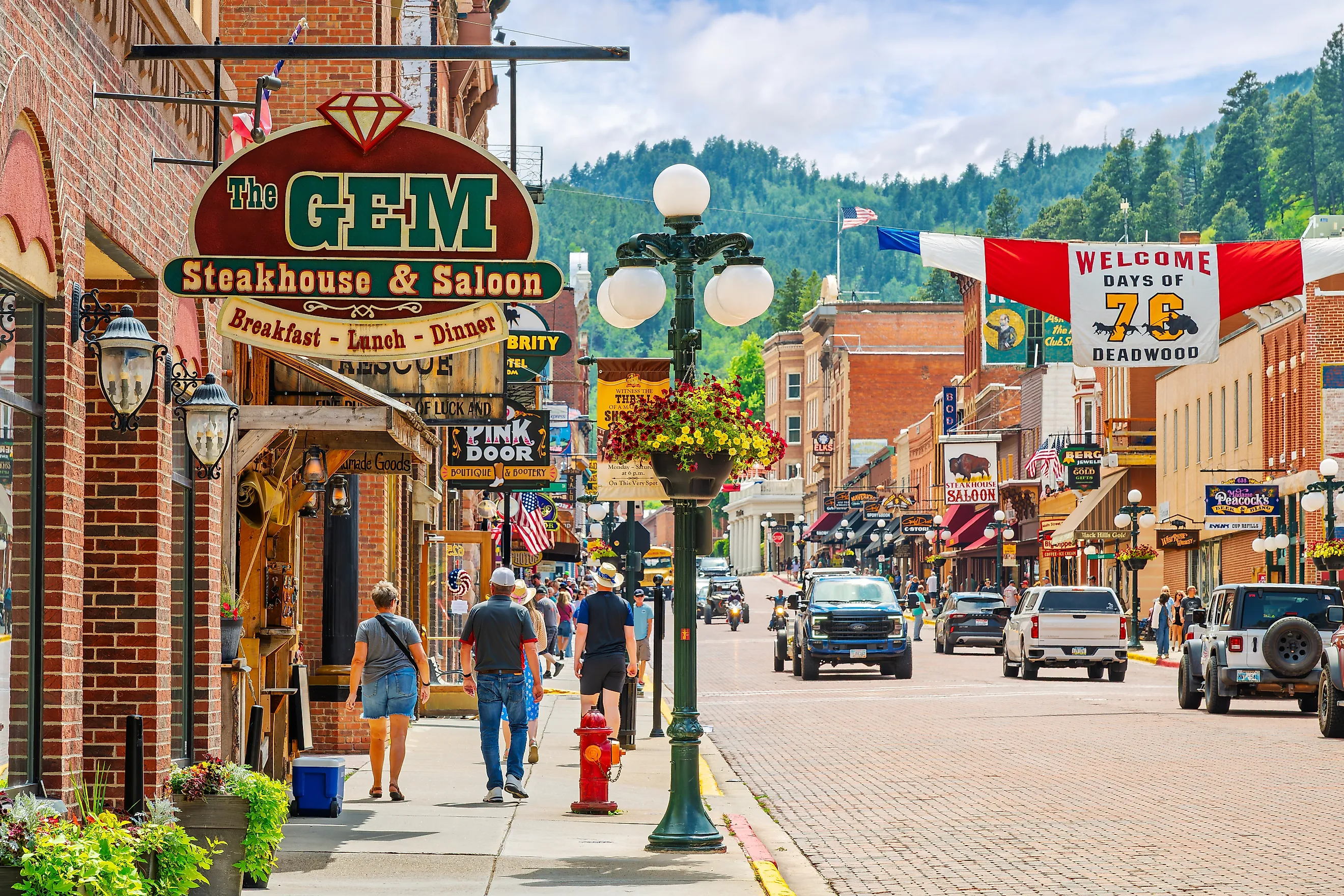
Unregulated growth. Illegal gambling. Frontier violence. These occurrences were common in the first thirteen years of Deadwood's existence. Deadwood was founded in 1876 in a narrow gulch in the Black Hills of South Dakota. The town was founded illegally on land the United States had guaranteed to the Lakota Sioux under the 1868 Treaty of Fort Laramie. Deadwood was populated by miners, gamblers, and outlaws of the Wild West, including Wild Bill Hickok, who was shot in the back of the head during a card game within weeks of arriving.
As the gold mines became less prosperous in the late 19th century, Deadwood declined. But the Wild West heritage on which the town was founded kept it alive. The emergence of historical tourism, combined with efforts to preserve the town's history, gave it new life. Today, the town is lined with historic buildings, like Saloon No. 10, where Wild Bill Hickok was killed. During the summer, Deadwood Alive stages historical reenactments and mock gunfights on Main Street three times a day, six days a week, keeping the town's frontier origins at the center of modern life.
Gold Towns That Withstood Time
A commercial hub between Sacramento and the Sierra Nevada. A ski resort town in the Rocky Mountains. A preserved town in the Black Hills of South Dakota that pays homage to the Wild West. These are just some of the ways that former gold boom towns have found their way to survive. While gold may have created them, it could not sustain them. Each of these towns found a new purpose, whether it be commerce, agriculture, tourism, or recreation.