8 Prettiest Small Towns In Wales
Wales packs dramatic coastlines, mountain landscapes, medieval castles, and centuries-old architecture into a remarkably small corner of Britain. Its prettiest towns bring those landscapes together with colorful streets and historic landmarks in settings that have worked to preserve the heart of Welsh heritage. Their harbors are lined with pastel houses. Forests and waterfalls surround their villages. These eight destinations stand out for the scenery and character that make them some of the most beautiful places in the country.
Tenby

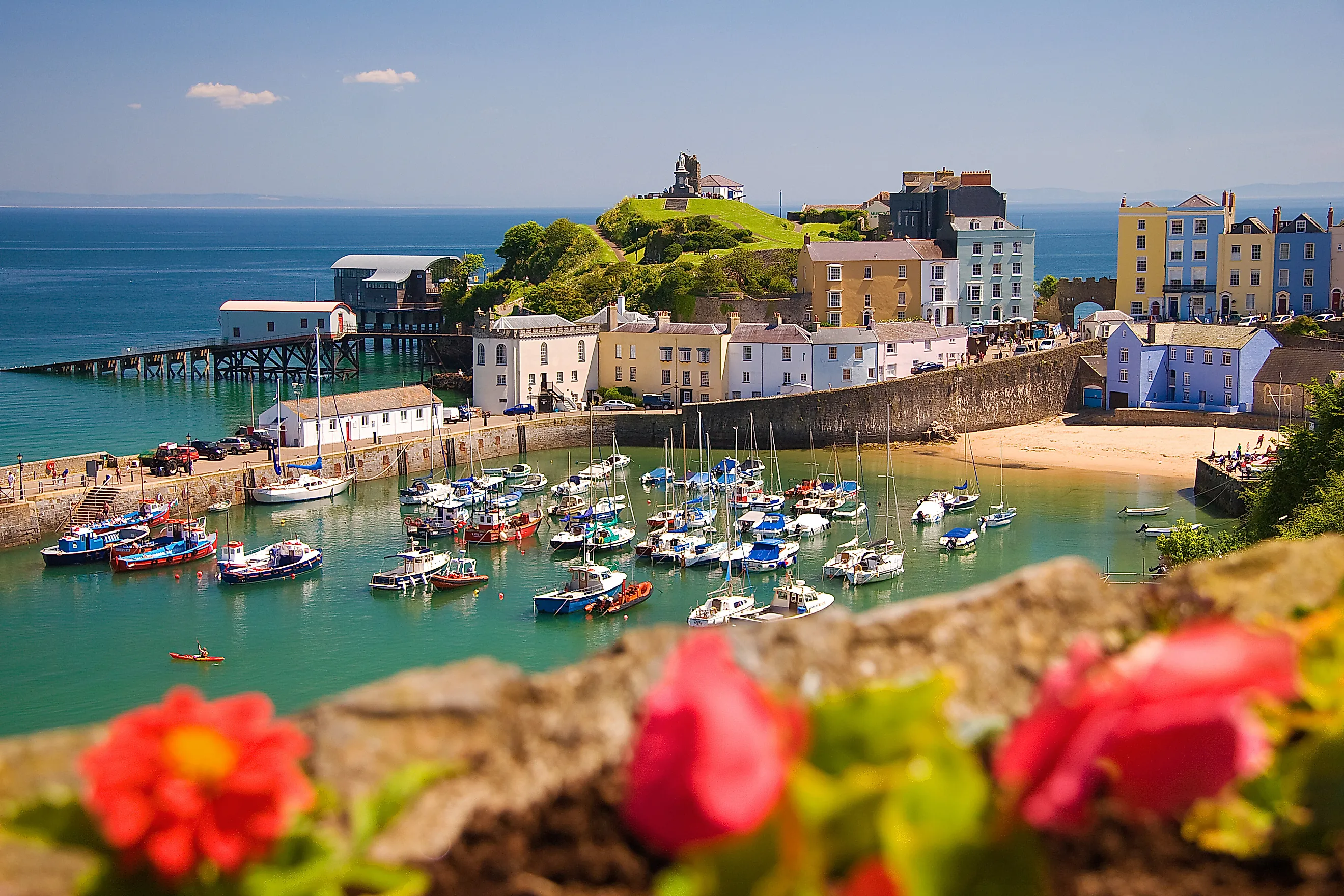
Perched on a limestone headland above Carmarthen Bay, Tenby is framed by four sandy beaches and enclosed by medieval stone walls. North Beach faces clear turquoise water in summer. Castle Beach and South Beach provide long stretches of glittering sand beneath the colorful skyline.
The old quarter is the town's defining feature. Georgian townhouses painted pink, yellow, and blue climb the hill above the harbor, ringed by a 13th-century town wall that still includes the Five Arches gatehouse. At the top, Castle Hill combines the ruins of Tenby Castle with wide views across the coastline, making it one of the most photographed spots in Pembrokeshire.
The harbor itself adds another layer to the scenery, with fishing boats resting below the pastel buildings at low tide. Nearby, St. Catherine's Island rises from the sea with its Victorian fort, creating one of Tenby's most recognizable coastal landmarks.
Hay-on-Wye

Hay-on-Wye lies between rolling countryside and the Black Mountains, on the banks of the River Wye. The surrounding hills provide a striking backdrop. The Brecon Beacons National Park stretches beyond the horizons.
Its narrow streets are lined with Georgian storefronts and historic cottages that lead towards Hay Castle, a Norman fortress dating back to the 12th century. The restored castle grounds and the famous Honesty Bookshop blend naturally into the town's historic setting, adding to its distinct appearance.
Offa's Dyke Path skirts the edge of town. The nearby Gospel Pass climbs to one of the highest roads in Wales. Together, they frame Hay-on-Wye with broad mountain scenery.
Portmeirion

Portmeirion was designed as an Italianate coastal settlement by Sir Clough Williams-Ellis. Bright pink, yellow, and terracotta buildings overlook the Dwyryd Estuary, with wooded hills and the mountains of Eryri forming the backdrop.
Nearly every surviving structure in Portmeirion dates back to its original creation. A campanile, domed pantheon, lighthouse, and elegant colonnades surround the central piazza, creating a historic town square. Williams-Ellis also preserved architectural pieces from older buildings, including a Jacobean ceiling now installed in the Town Hall.
Woodland paths circle the peninsula before reaching the estuary shoreline. The Belvedere provides one of the finest perspectives of the colorful village and the estuary beyond.
Solva

Built around one of Pembrokeshire's most distinctive natural harbors, Solva occupies a ria, a flooded river valley that reaches inland from St. Brides Bay. At high tide, the water reaches almost to the cottages. At low tide, boats rest on the riverbed as the inlet empties.
Lower Solva follows the waterfront with stone cottages, old lime kilns, and narrow lanes tracing the harbor's edge. Upper Solva climbs the hillside above, where the Victorian St. Aidan's Church overlooks the village and the bay beyond.
The harbor curves between steep green slopes before meeting the sea, creating one of the most scenic settings in the area. The Pembrokeshire Coast Path passes through Solva in both directions, with one stretch leading toward Solva Head and the clifftop views above the harbor mouth.
Betws-y-Coed

At the meeting point of the Conwy, Llugwy, and Lledr rivers, Betws-y-Coed is surrounded by woodland that gives the village its name, "prayer house in the woods." Stone buildings, traditional shopfronts, and the 14th-century St. Michael's Church give the center a timeless appearance.
Just beyond the main street, the stone bridge of Pont-y-Pair crosses the Llugwy, built around 1500 where the river rushes through rocky rapids. Its weathered masonry and rushing water have become one of the village's defining landmarks.
Betws-y-Coed has attracted visitors since the Victorian Era, when landscape painters settled there and turned the surrounding valley into one of the most painted stretches of countryside in Wales. Swallow Falls tumbles through a series of cascades nearby. Gwydyr Forest wraps around the village with dense woodland.
St Davids

Britain's smallest city is home to fewer than 2,000 residents, yet its skyline is dominated by one of Wales' greatest landmarks. St. David's Cathedral rises unexpectedly from a sheltered valley, its purple-gray sandstone contrasting with the surrounding greenery.
Beside it stands the dramatic ruins of the 14th-century Bishop's Palace, whose towering walls and arched windows remain remarkably intact. Inside the cathedral, the carved oak ceiling and slightly leaning nave add to its architectural character.
The city also lies beside the Pembrokeshire Coast Path, with Whitesands Bay only a short distance away. The combination of medieval architecture and rugged coastline gives St Davids a setting unlike anywhere else in Wales.
Conwy

Encircled by one of Europe's best-preserved medieval defensive walls, Conwy looks much as it did centuries ago. The walls include 21 towers and three original gateways still surrounding the historic center, with the estuary on one side and the mountains of Eryri beyond.
Conwy Castle dominates the skyline with its eight massive towers rising above the town. Nearby, Plas Mawr remains one of Britain's finest Elizabethan townhouses. Aberconwy House preserves one of the country's few surviving medieval merchant homes.
Thomas Telford's suspension bridge stretches beside the castle across the River Conwy. Together, the bridge, castle, walls, and waterfront create one of the most historic and recognizable landscapes in Wales.
Beaumaris

Beaumaris combines elegant Georgian streets with one of Britain's greatest medieval castles. It faces the Menai Strait on the Isle of Anglesey and looks across the water towards the mountains of Eryri and Puffin Island.
Construction of Beaumaris Castle began in 1295 as part of Edward I's campaigns in North Wales. Although never completed, its perfect symmetry, wide moat, and layered gatehouses make it one of the country's finest examples of medieval military architecture.
Historic buildings continue through the town center, including the Parish Church of St. Mary and St. Nicholas and one of Britain's oldest surviving houses, on Castle Street. A few miles along the strait, Thomas Telford's Menai Suspension Bridge, completed in 1826, links Anglesey to the mainland.
Small Towns Built to Last
The prettiest towns in Wales stand out because their historic buildings remain closely connected to the landscapes around them. Medieval walls still overlook the sea in Tenby. Castles rise above rivers in Conwy and Hay-on-Wye. Forests frame Betws-y-Coed. Colorful architecture transforms Portmeirion into one of the country's most distinctive villages. These towns show how Wales' history and scenery continue to shape some of Britain's most beautiful places.