This Florida Town Instantly Transports You To The Past
The old city of St. Augustine, Florida, looks much as it did when Spanish troops guarded its walls nearly 400 years ago. It was founded in 1565 by Pedro Menendez de Aviles, an admiral sent to defend Spain's claim to La Florida, which makes it the oldest continuously occupied European settlement in the continental United States. That is 55 years before the Pilgrims left England and landed at Plymouth Rock. Built in 1695, the Castillo de San Marcos still dominates the town and has guarded Matanzas Bay ever since. Other Florida towns keep their own hold on the past, among them Fernandina Beach, Pensacola, and Micanopy, but few places carry it the way St. Augustine does.
Founded Before Plymouth Rock

St. Augustine's story began at Seloy, a village belonging to the Timucua people who had lived along this stretch of coast for thousands of years. The Spanish came ashore here on September 8, 1565, to remove French settlers from Fort Caroline, a rival outpost near present-day Jacksonville. Menendez had first sighted land days earlier on the feast day of St. Augustine of Hippo and so chose to name the new settlement after the saint.
Now preserved today as the Fountain of Youth Archaeological Park, that landing site has been the scene of excavations since the 1930s, with more than 97,000 artifacts found. Costumed interpreters give blacksmithing and cannon-firing demonstrations, and a reconstructed Timucua village provides an insight into the people who greeted the Spanish.
The town's early years were certainly tumultuous, with it changing hands frequently as rival nations fought for dominance. Spain governed from 1565 to 1763, Britain from 1763 to 1784, and Spain again until 1821 when the United States purchased Florida. As a visit shows, each left its mark on the architecture, street names, and food of the place locals call "the Ancient City."
The Castillo de San Marcos

Construction of the Castillo de San Marcos kicked off in 1672, spurred on by pirate raids that convinced the Spanish something stronger than a wooden fort would be needed. Completed in 1695, its walls were made from coquina, a soft local stone of compressed seashells. Surprisingly, coquina proved remarkably effective in battle, absorbing cannonballs rather than shattering. As a result, it never fell in battle, despite repeated British sieges.
Now managed by the National Park Service as a National Monument, the Castillo offers self-guided tours of its gun deck, chapel, and soldiers' quarters, along with ranger talks and weapons demonstrations by costumed reenactors. Walking the full perimeter overlooking Matanzas Bay costs nothing and gives a true sense of the structure's scale, with views those first colonists would recognize.
A short walk north, the Old City Gates, a pair of coquina pillars built in 1808, once formed the only land entrance to the walled town. They now serve as the gateway to St. George Street, the pedestrian spine of St. Augustine's historic district.
St. George Street

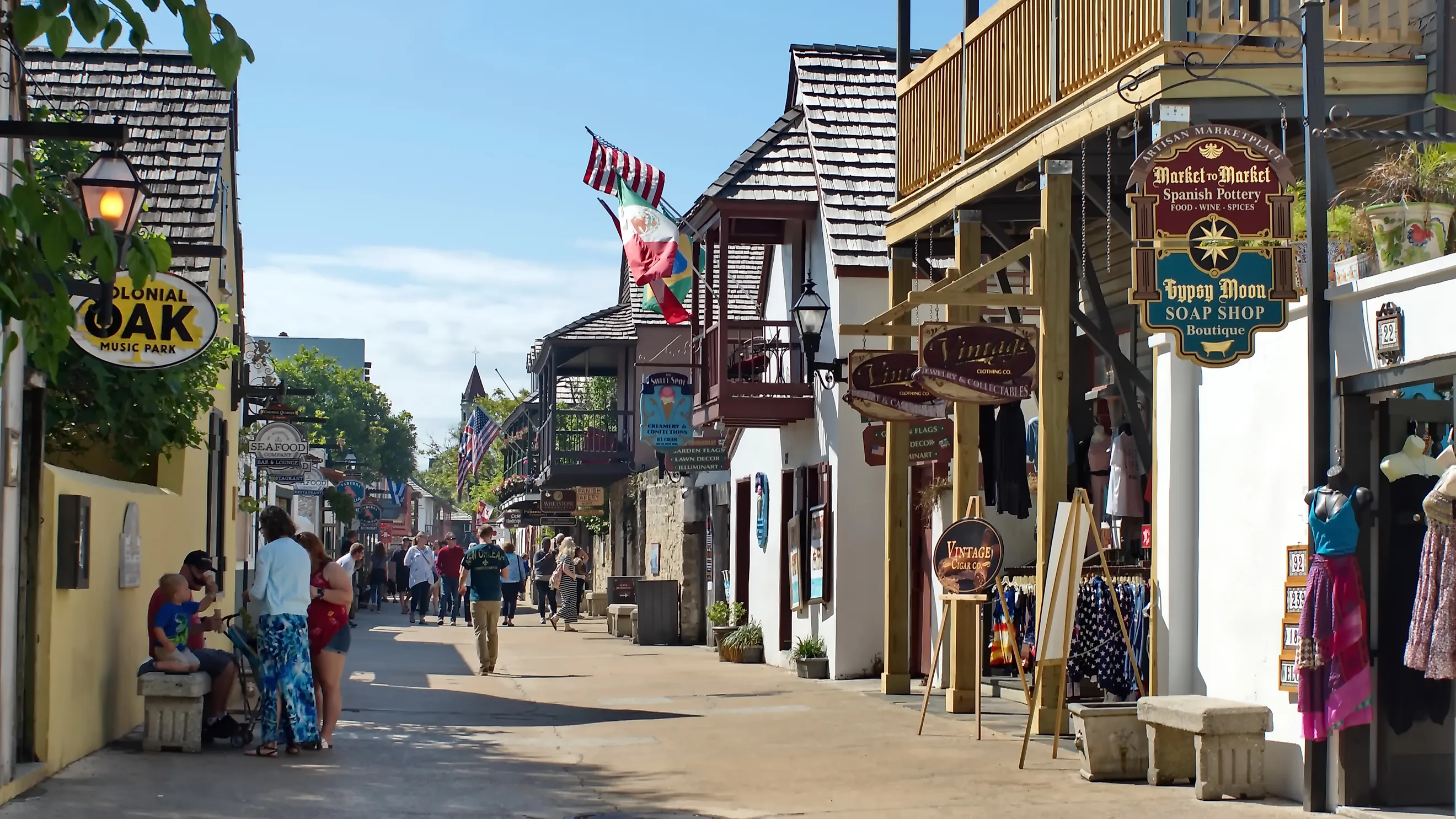
Immensely walkable and pedestrian-friendly, St. George Street shows evidence of four centuries of history, and all just a short stroll from the Castillo. Highlights include the Oldest Wooden Schoolhouse near the Old City Gates. Built from red cedar and cypress in the late 1700s, it's still held together with wooden pegs and handmade nails.
The Colonial Quarter recreates life from the 16th to 18th centuries, complete with a working blacksmith shop, musket drills, and a 35-foot replica watchtower with views over the Castillo. It's also where you'll find De Mesa-Sanchez House, a coquina residence built in the 1740s, and the Taberna del Caballo, a tavern serving tapas in 18th-century style.
One block over, the Cathedral Basilica of St. Augustine serves the nation's oldest Catholic parish. Established in 1565, they still worship in the building that was completed in 1797. South of the Plaza de la Constitucion, a public square laid out in 1573, Aviles Street appears on maps drawn in the 1570s and is widely described as the oldest street in America. Check out Pena-Peck House, a home built in the 1740s for Spain's Royal Treasurer that's open for guided tours.
St. Augustine's Gilded Age Hotels

In 1885, oil magnate Henry Flagler visited St. Augustine and was so impressed he decided to turn it into the American Riviera. The result was the Hotel Ponce de Leon, a Spanish Renaissance palace of poured concrete that opened in January 1888. It was also one of the first hotels to feature electricity supplied by Thomas Edison's company. Now the home of Flagler College, a private liberal arts school, guided tours are available and include the domed rotunda and a dining hall with 79 rare stained-glass Tiffany windows.
Across King Street, Flagler opened the Alcazar Hotel around the same time. After it closed in 1932, Chicago magazine publisher Otto Lightner bought the building and opened the Lightner Museum to display his vast collections of Gilded Age furnishings, cut glass, and mechanical musical instruments. A truly unique experience these days is booking a lunch at Cafe Alcazar, set in the deep end of what was once the world's largest indoor swimming pool.
Other Florida Towns Frozen in Time

Located at the northern end of the A1A Scenic & Historic Coastal Byway on Amelia Island and an easy drive from St. Augustine, Fernandina Beach flew eight different flags between 1562 and 1861, more than any other American city. The Florida House Inn, opened in 1857 and the state's oldest continuously operating hotel, once hosted President Ulysses S. Grant, while Fort Clinch State Park protects a brick fortress begun in 1847.
Twelve miles south of Gainesville, Micanopy was founded in 1821 and is Florida's oldest inland town. Antique shops line its oak-shaded main street, Cholokka Boulevard, and the elegant Herlong Mansion Bed and Breakfast, rebuilt in 1910, offers classy accommodations just steps away.

Over on the Florida Panhandle, Spanish colonists arrived in the Pensacola area in 1559, but a hurricane destroyed the fleet, and the original settlement was abandoned. Permanent settlement returned in 1698, and Historic Pensacola Village preserves a downtown collection of heritage buildings that includes Old Christ Church, built in 1832.
America's Earliest Communities
While plenty of American towns boast historic districts, none can claim the diversity of cultures and architecture that St. Augustine preserves. Visitors can stand inside a Spanish fortress completed in 1695, attend Mass in the nation's first parish, and tour Gilded Age hotels that now house a college campus and museum, respectively. Whether it's viewing its 460-plus year-old buildings and fortress walls, hopping aboard a trolley tour, or even joining a ghost walk, St. Augustine transports visitors back to Florida's early years.