America's Oldest City is in Florida, and It Looks Nothing Like the Rest of the Country
In 1565, more than half a century before the Pilgrims arrived in New England, Spanish conquistadors led by Pedro Menéndez de Avilés claimed a patch of Atlantic coastline for King Philip II of Spain. There they shared a communal meal with the native Timucua people — sometimes called a precursor to the first Thanksgiving in America.
According to the Jacksonville History Center, “from what we know of the food provisions stocked on Menéndez’s ships, the meal … was probably cocido,” a stew of salted pork and garbanzo beans, accompanied by hard sea biscuits and red wine, with the Timucua likely contributing local game, fish, and native staples such as corn, beans, and squash.
Named St. Augustine after the saint whose feast day they were celebrating, the land here has been continuously occupied ever since, making it the oldest European-established city in the contiguous United States.

Located on Florida's northeast Atlantic coast, less than an hour's drive south of Jacksonville, St. Augustine is today one of the Sunshine State’s top tourist destinations. It’s also the only place in the United States with a Spanish street grid and architectural character that has changed little since its colonial origins. Yes, the streets are narrow, cobbled, and usually busy.
This, plus the fact the dominant building material is coquina, a sedimentary rock made from ancient seashells quarried on nearby Anastasia Island, creates an old-world atmosphere that feels more Mediterranean than anything you’d typically associate with America.
A City Built by Spain

St. Augustine’s Spanish origins are everywhere evident. The most prominent reminder of the era is Castillo de San Marcos, the oldest masonry fort in the United States. Situated on the western shore of Matanzas Bay, the Castillo was ordered built after English pirates sacked and burned the city to the ground in 1668.
Construction of this still formidable fort started in 1672 and was completed in time for the Brits to try again in 1702. This time, cannonballs simply sank into the soft coquina rather than shattering the stone and causing serious damage to the fort and its defenders. Subsequent British raids and attacks in 1728 and 1740 produced the same outcome, and the fort never fell to an enemy assault.
Now a National Monument, cannons are still fired here, but now for demonstrations and celebrations on weekends (check the Castillo website for details). The views from the ramparts over the bay and the Bridge of Lions are also spectacular, while those of the fort from the water make a cruise around the bay a must-do.
Spanish Colonial History

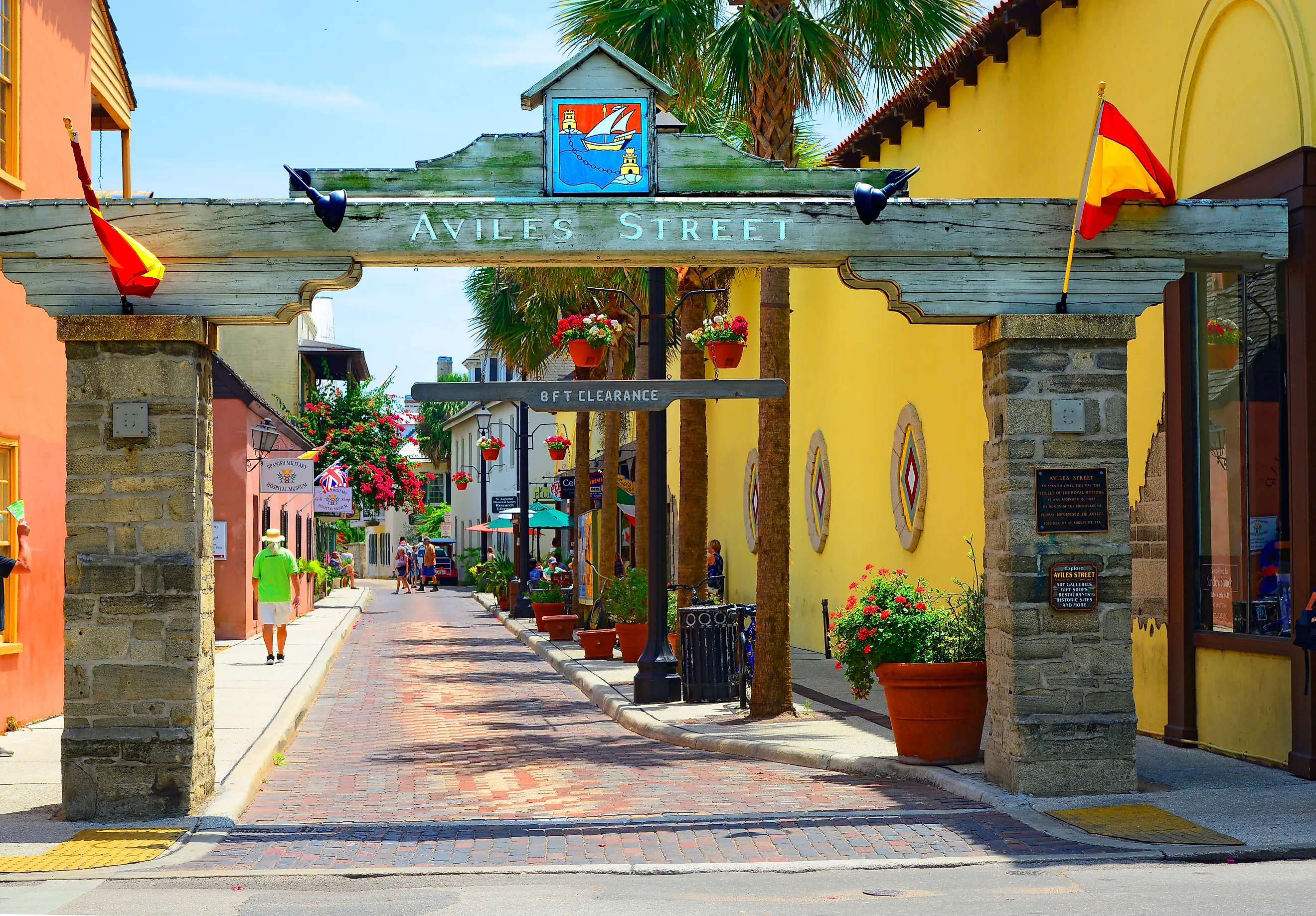
Take a short walk from the Castillo along Aviles Street, the oldest surviving street in the United States, and you’ll find the original Spanish Military Hospital Museum. Built in 1724 to serve soldiers garrisoned at the Castillo, as well as civilians, it’s furnished to look just as it would have in the 18th-century. Guided tours of this remarkable reconstruction with its period surgical tools and an authentic apothecary are a must.
Another important Spanish-era site is the Mission of Nombre de Dios, which marks the location of the first Catholic Mass in what would become the United States in 1565. And it’s hard to miss. The Shrine of Our Lady of La Leche, a 208-foot-tall stainless-steel cross, dominates the skyline and is so tall it’s even visible from well out at sea.
St. Augustine’s Colonial Quarter is another must-visit. Spread over two acres, this living history complex in the heart of the historic downtown features costumed interpreters demonstrating blacksmithing, musket drills, and other period activities.
Explore St. Augustine’s Fascinating Past

St. Augustine is undoubtedly the most walkable city in Florida, and enjoying a stroll here is the best way to really get a grasp of its unique character. Starting at the Old City Gates at the north end of St. George Street, in addition to its many small shops and restaurants, you’ll find attractions like the Oldest Wooden Schoolhouse, a modest wood structure from the 1700s that now features a great little museum.
Keep walking and you’ll eventually find yourself on Aviles Street and the already mentioned Spanish Hospital. A much quieter street, carry-on past the hospital, shops, and galleries like the Plum Gallery to the Ximenez-Fatio House Museum. A restored coquina boarding house from the 1790s, tours offer a fascinating peek into the domestic side of colonial life in St. Augustine.
Although immensely fun to walk, St. Augustine also boasts one of the best tourist transit systems in Florida. Operated by Old Town Trolley Tours, a fleet of open-air green and orange trolleys zip along a seven-mile route with 22 stops covering more than 100 of the city’s most popular points of interest. Its hop-on, hop-off format means you can get off at whatever destination tickles your fancy, explore, then climb back on to the next locale.
St. Augustine’s Gilded Age

America’s Gilded Age, the boomtime that created a class of mega-wealthy individuals in the late 1800s, also left its mark on St. Augustine. Spearheaded by tycoon Henry Flagler, a pair of enormous Spanish-influenced hotels were built that started America’s love affair with vacationing in Florida.
The first and grandest of these was the Hotel Ponce de Leon, completed in 1888 and now the main campus building of Flagler College. Designed in Spanish Renaissance Revival style, it was one of the world’s first poured-concrete buildings and featured amenities considered revolutionary for the time. These included indoor plumbing and electric lighting provided by a generator that Thomas Edison himself helped install.
Tours of the building’s interior are available through Flagler's Legacy Tours. Led by Flagler College students, highlights include the Rotunda with its 68-foot domed ceiling, and the huge Dining Hall, home to the world’s largest collection ofTiffany-stained glass windows. The courtyard and gardens are also delightful and are open to the public.

Directly across King Street from the college, Flagler's second grand hotel, the Hotel Alcazar, is now home of the magnificent Lightner Museum. Also completed in 1888 with Spanish colonial influences throughout its design, it re-opened in 1948 as the city’s flagship museum. Today, its original spa, Turkish baths, and magnificent three-story ballroom now house its vast collections.
Highlights include Tiffany lamps and cut and blown glass, mechanical musical instruments that still function, period costumes, as well as natural history specimens. The ground-floor indoor pool area, the first of its kind in the country, is now home to Cafe Alcazar and offers a unique dining experience.
Why You Need to Visit America's Oldest City
St. Augustine isn’t your typical Florida holiday destination. Forget the amusement parks, the sprawling resort complexes, and souvenir stores. Instead, America’s oldest city offers something that’s so much more satisfying: a genuine sense of place built on 460 years of history. Best of all, this remarkable and entirely unique cityscape is easy to access and explore, either on-foot or tourist trolley ... or a mix of both.