These 10 Towns on the Pacific Coast Have Beautiful Architecture
Frank Lloyd Wright designed exactly one house to look out over the ocean. It clings to the granite at Carmel-by-the-Sea. Farther north, Mendocino looks less like California than like a fishing village lifted off the coast of Maine. Port Townsend built a whole Victorian seaport in the 1880s, then went broke before it could tear any of it down. On a coast better known for redwoods and surf, the buildings change centuries between one town and the next.
Carmel-by-the-Sea, California

Builder Hugh Comstock put up his first cottages in Carmel-by-the-Sea in the 1920s, all rolled eaves and tiny arched doors. The town liked the look enough to write building codes that lock it in. A century later, the cottages still stand.
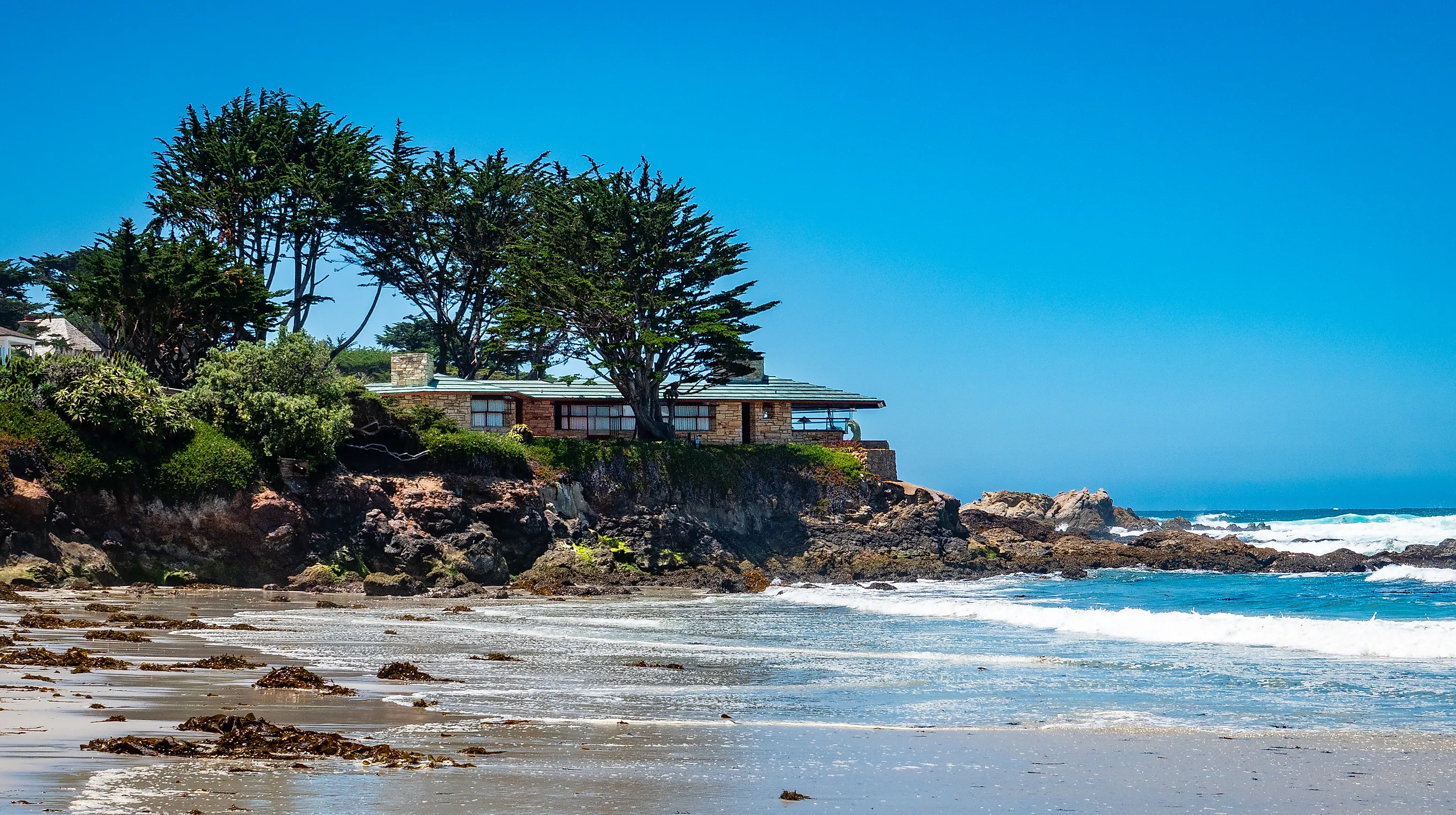
The Carmel Mission Basilica brings older craftsmanship to town, its stone church finished in 1797 with Spanish colonial archways and a bell tower. Out on Scenic Road, Frank Lloyd Wright's 1952 Walker House is the modern outlier, a low cabin of Carmel stone built right onto the oceanfront granite.
Astoria, Oregon

The Flavel House crowns Astoria's Victorians, an 1885 Queen Anne built for a Columbia River bar pilot who got rich guiding ships across the river's deadly mouth. Hand-carved woodwork and imported-tile fireplaces show what shipping money bought. The rest of the town followed, lining the hills above the water with bracketed eaves and porches angled for the view.
The Astoria Column rises 125 feet above the rooftops, a 1926 tower wrapped from base to crown in a spiral mural of the region's history. A 164-step staircase climbs the inside to the observation deck at the top.
Port Townsend, Washington

Aerial view of Port Townsend, Washington.
Port Townsend expected to become the great seaport of Puget Sound. It built like it before the railroad bypassed the town and the money dried up. The 1889 Ann Starrett Mansion is the showpiece, a Queen Anne with a free-hung spiral staircase that climbs to a frescoed dome. The 1892 Jefferson County Courthouse answers with a 143-foot Romanesque clock tower.
The 1868 Rothschild House survives downtown as a museum furnished the way a merchant family left it. Out at Fort Worden, the officers' quarters and gun batteries from the turn of the century overlook the water.
Mendocino, California

Mendocino main street shops and cliff above the sandy beach
The wooden water towers give Mendocino away first, tank houses on stilts standing among the steep-roofed cottages. Lumber crews from the Northeast settled the headland in the 1850s and built in the saltbox and Gothic Revival styles they knew, which is why this California town looks more like coastal Maine.
When the mills closed, the town's remote perch left its 19th-century buildings untouched. The 1854 Ford House and the false-front stores along Main Street still line the headland, with Mendocino Headlands State Park wrapping the bluffs right behind them.
Port Gamble, Washington

Port Gamble looks like a New England village because Maine lumbermen built it to. The Pope and Talbot company laid out the town above its Gamble Bay sawmill in 1853 and modeled it on East Machias, the Maine town its workers had left, right down to the steepled white church and the gabled clapboard houses behind picket fences.
The whole village is a National Historic Landmark now, one of the best-preserved company towns in the country and small enough to walk in twenty minutes. The grandest building is the 1888 Walker-Ames House, a Queen Anne with a square tower that local lore swears is haunted.
Ferndale, California

Dairy farmers got rich enough in Ferndale that locals nicknamed their homes the Butterfat Palaces. Two blocks of Main Street still show the spending, a row of Victorian storefronts with turrets and fish-scale shingles painted in full color, hand-trimmed when the Eel River valley's butter trade peaked in the 1890s.
The Gingerbread Mansion layers Queen Anne and Eastlake detail under a steep gabled roof. The hillside Ferndale Cemetery carries the same styling into its headstones.
La Conner, Washington

First Street in La Conner is a National Register historic district, a row of false-front and brick buildings from the 1880s standing at the edge of the Swinomish Channel. The storefronts that once traded fish and farm goods now house galleries and shops, their pastel paint reflecting in the water.
The 1891 Gaches Mansion presides over the rest, a Victorian with a corner tower that is now home to the Pacific Northwest Quilt and Fiber Arts Museum. The orange arch of the Rainbow Bridge frames the waterfront row from the south. In spring, the Skagit Valley tulips set those painted storefronts against rows of color.
Pacific Grove, California

Pacific Grove began as a Methodist summer camp in the 1870s. The campers' little board-and-batten cabins were rebuilt over the years into the Victorian and Craftsman cottages that crowd its side streets. Many wear plaques with their build dates, ornate porches and patterned shingles facing the street.
Out at the tip of the peninsula, Point Pinos Lighthouse has shone since 1855, the oldest continuously operating lighthouse on the West Coast. Its light rises from the middle of a Cape Cod-style keeper's house, more cottage than tower.
Coupeville, Washington

Sea captains and farmers built Coupeville on Whidbey Island in the 1850s. Enough of their work survived that the whole town falls inside the Central Whidbey Island Historic District. More than a hundred of its buildings are on the National Register, among them Captain Thomas Coupe's 1853 house, one of the oldest homes standing in Washington.
Front Street lines Penn Cove with false-front storefronts, the red Coupeville Wharf reaching out over the water at its center. The 1881 depot, built in Stick and Eastlake style, was the state's first passenger station. The Olympic Mountains rise across the cove, unchanged behind a waterfront that has barely changed either.
Eureka, California

The Carson Mansion is a dark-green Queen Anne of redwood and white mahogany, built in the 1880s for lumber baron William Carson and often called the most photographed Victorian in the country. The Newsom Brothers piled it high with turrets and curlicues, then drew the pink Queen Anne across the street as a wedding gift for Carson's son.
Old Town Eureka shows blocks more of the same lumber money in Gothic Revival and Italianate storefronts, with the Clarke Historical Museum in a former bank building. Behind it all, the ancient redwoods of Redwood National and State Parks stand taller than any tower in town.
The Coast That Saved Its Buildings
The buildings outlasted the booms that paid for them. Lumber and shipping money built big in these towns and then dried up before anyone modernized the result. The old blocks were never replaced. A redwood baron's Queen Anne, a missionary's stone church, and a company town copied from Maine all still stand. A few towns wrote codes to protect them on purpose, but most just got lucky. Either way, a Californian gets the whole century of it.