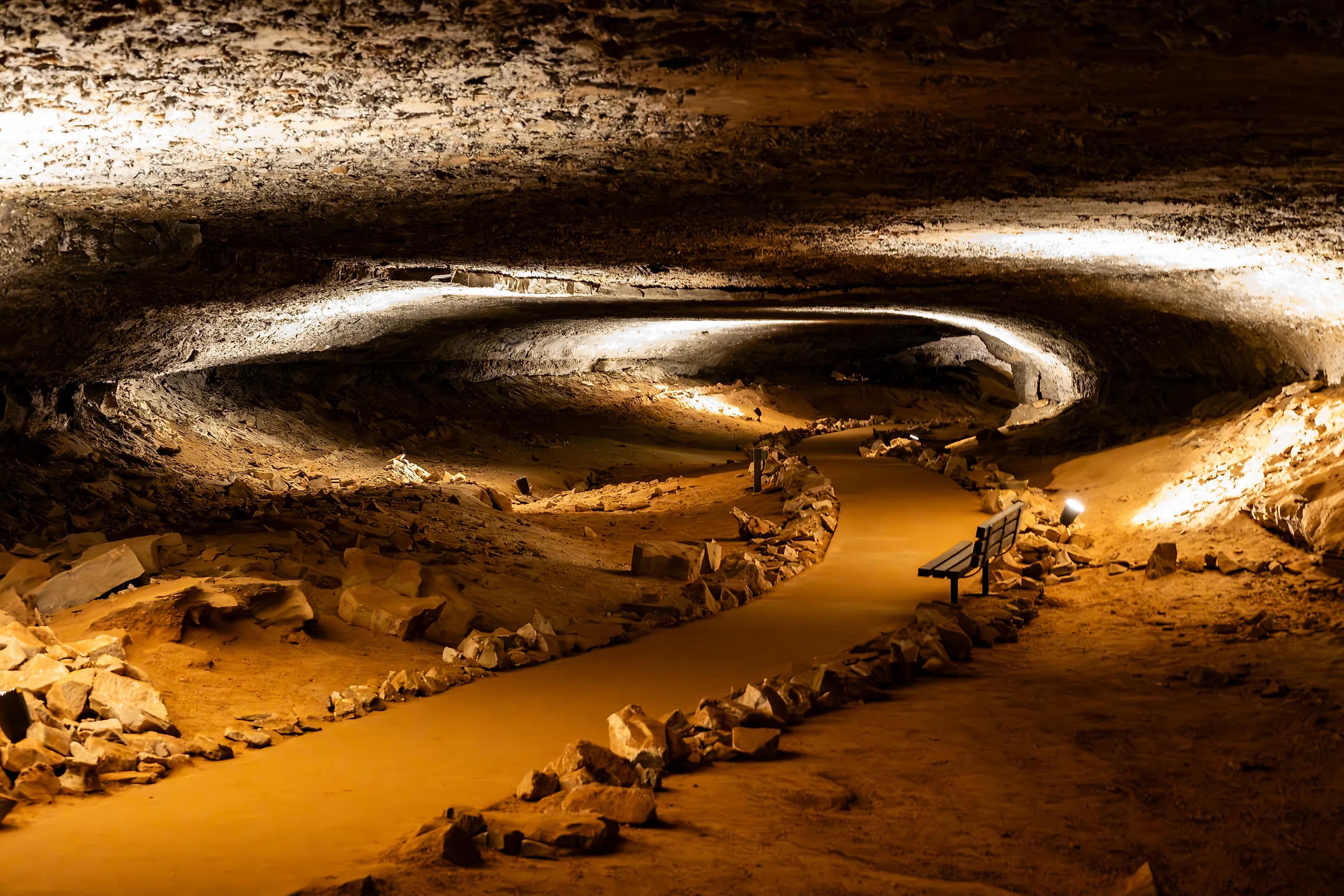
The National Park With The Longest Cave System
John Wilcox had been wild caving for 12 hours when his lamp finally picked out what he'd been hoping for, a smooth, graded trail laid for tourists. He and five others had entered Kentucky's Flint Ridge system that morning, hunting the connection to Mammoth Cave that cavers had been chasing for years. Pushing through the last passage alone so the others wouldn't waste their strength if it pinched shut, he came out into Mammoth Cave. On that day, September 9, 1972, the two became the longest cave system in the world, a title it has held ever since.
Measuring the Growing Mammoth Cave

According to the National Park Service, Mammoth Cave has 426 measured miles of passage. That's not the size of the cave, but the amount that has been mapped so far. And volunteers from the Cave Research Foundation did nearly all of that mapping. Founded in 1957, this non-profit maps and studies the cave under an agreement with the park, running at least 10 expeditions a year.
Survey teams move carefully from station to station with tape, compass, and clinometer to measure the angle of a slope. Distances and bearings are recorded at each point, and the passage's shape is sketched by hand. This information is then tied to surface benchmarks and topographic maps to ensure the underground world lines up with what's above it.
Getting to the unmapped ends of the cave can mean rappelling into pits, wading, or squeezing through openings barely wider than a body, and a hard weekend underground might add a few hundred feet. The park's cave resource specialist has said that without that volunteer labor, Mammoth Cave might still be a 44-mile cave.
The Undisputed King of Caves

The Park Service had recognized Mammoth Cave as the world's longest back in 1969, when 65 miles had been surveyed. By 1972, though, Flint Ridge had overtaken it, with 86.5 mapped miles to Mammoth's 57.9. Wilcox's connection merged the two into a single system of 144.4 miles, with later links to Proctor Cave, Roppel Cave, and Morrison Cave pushing it past 400.
Another eight miles were announced in 2021, and six more in 2022 during the 50th anniversary celebrations of that all-important connection, taking the count to its present 426. Nothing else comes close. Mexico's Sac Actun, a flooded system on the Yucatan Peninsula and one of the longest anywhere, measured 215 miles when its own connection was announced in 2018.
And it likely won't end there. Park publications have suggested there may in fact be a further 600 miles down there still unmapped. All of which means few cavers believe that 426 will remain the cave's length for long.
Life in Mammoth Cave

Long before tourism cottoned onto the money-making potential of the cave, bats made it valuable. Thousands of years of guano meant the cave was rich in the raw material for gunpowder, and commercial saltpeter mining began in 1811. It was even more profitable as a result of the British naval blockade during the War of 1812, but the market collapsed when hostilities ended in 1815. By 1816, the owners were selling tours instead, making Mammoth Cave one of the oldest tourist attractions in North America.
In addition to the bats, more than 130 animal species live inside the cave system. So important an ecosystem is it, in fact, that UNESCO declared the park a World Heritage Site in 1981, describing its cave-dwelling wildlife as the richest on the planet. Twelve of those species are troglobites, creatures that can't complete their life cycle outside a cave and have lost both eyes and pigment along the way. Several are found nowhere else on Earth.
Cave crickets, eyeless beetles, blind crayfish, and the orange, spotted-tail cave salamander make up most of the rest of the community. The rarest is the federally endangered Kentucky cave shrimp, transparent, just 1.25 inches long, yet capable of living 10 to 15 years. It uses two pairs of antennules to taste, touch, and smell its food in place of sight.
Two eyeless fish types have also been discovered. The northern cavefish reaches four to five inches, and the southern cavefish three and a half, and both locate prey by sensing vibration. Nineteenth-century guides used to catch them and sell them to visitors as novelties.
Choosing a Cave Tour

Not surprisingly, there's no unguided wandering permitted in Mammoth. Every trip below ground, except for the short self-guided Discovery Tour, goes out with a park ranger. Tickets are required, and tours sell out weeks ahead, which makes a reservation through Recreation.gov more important at Mammoth Cave than at most other parks. All tours leave from the visitor center.
The Historic Tour is the standard first visit. This two-hour, two-mile excursion includes 540 stairs through the passages tied to the cave's early saltpeter and tourism history, including Fat Man's Misery and the Bottomless Pit. Domes and Dripstones covers three-quarters of a mile but packs in 638 stairs on a descent through vertical shafts to the dripstone formations at Frozen Niagara. The Frozen Niagara Tour reaches those same formations in a quarter mile and 64 stairs, with an optional 98-step detour. A fully accessible tour runs two hours over half a mile.
The Great Onyx Lantern Tour covers a mile of a separate cave by lantern light with no electric lighting at all, and the River Styx Tour, at 2.5 miles and 600 stairs, is the long option. Families with young children tend to book the Trog Tour, which sends kids into crawlways while parents wait.
Three shorter routes are also available. The Extended Historic Tour adds 15 minutes and the tuberculosis huts to the standard route. The Gothic Avenue Tour covers a mile and 160 stairs through a passage papered with smoke signatures left by 19th-century visitors. The Mammoth Passage Tour runs 75 minutes over three-quarters of a mile with 135 stairs. Schedules shift with the season and staffing, so check the current lineup rather than assuming a route will be running.
Visiting the World's Longest Cave
The cave stays at 54 degrees Fahrenheit year-round, so bring a light jacket whether you visit in August or in January. And because white-nose syndrome, a fungal disease that has killed millions of North American bats, is confirmed in Mammoth Cave, you have to walk across biosecurity mats at the end of your tour. It's a small price to pay for having the opportunity to explore the longest cave system of any national park, or indeed on Earth.