10 Best Places To Live In Germany In 2026
Germany's diverse regions accommodate a wide variety of lifestyles, giving residents opportunities to pursue career advancement, enjoy natural surroundings, and achieve a balanced quality of life. These benefits are complemented by access to quality healthcare and educational institutions.
Lindau's waterfront lifestyle is in a unique setting, with its historic center on an island in Lake Constance. In contrast, Landsberg am Lech stands out for its varied employment opportunities and strong local economy. Celle, in Lower Saxony, is home to a specialized technical college and an adult education center. Garmisch-Partenkirchen, located in Bavaria, has graduate-level programs through the George C. Marshall European Center for Security Studies.
These 10 towns are some of the best places to live.
Lindau

Set on Lake Constance (Bodensee) in southwestern Bavaria, Lindau presents parks, cultural landmarks, and outdoor recreation combined with a varied job market and access to healthcare. The estimated cost of living in Lindau per month, with rent, is approximately $1,709 USD (1,497 EUR).
The area is home to aerospace, engineering, and manufacturing industries, with companies such as Siemens, Cooper Standard, and ENGIE Refrigeration operating in the region. Asklepios Clinic Lindau is known for orthopedics, cardiology, and general surgery.
Often associated with the Bavarian Riviera for its lakeside setting, Lindau is close to the Austrian and Swiss borders, and regional rail links connect it with Bregenz, Friedrichshafen, and Munich. The town also features a lively social scene with festivals and farmers’ markets.
Quedlinburg

Quedlinburg, in Saxony-Anhalt, is known for affordability, access to healthcare, and proximity to cultural landmarks. The estimated cost of living per month, with rent, is approximately $1,427 USD (1,250 EUR), lower than larger cities. Quedlinburg’s designation as a UNESCO World Heritage Site offers history and culture, including Quedlinburg Castle, the Romanesque Stiftskirche St. Servatius Church, and the Schlossmuseum.
The job market includes construction, manufacturing, and agriculture realted industries with the town also recognized for its long history of seed breeding and plant research. A local hospital, Harzklinikum Dorothea Christiane Erxleben, provides healthcare services equipped with departments in pediatrics, internal medicine, and dermatology.
Cochem

Cochem's Moselle River location in Rhineland-Palatinate combines career opportunities with healthcare and outdoor recreation. The estimated cost of living per month in Rhineland-Palatinate, with rent, is around $1,685 USD (1,476 EUR).
The job market comprises hospitality, transportation, and the wine industry, including a leading Moselle Valley wine manufacturer, Andreas Oster Wines. An acute care hospital, MarienKrankenhaus Cochem, has departments in internal medicine, urology, and geriatrics.
Residents of Cochem can spend leisure time kayaking and canoeing on the Moselle River or explore a variety of historic landmarks. The 12th century Reichsburg Cochem Castle, the cobblestone streets of Old Town, and the Mosel Promenade along the river are local landmarks with ties to the town's past.
Bad Dürkheim

Located in the German state of Rhineland-Palatinate, on the eastern boundary of the Palatinate Forest, Bad Dürkheim offers career training, healthcare access, and a vibrant cultural scene. The estimated monthly cost of living in Rhineland-Palatinate, with rent, is approximately $1,685 USD (1,476 EUR).
The main industry is wine making with other small to medium-sized businesses including automotive supply, paper and wood products, and textile manufacturing. The Evangelisches Krankenhaus is a general hospital with departments in trauma surgery, geriatrics, and internal medicine.
Set along the German Wine Road, in Riesling wine country, the town hosts the Dürkheimer Wurstmarkt. While the name translates to “sausage market,” it is a wine festival, said to be the world’s largest. Residents can spend time at the historic Roman quarry and the Heidenmauer, the remains of an ancient Celtic settlement from 500 BC.
Landsberg am Lech

In Bavaria, Landsberg am Lech extends a welcoming atmosphere for families seeking a diverse job market and vocational training opportunities. The estimated cost of living per month, with rent, is about $1,789 USD (1,567 EUR), in line with other Bavarian towns.
On the educational front, the Berufliche Schulen Landsberg am Lech is a continuing education campus that holds vocational and specialized trade programs in subjects such as social sciences, engineering, and childhood education. Career paths lead to manufacturing and industrial machinery. Leading companies operating in town include Aalberts Surface Technologies, specializing in industrial coatings, and Pottinger Deutschland GmbH, which makes agricultural machinery.
With the town's location along Germany’s 285-mile-long Romantic Road, which winds from Wurzburg to Fussen, residents will find historic landmarks and locally owned restaurants in the Old Town district. The area features the medieval town wall, the Marienbrunnen fountain in the main square, and the Bayertor Gate, an approximately 118-foot tall former city gate built in 1425.
Garmisch-Partenkirchen

Set at the base of the Zugspitze, Germany’s highest mountain, Garmisch-Partenkirchen is a community based on outdoor recreation, with the availability of healthcare and public transportation. The estimated cost of living per month, with rent, is around $2,075 USD (1,818 EUR), coming in higher than many regions of Germany. Bavaria is one of the most expensive states in Germany, but in return, it has a strong job market, natural beauty, and opportunities for recreation in the Alps.
Career markets lean toward industries in manufacturing, healthcare, and hospitality. UP International produces paraglider gear, and Langmatz GmbH specializes in fiber-optics and telecommunications. The Klinikum Garmisch-Partenkirchen is a general hospital with departments in geriatrics, pediatrics, and sports medicine. The George C. Marshall European Center for Security Studies has graduate-level programs in international security. Local and regional bus lines, as well as connections via Deutsche Bahn, are available.
While famous for its historic architecture, Ludwigstraße also serves as a fully functioning local hub, offering daily essentials like grocery stores, bakeries, and pharmacies. Lake Eibsee has public walking routes and seasonal swimming access about six miles southwest of central Garmisch-Partenkirchen.
Schwäbisch Hall

Schwäbisch Hall, in Baden-Württemberg on the Kocher River, combines dependable healthcare with a range of educational programs for families. Financial and manufacturing firms fill out the job market. Bausparkasse Schwäbisch Hall is a loan association for financial and housing sectors, and Optima Packaging Group designs and builds packaging equipment. The estimated cost of living per month, with rent, is around $1,736 USD (1,521 EUR), in line with towns in Rhineland-Palatinate and Saxony-Anhalt.
Vocational and technical schools are found throughout the area. The Heilbronn University of Applied Sciences has degree programs in engineering and business, while the Goethe-Institut at Schwäbisch Hall is a German-language learning center. For medical assistance, Diak Klinikum offers cardiovascular, internal medicine, and oral surgery departments.
The 35.6-mile Kochersteig Trail passes through forests and gorges, and the Kocher River has routes for kayaking. Cultural attractions include the Neue Globe Theater, an open-air amphitheater modeled after Shakespeare’s Globe Theater hosting plays and festivals.
Rottach-Egern

Bavaria’s Rottach-Egern lies on Lake Tegernsee at the base of the Alps, with direct access to outdoor recreation and nearby healthcare. The estimated cost of living in Bavaria per month, with rent, is around $1,936 USD (1,697 EUR). It is higher than some other towns, but the accessibility of outdoor recreation may be a priority for some.
The job market comprises hospitality, tourism, and technology. Wonderland Real Estate & Investment is a specialized investment firm, while AOBIS and Dynamic Concepts Information manages computer repair and office solutions. The Hospital Agatharied GmbH is a primary acute care hospital about 20 minutes away, with emergency care and multiple specialized departments. MoleQlar GmbH focuses on preventative care and longevity.
Along with the proximity of Lake Tegernsee for boating and swimming, Rottach-Egern is home to the Kutschenmuseum, an antique carriage museum. Nature walks to the Rottach Waterfall and skiing in the Wallberg Mountains are popular recreational activities.
Celle

Celle, in Lower Saxony on the River Aller, shares affordability with a varied job market, higher education, and healthcare opportunities. Manufacturing, oil and gas supply, horse breeding, and agriculture are among the top industries, with companies that include Koller Solutions and HÜDIG, a leading producer of large-area irrigation machines. The estimated cost of living per month, with rent, in Celle is approximately $1,547 USD (1,356 EUR).
The Fachhochschule der Wirtschaft (FHDW) is a private university focused on bachelor’s and master’s degrees in topics that include business administration. On the healthcare side, the Allgemeines Krankenhaus Celle has departments in neonatology, pediatric dermatology, and gastroenterology.
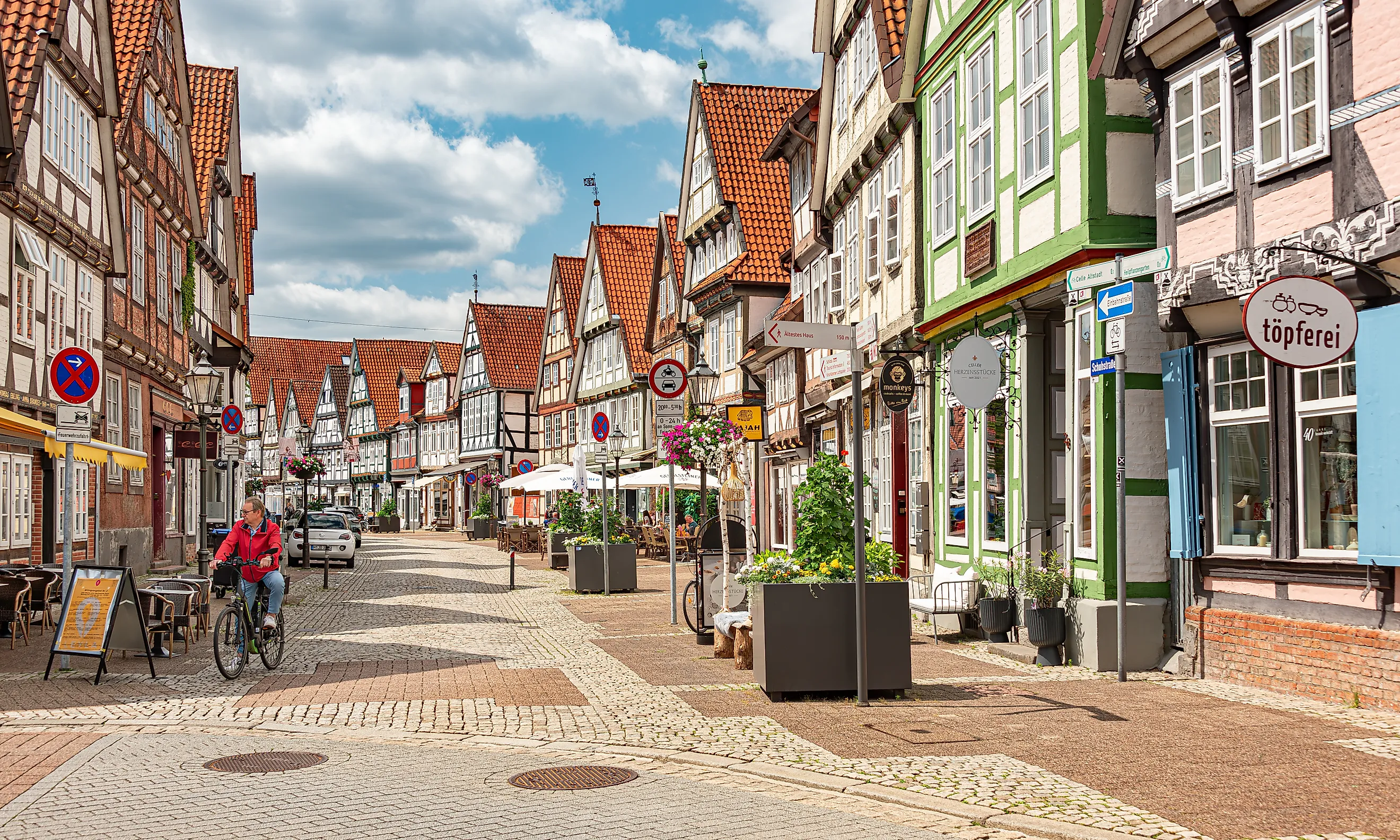
Celle’s Old Town features historic landmarks such as the 1532 Hoppener Haus, a Renaissance half-timbered building located near the Renaissance and Baroque Celle Castle. The Aller River and Südheide Nature Park provide opportunities for fishing and hiking.
Eckernförde

Situated along the Baltic Sea in Schleswig-Holstein, Eckernförde is a quiet community with scenic beauty, healthcare access, and a strong job market. The estimated cost of living per month, with rent, in Eckernförde is around $1,533 USD (1,343 EUR), allowing residents to make the most of their incomes.
Medical and manufacturing industries are among the career paths residents can pursue. THITRONIK specializes in security and alarm systems for boats, motorhomes, and residential houses, while punker GmbH produces sheet metal products and industrial fans. The Schön Klinik Eckernförde is an acute care facility with specialty departments in orthopedics, diabetes, and internal medicine.
Historic landmarks and attractions include the circa-1300s St. Nicolai Church, and the Meerwasser Wellenbad, an indoor wave pool and wellness center. Eckernförde Bay allows entrance to boating and swimming in the waterfront community.
Ten German Towns With Small-Town Appeal
Choosing the right place to live depends on personal priorities, and Germany emphasizes a variety of communities that accommodate different lifestyles and needs with practical services and distinct local strengths. Lindau and Eckernförde pair waterfront living with active job markets and reliable connections. Bad Dürkheim brings together regional rail access, healthcare, and a long-established wine economy. Celle has a broader range of services, education, and employment. Across the list, these towns earn their place through strong local infrastructure, access to nature, and settings that support everyday life.