The Most Expensive Bridges Ever Built In America
Bridges are the most expensive type of city construction because they involve uniquely difficult engineering challenges in crossing natural breaks in geography like rivers, bays, or chasms. Let's see how high the stakes can go by exploring the most expensive bridges ever built in America. The biggest shift that occurred that made bigger bridges possible in the US has been the development of steel, both for structural reinforcement and for cable that would be used by suspension-styled bridges and, eventually, cable-stayed versions. Building technologies of today and the ability for the private and public sectors to mobilize the massive amount of capital necessary for such undertakings, while unprecedented in the last 20 years, are still marginally matched by some of the "pontifical" feats achieved earlier in the 20th century. Let's cross the most expensive bridges in US space and time and see what the construction "tolls" actually were that made them possible. In analyzing the multifaceted nature of bridge costs, later additions, repairs, and extensions, this study will focus on principal bridge span projects and include actual construction costs to the point in time of the bridge's official opening matched to inflation figures based on the Consumer Price Index from June 2026, to get a sense of what these numbers mean in today's dollars.
Governor Mario M. Cuomo Bridge - New York

The "New New York Bridge" would eventually come to be called the Governor Mario M. Cuomo Bridge. By this review's methodology, focused on single, standalone bridge projects, it is the most expensive ever built in the United States. Due to increased traffic and congestion along the Tappan Zee Bridge, replacement plans had been in the works for decades and the new bridge was intended as a replacement. The Mario Cuomo Bridge is a twin span, eight lane bridge that is 3.1 miles long. Standout features include 8 towers 419 ft tall, from which 192 steel cables are suspended, totaling 4,900 miles of steel. It was built over the Hudson River between Tarrytown and Nyack, 20 miles north of New York City, right alongside its forebear. Construction on the bridge began in 2013 and it was completely functioning by 2018, though it still had several features being developed at that time. The additional key elements of a footpath, maintenance, and police buildings adjacent to the bridge were added by 2020. The New York State Thruway Authority invested $3.77 billion in the project since 2013. Prior planning costs amounted to $152.8 million. Capital interest costs were $168.4 million. The total expenditures, discounting litigation and remediation expenses, came to $4.1 billion, adjusted to $5.9 billion based on today's consumer price index (June 2026). The bridge is intended to last for 100 years and carries 50 million vehicles annually.
Verrazzano Narrows Bridge - New York

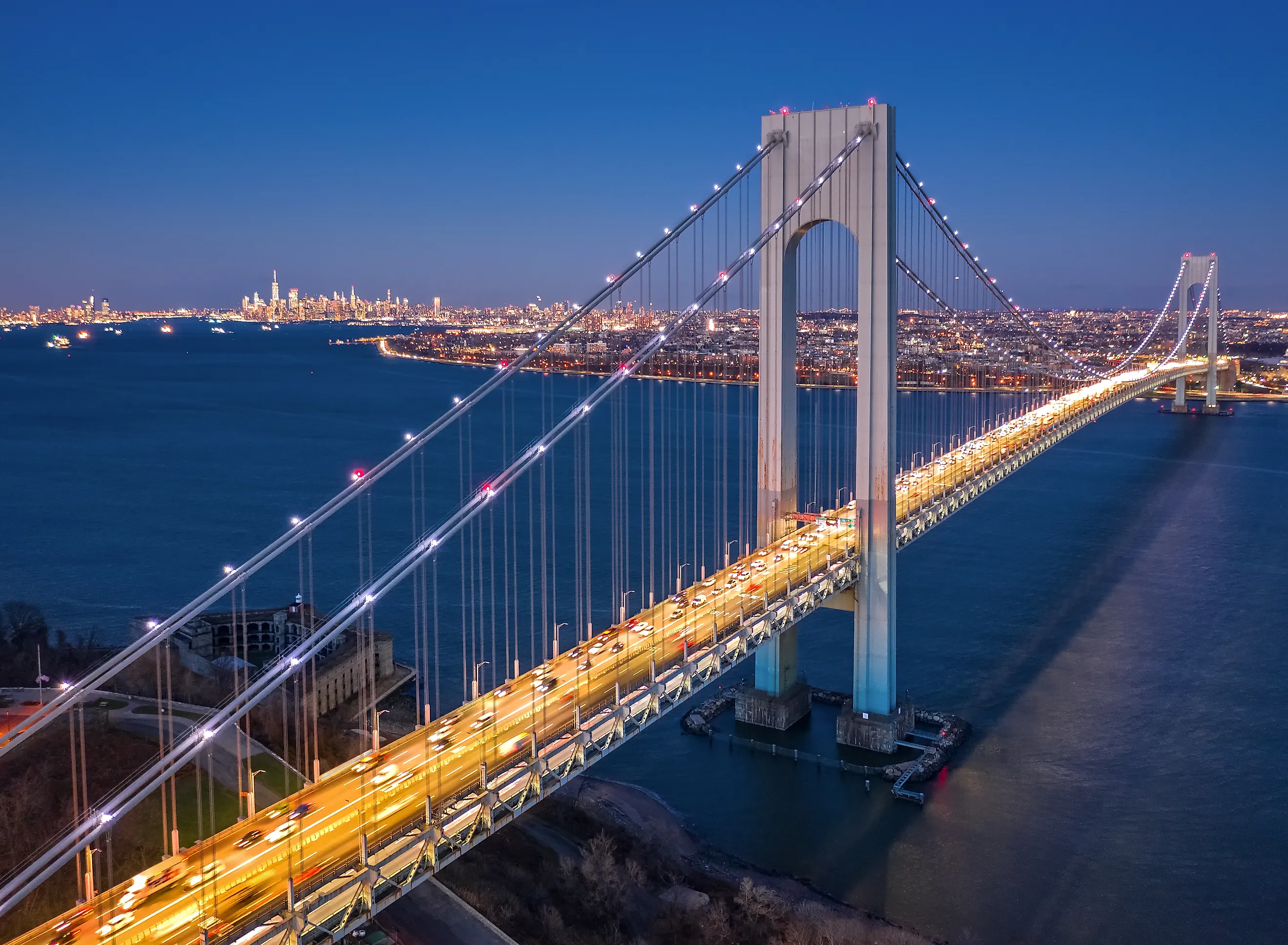
A double decker bridge is a doozy in regards to costs of construction and the Verrazzano Narrows Bridge, connecting Staten Island to Brooklyn, New York, does not disappoint. The initial upper portion of the bridge was constructed between 1959-1964 with an additional lower deck completed by 1969. The total cost was $342 million, adjusted to $3.873 billion in today's dollars. The central span of the bridge between its two towers is 4,260 ft long. Its towers are 693 ft high and are 1 5/8 inches wider at the top than the bottom to account for the earth's curvature! 190,000 vehicles cross the Verrazzano Narrows Bridge per day compared to 48,000 per day in 1965, right after its initial opening, when it was known as the "Verrazano Narrows Bridge," with 1 "z." For the double decker version, another "z" would seem to be a poetic flourish, though, in truth, the slight name change came about to more accurately reflect its namesake, Giovanni da Verrazzano, the first European explorer on record to have sailed into New York Harbor in 1524.
Long Beach International Gateway Bridge - California

The Long Beach International Gateway Bridge cost $1.56 billion (approximately $2 billion in 2026) and was constructed between 2013-2020. Operating within the highest volume seaport complex in the US, it links the Long Beach port to the Los Angeles port. The new 6 lane, 1.7 mile bridge was a replacement of the former 5 lane Gerald Desmond Bridge completed in 1968. Its two towers stand at over 515 ft tall, with a 205 ft vertical clearance to accommodate the largest container ships. Funding for the construction was made possible through a series of loans from federal, state and local governmental agencies including the US Department of Transportation (DOT). The most significantly large allotment was a $500 million loan made possible through the Transportation Infrastructure Finance and Innovation Act (TIFIA) distributed to the Board of Harbor Commissioners of Port of Long Beach.
Goethals Bridge - New York/New Jersey

The new Goethals Bridge is an interstate connector between Staten Island, New York and Elizabeth, New Jersey that spans the Arthur Kill Strait, replacing an older bridge by the same name, dating back to 1928. The replacement involved constructing a completely new bridge undertaken between 2014-18, and sponsored by the Port Authority of New York and New Jersey. Total construction costs for the bridge were $1.5 billion (~$2.09 billion today). Major features of the new bridge include twin spans both 1.4 miles in length, with six total car lanes (3 in both directions) where each lane is 12 ft. wide. There is also a 10 ft. bike/pedestrian path. It has four sets of V-shaped 272 ft tall towers with 144 13 inch diameter steel cables, up to 400 ft. long. The necessity for the new bridge was based on massive traffic and congestion rising in the early 2000s when the original bridge averaged 15.5 million vehicles per year, dangerously packed within only 4, narrow 10 ft. lanes. The new Goethals bridge was created to operate for 100 years, with the towers and foundations built to last 150 years.
Arthur Ravenel Jr. Bridge - South Carolina

Sometimes larger contemporary bridges will replace two or more older bridges when separate structures were constructed for traffic moving in opposite directions, which sometimes happened as transportation evolved so rapidly during the 20th century, with vehicles enlarging, moving faster, and with traffic increasing. This is a definite indicator of a more expensive super bridge on the horizon. That was the case with the Arthur Ravenel Jr. Bridge, designed by Parsons Brinckerhoff, constructed between 2001-2005 to span the Cooper River connecting the downtown of Charleston to Mt. Pleasant, South Carolina. The Ravenel Bridge cost a total of $675.2 million (~$1.23 billion today, according to the Federal Highway Administration within the U.S. Department of Transportation). It replaced the Grace Memorial Bridge, completed in 1929, and the Silas N. Pearman Bridge, completed in 1964. The new Ravenel Bridge stands out against the Charleston skyline for its 2 diamond shaped 575 ft towers. The main span between the towers is 1,546 ft. There is a 2.5 mile footpath covering the entire bridge and then some, winding into the mainland on either side. The Ravenel Bridge has 128 steel suspension cables and is the third longest cable-stayed bridge in the Western Hemisphere.
Kosciuszko Bridge - New York

When the first span of the new Kosciuszko Bridge was completed in 2017 connecting Queens and Brooklyn, the $555 million construction cost of the project's first phase stood out as the largest single construction contract in New York state history. After the second span opened signalling the completion of the entire bridge on August 29, 2019, the total cost had expanded to $873 million (~$1.2 billion today). Amazingly, $800 million (more than 90%) of the construction cost was financed through the federal government. The Kosciuszko Bridge replacement was the first cable-stayed bridge built in New York state. The difference between a normal suspension bridge compared to a cable-stayed bridge is that on a suspension bridge cables are hung or "suspended" from two master cables stretching between the main bridge towers whereas in the cable-stayed version the cables all intersect the actual towers.
Tappan Zee Bridge - New York

The Tappan Zee Bridge is the only bridge that is no longer standing today of the all time most expensive American bridges reviewed here. It stood right next to where the Mario Cuomo Bridge now stands as its contemporary replacement. This bridge was constructed between 1952-1955 and cost $81 million (~$1.01 billion today) to complete. The engineering challenges were extraordinary because of the especially wide width of the Hudson River at this juncture, almost exactly 3 miles, requiring a 1,212 ft. navigation channel. Another issue was the 250 ft drilling depth to reach firm bedrock for foundational strength. Former World War II Allied Forces engineer Emil H. Praegar developed the original solution of floating caissons, which were concrete reinforcement boxes on buoys that took considerable weight off of the lower and longer portions of the primary foundation beams so that there did not have to be as many, which would have otherwise made costs too astronomical to realize. This feat made the bridge renowned as an engineering achievement. In the 1950s, the opening of Tappan Zee had an immediate impact on the Rockland County (Nyack) side of the bridge, where the population increased 50% within five years.
Mackinac Bridge - Michigan

Beginning in 1923, a ferry service began running people between the Upper and Lower peninsulas in Michigan at their nearest point over the Straits of Mackinac, a 4 mile stretch. For the next 20 years, demand increased until the ferry was overloaded with 900,000 vehicles a year. Finally, plans materialized to begin the Mackinac Bridge, constructed between 1954-1957. The Mackinac Bridge Authority reported a construction cost of $70,268,500. There was an additional $3.5 million contracted for all design components done by the renowned Dr. David B. Steinman, one of the greatest bridge designers and engineers in the world who built over 400 bridges on five continents. Steinman considered the Mackinac Bridge to be his "crowning achievement." With that substantial allotment, the grand total cost came to $73,768,500 (~$906 million today). The Mackinac Bridge is a suspension bridge containing 42,000 miles of steel cable. It is 5 miles long, with one of the longest suspended spans in the Western Hemisphere, and it remains among the longest suspension bridges in the world.
Golden Gate Bridge - California

Though it is our lightest heavyweight considered, the Golden Gate Bridge is the ultimate symbol of bridge building in the US. No other bridge compares with the imprint made on the public imagination by this art deco jewel, connecting San Francisco to Sausalito over the Golden Gate strait. Total construction costs ended up being $33,666,000 ($821 million today), with a surplus of $1,334,000, considering the original $35 million bond issued by creditors. Additional expenses above the initial contract allocations of $23,843,905, included engineering, administrative and inspection costs, and features such as a toll plaza, toll collection equipment, and tower elevators, all incurred between 1933-1937. Safety measures included the extraordinary expense of a massive net to catch falling workers which cost $130,000 ($2.7 million today)! When completed, the bridge spanned 4200 ft and was 746 ft tall measured from the top of its two primary towers. 80,000 miles of steel suspension cable remain one of its most remarkable features, which is absolutely unparalleled by any future bridge. The Golden Gate Bridge was the longest and tallest suspension bridge in the entire world when it was first built.
The Greatest Bridge Builder
"Pontifex Maximus" was the original term adopted as a title by Roman emperors over 2000 years ago, which translates from the Latin as "Greatest Bridge Builder." Pont du Gard, built in the first century A.D., in particular, comes to mind when we think of outstanding Roman examples. Yet nothing in ancient Rome comes close to the expenses incurred by bridge building that has taken place in the United States from the beginning of the 20th century up to the present. And within the United States, the state of New York is the clear Pontifex Maximus! In the final lineup of most expensive bridges ever built in America, New York has 5 top scoring bridges, including the most expensive single-span project of all time, the Governor Mario M. Cuomo Bridge.
The Dark Horse
There are several other bridges that are definite contenders for most expensive bridges in the US, such as the Woodrow Wilson Memorial Bridge (2008), the George Washington Bridge (1931), the Walt Whitman Bridge (1957) and the Tacoma Narrows Bridge (2007). The ultimate dark horse, however, excluded from the ranking though it is possibly the most visually stunning, would be the original double decker San Francisco-Oakland Bay Bridge (1936) in northern California, cited as costing $77.6 million (~1.892 billion today), that then balloons up astronomically when the later additional eastern span replacement (2013) is taken into consideration, including the Yerba Buena Island Tunnel, the widest bore tunnel in the world, linking the two portions. The Bay Bridge East Span complex replacement itself actually surpasses the Mario M. Cuomo Bridge in New York, according to the Metropolitan Transportation Commission (MTC), at a whopping total cost of $6.4 billion (~$9.175 billion today)! The issue is scope. The bridges selected in this review are the ones with the clearest cost profiles that could be verified and that provide the best coverage of the actual construction of a singular bridge with recognizable classic features. The other expensive bridges, including the Dark Horse, were passed for this review due to inflated costs when combined with various repairs, partial replacements, multiple bridge segments, longer road connections, tunnels, and subsequent additional features. Still, it's fun to give a Dark Horse an honorable mention.