The Most Picturesque Small Towns on the Pacific Coast
The Pacific Coast of the United States is studded with small towns whose stories are bigger than their populations: a 19th-century resort that predates most of the rest of California, the oldest American settlement west of the Rockies, an Olympic Peninsula seaport saved by a railroad that never came, and a Washington town sitting in one of the driest microclimates on the West Coast. The eight small towns below stretch California's Central Coast up to the Canadian border, each anchored by something specific that earns the trip.
Capitola, California

The pastel apartments of the Venetian Court have stood directly on Capitola Beach since 1929, painted in Mediterranean reds, yellows, and pinks that make the row instantly recognizable from any photo of the California coast. Capitola bills itself as California's oldest seaside resort town, dating its continuous resort history to a tent camp opened on the bluffs above Soquel Creek in 1856. Today it is a Santa Cruz County beach town of roughly 10,000 people on the eastern shore of Monterey Bay, about 40 minutes south of Santa Cruz. The adjacent Capitola Village holds the Riverview Historic District, a wharf, and a working pier that draws anglers year-round. Soquel Creek empties into the bay through the village, which gives Capitola one of the more compact and walkable downtowns on the California coast.
Port Townsend, Washington

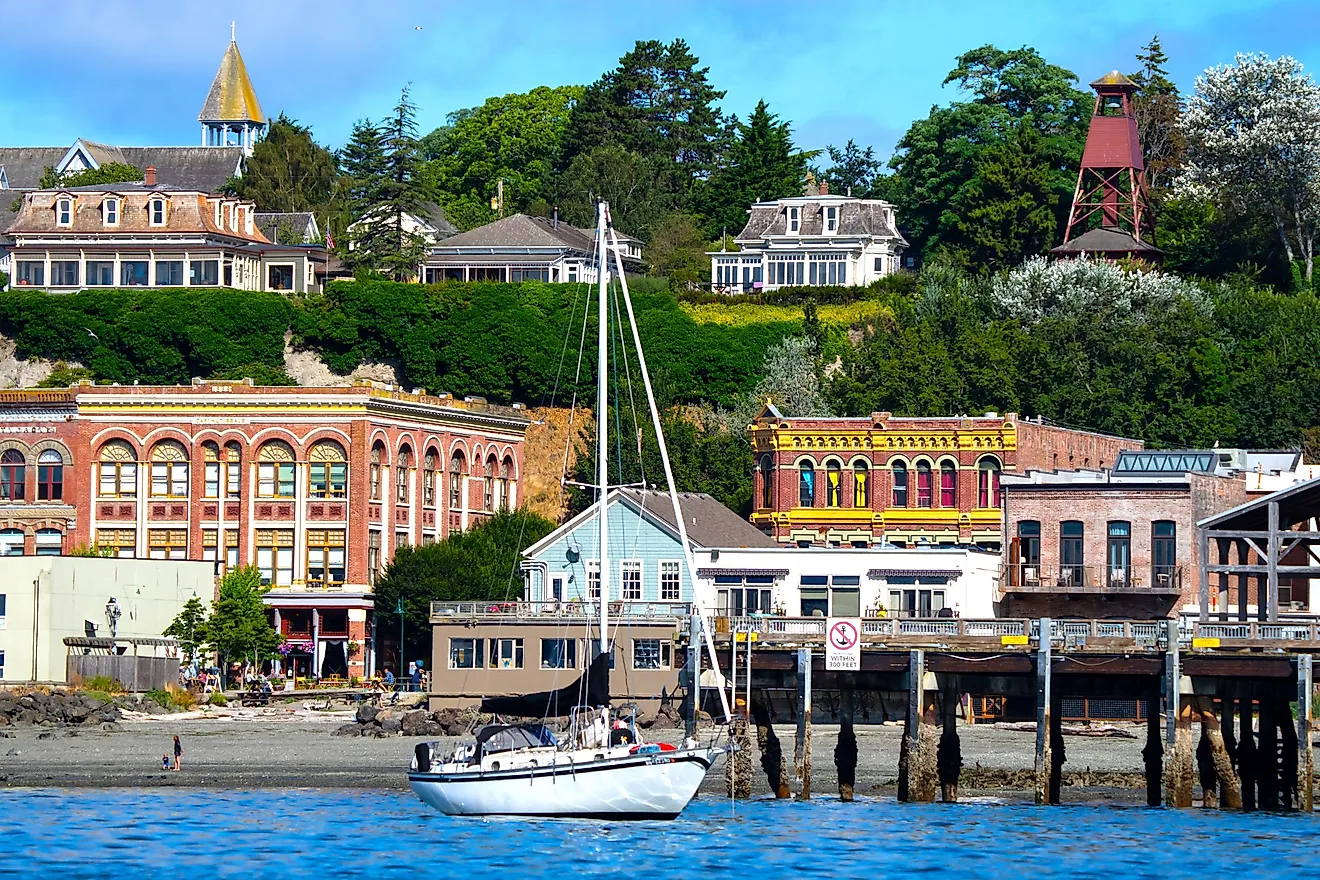
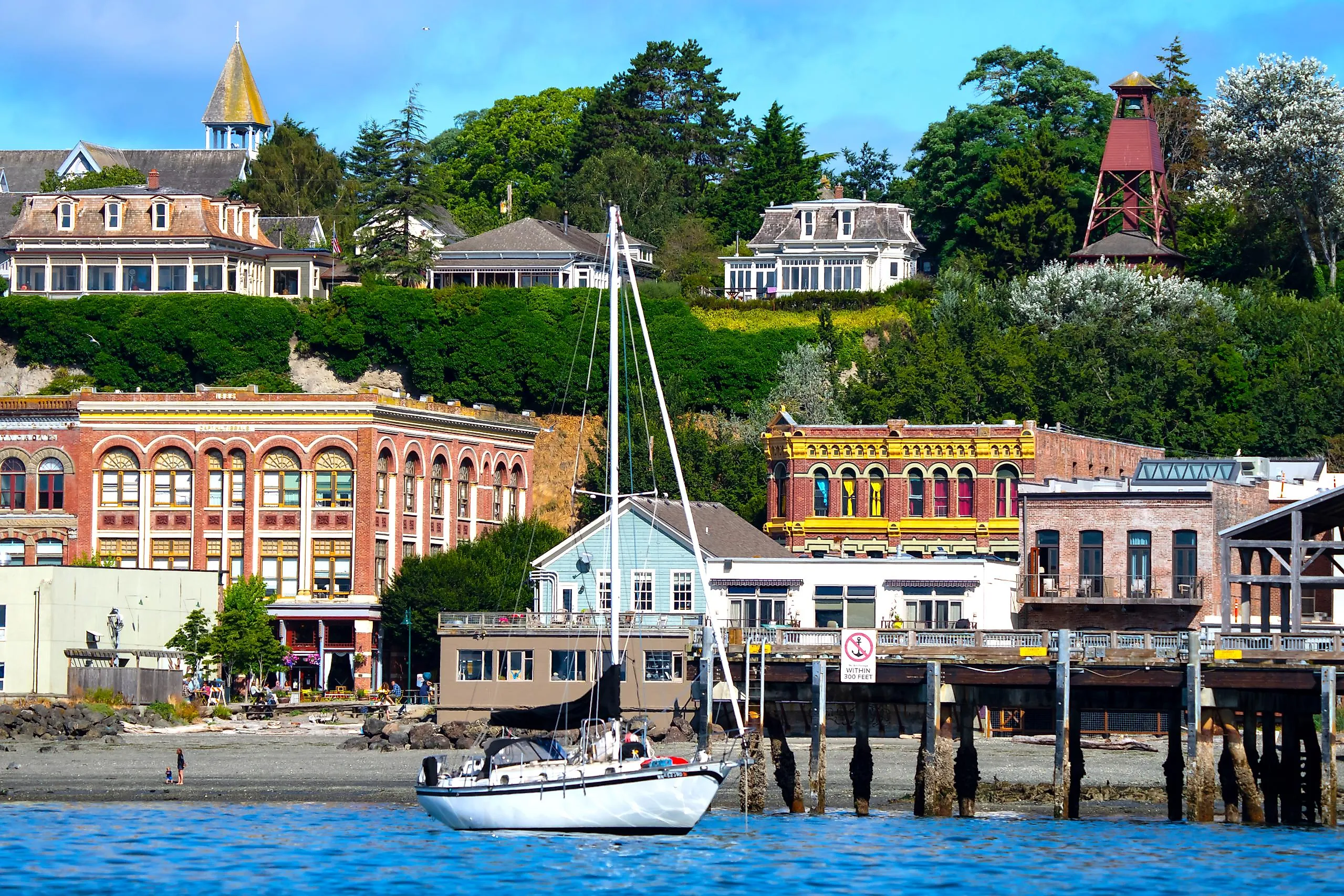
Port Townsend's late-19th-century building boom assumed the town would become the rail terminus for Puget Sound. When the railroad went to Seattle instead, the boom froze in place, and the result is one of the most intact Victorian seaports in the country and a National Historic Landmark District. The town sits at the northeast tip of the Olympic Peninsula and houses around 10,000 people. Captain George Vancouver named the harbor in 1792 after the Marquis of Townshend, but the town itself was settled in 1851 and incorporated in 1860.
Highlights include St. Paul's Episcopal Church (1865), the Bartlett House (1883), and Fort Worden Historical State Park, a former coastal artillery installation now spread across 432 acres of bluffs and beaches above the Strait of Juan de Fuca.
Astoria, Oregon

Astoria, the seat of Clatsop County, was founded in 1811 as a fur-trading outpost for John Jacob Astor's Pacific Fur Company. That makes it the oldest American settlement west of the Rocky Mountains, predating Oregon statehood by nearly half a century. The town sits at the mouth of the Columbia River where the river meets the Pacific, and the working waterfront still handles real shipping traffic.
The 125-foot Astoria Column on Coxcomb Hill, painted with a spiral mural of regional history, is the town's most photographed landmark. The Columbia River Maritime Museum on the riverfront ranks among the better maritime museums on the West Coast and earns at least an afternoon. Downtown also holds the Liberty Theatre (1925), the Captain George Flavel House Museum (1885), and the Hotel Astoria (1923). The Astoria Riverfront Trolley, a restored 1913 streetcar, runs along the river through downtown for a fare of a couple of dollars and gives a clean overview of the waterfront in about an hour.
Sequim, Washington

Sitting in the rain shadow of the Olympic Mountains, Sequim gets only about 16 inches (around 400 mm) of rain a year, less than half what Seattle gets and one of the driest totals anywhere on the western Washington coast. That microclimate is why the town has become the lavender capital of North America. More than a dozen working lavender farms operate in and around the Dungeness Valley, and the Sequim Lavender Weekend, held the third weekend of July, is the area's biggest annual draw.
Beyond the farms, the Dungeness National Wildlife Refuge protects the 5.5-mile Dungeness Spit, the longest natural sand spit in the United States, with a working 1857 lighthouse at its tip. The town's year-round population sits around 8,500.
Morro Bay, California

Morro Rock rises 576 feet straight out of the harbor mouth, a volcanic plug visible from anywhere in town and the last in a chain of nine ancient peaks running inland from the coast. The rock is now a State Historical Landmark and a peregrine falcon nesting site. Morro Bay sits halfway between San Francisco and Los Angeles on California's Central Coast, with a population of just under 11,000 and an estuary protected as a state marine reserve. The town itself was formally established in the 1870s.
The Embarcadero, the waterfront strip, holds working fishing docks, kayak rentals, and the Morro Bay Maritime Museum. Hearst Castle, William Randolph Hearst's hilltop estate above San Simeon, is about a 35-mile drive up Highway 1 and pairs naturally with a Morro Bay visit.
Port Angeles, Washington

The harbor at Port Angeles was named in 1791 by Spanish explorer Francisco de Eliza, who called it Puerto de Nuestra Señora de los Ángeles. The town now serves as the seat of Clallam County, with a population of about 19,000, and is the main gateway to Olympic National Park. Hurricane Ridge Road climbs roughly 17 miles from downtown into the park to the Hurricane Ridge visitor area at 5,242 feet, with views straight across the Olympic interior.
Port Angeles is also the US terminus of the Coho ferry, which crosses the Strait of Juan de Fuca to Victoria, British Columbia, in about 90 minutes. The City Pier on the waterfront has a small observation tower, a marine lab, and one of the better in-town views of the strait.
Bandon, Oregon

The beaches south of Bandon are stacked with offshore sea stacks (Face Rock, Wizard's Hat, Cat and Kittens) close enough to walk to at low tide. The town sits on the southern Oregon coast at the mouth of the Coquille River, founded in 1873 by Lord George Bennett, an Irish settler who named it after his hometown of Bandon in County Cork. The current population is just over 3,000.
Bandon Dunes Golf Resort, a few miles north of town, is one of the most acclaimed links-style golf venues in North America and the single biggest economic driver in the area. In town, the Coquille River Lighthouse (1896) sits across the river at Bullards Beach State Park. The annual Cranberry Festival in September celebrates the region's cranberry industry, which dates to the 1880s.
Coupeville, Washington

Coupeville is the second-oldest town in Washington State, founded in 1853 on the shore of Penn Cove on Whidbey Island. With a population of about 1,900, it sits inside Ebey's Landing National Historical Reserve, the first such reserve created in the National Park System and a deliberate effort to preserve a working agricultural and maritime landscape rather than an empty one.
The waterfront historic district preserves a stretch of 19th-century false-front commercial buildings on Front Street and a long wooden pier over the cove that is the town's defining image. Penn Cove is the source of the well-known Penn Cove mussels, harvested from rafts visible from the pier. Just outside town, Fort Casey and Fort Ebey State Parks occupy two former coastal artillery installations on the Strait of Juan de Fuca, with intact gun emplacements, miles of bluff trails, and beach access.
Eight Towns, One Coast
The Pacific Coast small towns above each anchor on something specific: a 19th-century lavender microclimate, a Victorian seaport frozen by a missed railroad, a fur-trade outpost at the mouth of a continental river, a volcanic plug at a harbor entrance, a sand spit longer than any in the country. Visit any of them on its own merits rather than as a stop on a generic coastal drive, and the West Coast starts to feel a lot less like one long stretch of beach.