9 Stress-Free New Zealand Towns For A Weekend Retreat
A weekend that resets the pace does not require going far off the map in New Zealand. In Arrowtown, wooden gold-rush cottages still line Buckingham Street, and the Arrow River beside them is shallow enough to wade. Hanmer Springs sits around a set of thermal pools that the Māori used as a healing place long before any spa opened. At Lake Tekapo, a town of fewer than 1,000 people, the night sky is dark enough to sit inside one of the world's largest dark-sky reserves. Each of these towns hands a visitor a main street, a pool, or a quiet stretch of water and asks nothing more than two unhurried days.
Arrowtown

Gold-rush cottages line the streets of Arrowtown, an Otago village that sprang up beside the Arrow River during the 1860s gold rush. By the 1880s, the gold had mostly disappeared, but the town's wooden cottages remained intact. Arrowtown stayed a quiet farming village before tourism revived it in the 1960s and 1970s. Today, Buckingham Street preserves 19th-century gold-rush buildings that house boutiques, cafes, and the Lakes District Museum. This former bank building now displays mining artifacts and rents out gold-panning equipment. The same gentle river that drew gold seekers still invites wading and panning, with the rented equipment from the museum.
After exploring the museum, visitors can walk to the Historic Chinese Settlement, where restored huts and interpretation panels tell the story of Chinese miners who lived here during the 1870s. This settlement keeps visitors aware of the significant discrimination and segregation experienced by the Chinese, an overlooked but important chapter of New Zealand history. Walkable from the settlement, the museum, Buckingham Street, and trails along the river is Arrowtown Lodge. The boutique accommodation in the historic precinct offers cottages within secluded gardens, a short walk back from a day on the river.
Akaroa

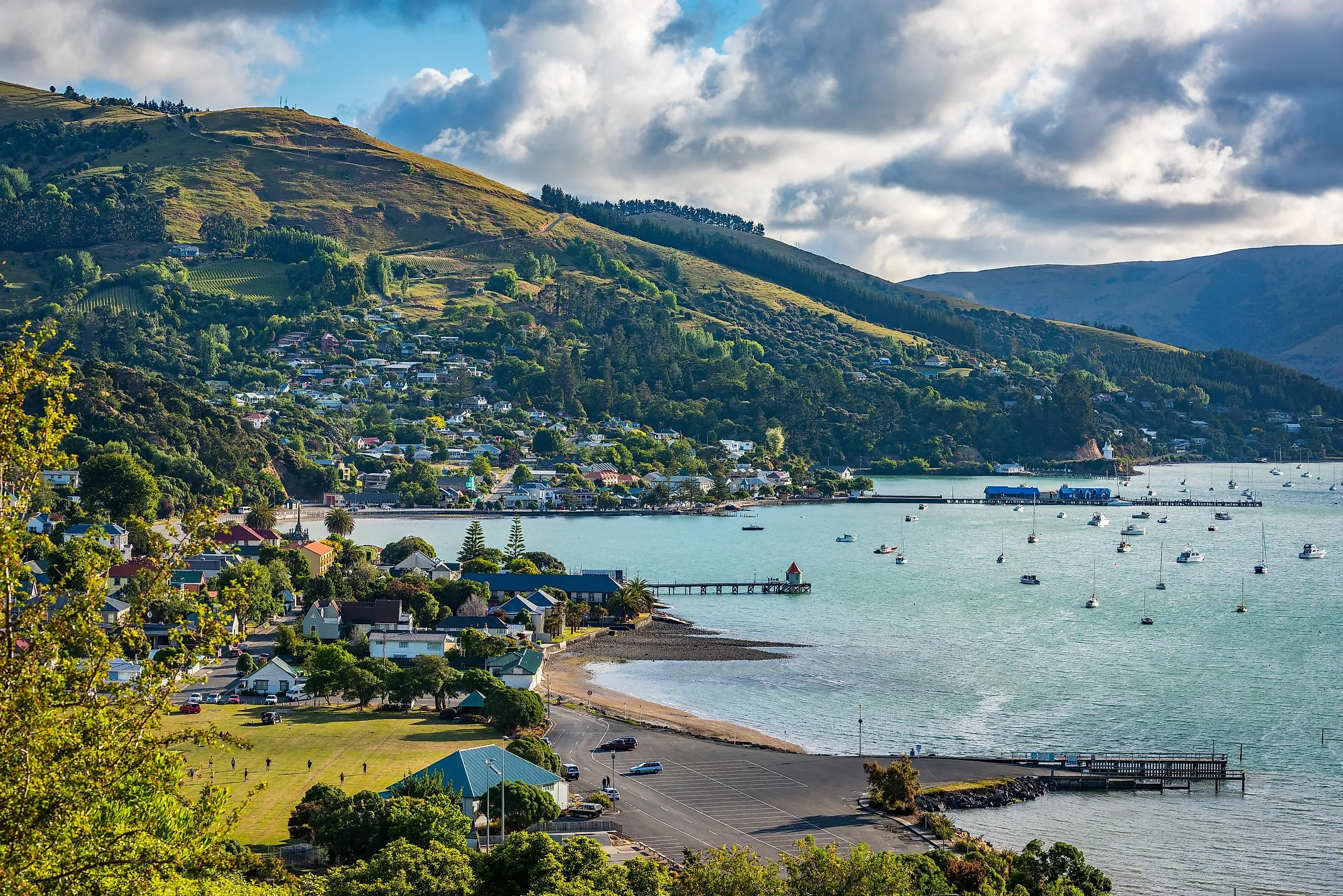
Captain Langlois, sailing from France in 1838, attempted to establish a French colony here at Akaroa. By the time he arrived, the United Kingdom had won the race: signing the Treaty of Waitangi and flying the British flag. The French settlers were allowed to stay, giving the town its distinctive European character still seen today. The Akaroa Museum explains some of this local history through archives and photography, detailing the failed French colonial venture and the story of French and British settlement.
Most of the town sits up against the Akaroa Harbor, whether on the north end of town near the museum or farther south by the Akaroa Lighthouse, which was first lit in 1880 and is one of the few remaining wooden lighthouses in New Zealand. Head to Rue Balguerie for the Giant's House, a mosaic garden and sculpture gallery created by artist Josie Martin. Holiday homes, cottages, and apartments line the volcanic harbor, but the Akaroa Criterion Motel offers a more heritage-style motel in the town center. Another option is the Akaroa Waterfront Motels right next door.
Kerikeri

Kerikeri is awash with Māori and European history. The town began as a major settlement of the Ngāpuhi iwi, and the powerful chief Hongi Hika established his pā nearby in the early 19th century. As one of the first places of sustained Māori-European contact in New Zealand, the Church Missionary Society, with Māori labor, built the Stone Store and the Kemp House. The Stone Store, built in the 1830s, is New Zealand's oldest surviving stone building. Originally used to store wheat and trade goods, it now operates as a shop and museum. Next door is the Kemp House, built in the 1820s. It is New Zealand's oldest wooden building and was originally built for the missionary John Butler.
Surrounding the town is orchard country and five waterfalls. Rainbow Falls is a 27-meter waterfall in the Kerikeri River basin that's accessible by a short walking track. The Māori name of Waianiwaniwa refers to the rainbow mist that rises from the base of the falls. Set among the citrus and mandarin orchards surrounding the town is the Kerikeri Park Lodge, less than a 10-minute drive from all the history Kerikeri offers.
Hanmer Springs

Even though the Māori knew the thermal waters at Hanmer Springs were a healing place long before European settlers arrived, the town is named after Thomas Hanmer. An early settler who recognized the springs' value in the late 1800s, Hanmer helped to develop a tourist center around the thermal springs. Hanmer Springs Thermal Pool & Spa has 22 pools, including rock pools, sulfur pools, and a lazy river. Naturally heated by an underground geothermal reservoir, the water reaches temperatures between 32°C and 42°C (90°F and 107.6°F).
Located near the thermal pools, both Edit Hanmer Springs and Braemar Lodge & Spa have accommodations with spa treatments and mountain views. For more mountain views, the Conical Hill Walk is a short forest walk to a lookout offering panoramic alpine views over the town and surrounding mountains, suitable for most fitness levels. For more intensive outdoor activities, Hanmer Forest Park is a mixed pine and native forest with walking and mountain biking trails surrounding the town.
Martinborough

Initially built as a rural service town, Martinborough was laid out in a Union Jack pattern by the Irish immigrant John Martin in the 1870s. The region's wine industry began in the 1970s, with commercial vineyards being planted in the late 1970s and early 1980s, transforming Martinborough from a farming village into a wine destination. One of the region's best-known vineyards is Palliser Estate, offering tastings of its popular Pinot Noir and Sauvignon Blanc. Schubert Wines is a boutique winery with tastings in a garden setting, a smaller producer known for handcrafted wines.
Martinborough Square is the center village green, with cafes, shops, and the historic Martinborough Hotel, opened in 1882. The heritage hotel was restored in 1996 to serve the booming wine tourism with its 20 rooms. Near the hotel is the Settler's Museum and Pain and Kershaw's General Store. Today, the General Store is a modern grocery store and a clothing shop, but the business and location have had an unbroken family lineage since 1873.
Clyde

Gold was discovered in the Clutha River in 1862, and Clyde became a major supply town for the surrounding goldfields. When the gold ran out, the town shrank but never modernized, leaving a remarkably intact 19th-century streetscape. Many of the preserved schist stone buildings are on Sunderland Street. Among them are Olivers Restaurant, an award-winning restaurant housed in a restored 1869 general store, and The Lord Clyde heritage hotel, a 120-year-old building renovated into a luxury B&B with a garden overlooking the Clutha River and period furnishings.
Opened in 2000, the Otago Central Rail Trail revived the town as a cycling destination. The trail's most popular starting point is at Clyde, and the 152-kilometer (95-mile) cycling and walking trail follows a former railway line through historic viaducts, small towns, and hand-built tunnels connecting former railway stations. Clyde, being the trail's western terminus, makes the small town a perfect resting spot for weekenders who see cycling as a stress-free experience.
Ohope

The name of the town, Ōhope, is Māori, and the beach and surrounding area were part of the traditional lands of local iwi. The nearby Otarawairere Bay and Whakatane Heads have deep Māori significance. Whakaari (White Island) and Moutohorā (Whale Island) are visible from the coast and feature in local Māori stories. Ohope Beach, along this Māori coast, is an 11-kilometer stretch of unbroken white-sand beach. For those visiting the beach, the Ohope Beach TOP 10 Holiday Park is a collection of beachfront apartments, motel units, and campsites right on the sand.
Just a short walk from the main beach is Otarawairere Bay, a smaller, more secluded bay with a native-bush backdrop. This bay remains popular for its rock pools and quieter atmosphere, compared to the nearby beach. Between Ohope and the town of Whakatane is the Kohi Point Scenic Reserve, with the Kōhī Point Walkway connecting the two towns. This walking trail offers panoramic views of the Pacific Ocean, White Island, Whale Island, and the Whakatāne Harbor, and encompasses Kapu Te Rangi (Toi's Pā), one of New Zealand's oldest and most historically significant ancient Māori settlements.
Lake Tekapo

Lake Tekapo, a town of fewer than 1,000 people, is located at the southern tip of the lake of the same name. The town is tiny, but the views are dramatic: a turquoise glacial lake, an iconic stone church, and one of the world's largest dark sky reserves. The Aoraki Mackenzie International Dark Sky Reserve covers 4,300 square kilometers, restricts outdoor lighting, and provides stargazing tours with minimal light pollution.
Built in 1935, the Church of the Good Shepherd is constructed of local stone and designed to blend with the landscape. Its location, where the Tekapo River meets the lake, makes the church one of New Zealand's most photographed buildings. A 15-minute walk across the MacLaren Footbridge and through the western side of town brings visitors to the Peppers Bluewater Resort. This lakefront hotel with mountain views and self-contained apartments is the right beginning and end to any weekend retreat on Lake Tekapo.
Takaka

The Māori town of Takaka existed long before European settlers arrived, owing to the nearby Te Waikoropupū Springs. This wāhi tapu, a sacred place, is revered by Māori for its exceptional clarity and spiritual significance. Māori consider the water taonga (treasure). In 1642, the nearby Golden Bay was one of the first areas sighted by European explorers, but their settlement came much later, in the mid-19th century, with farming and limestone quarrying. In the 1970s, Takaka became a gathering place for artists and alternative-lifestyle seekers, giving the town its current bohemian character.
Takaka's main street, Commercial Street, has many colorful art galleries, cafes, and craft shops in an alternative-culture setting. The Wholemeal Cafe is a Takaka institution known for its odd decor and organic food, pizza, and coffee. Hidden in the cafe's courtyard is the Wayward Rabbit. This tiny studio offers upcycled clothing and unique, naturally botanical-dyed felted hats. Set back from the main street and hidden among native New Zealand trees is Shady Rest, a B&B housed in a restored 100-year-old grand historic doctor's residence. Its collection of local modern art and worn, vintage furnishings suits Takaka's standing as the bohemian option for a weekend retreat.
A Weekend at New Zealand's Pace
A stress-free weekend in New Zealand isn't about remoteness or hiding from modern convenience. It needs a main street, a thermal pool, or a beachfront motel and little else. In some of these towns the history runs deep, with Māori travel routes, sacred springs, and healing waters that predate any European contact. In others the draw is preserved gold-rush architecture and 19th-century village squares. What the nine share is scale: each is small enough to cover on foot in a weekend, which is the whole point of going.