8 Tiny Off-Grid Towns In New Zealand
Some of New Zealand’s smallest towns barely show up on maps. Whangamōmona declared itself a republic in 1989 after a regional reform vote and has elected goats and turtles as its president since. Haast sits where the Tasman Sea meets the rainforest, with a highway that closes in storms. Ōkārito holds 30 permanent residents and the only habitat of New Zealand’s rarest kiwi species. Oban is the only town on Stewart Island, the country’s southernmost main island and an International Dark Sky Sanctuary. The towns ahead each run on the kind of remoteness that’s hard to manufacture.
Whangamōmona

Whangamōmona, a tiny town on the North Island, fought for and gained its own ‘independence’ starting in 1989. A government reform process would have seen the town become part of the Manawatu-Whanganui region, something the residents were vehemently against. They ‘revolted’ against the reform, elected their own president, and declared the town an independent republic. Located on the aptly named Forgotten World highway, Whangamōmona follows its own rules, even electing goats and poodles as ‘presidents.’ Today, it is estimated that there are only around 150 permanent residents in the town (many locals refuse to fill out census forms), and tourism is creating some mild tension. Visitors are still welcome, however, as long as they buy a Whangamōmona passport or get a stamp in their own passports. These passports are available at the Whangamōmona Hotel, which is one of the very few places in town with mobile coverage. Those who are curious should visit during January for the town’s biennial Republic Day, fittingly, on the odd years. The event attracts thousands of people who want to participate in possum skinning and gumboot-throwing festivities. The event also sees a new president elected, which could be anything from a child to a turtle. The next Republic Day will be held in January 2027.
Karamea

Karamea sits in a secluded location between the mountains and the sea on the Karamea River flats. The town is a geographic anomaly, protected from the destructive southern winds by the Kahurangi National Park, which forms part of its border on the south, east, and north. This means the town has a mild microclimate that lets citrus and nikau palm trees thrive. Karamea’s remoteness is part of its appeal, and visitors can find some of the country’s Great Walks or explore the Oparara Basin Arches at their own pace. Those who want to join a Great Walk should consider the Heaphy Track, which stretches 82 kilometers and takes trampers through forests, the wild west coast, and tranquil river flats. The Oparara Basin Arches, a series of limestone cliffs, caves, and arches, sit in the Kahurangi National Park and create a visual spectacle not easily forgotten. Then there are the beaches, which include Karamea Beach, Kohaihai Beach, and Scotts Beach. Karamea Beach is known for its sunsets and proximity to town, while Kohaihai Beach offers a campsite. Scotts Beach is more isolated and farther away (15 kilometers north) and features a long swing bridge spanning the Kohaihai River. It is not a swimming beach, however, as the currents and undertow are too dangerous.
Haast

The Haast Settlement on State Highway 6 lies close to the Haast River mouth, in the shadow of the mountains beyond the Tasman Sea coast. The town has an unusual layout, made up of three tiny settlements: Haast township, Haast Beach, and Haast Junction. When storms roll in, the highway is often closed, sealing off the town from the outside world. Visitors who have to wait a little longer to leave Haast’s shores due to road closures will not regret the extra time spent here. When the bad weather blows over, they can explore Haast Pass, where the Blue Pools and Fantail Falls are both worth the trip. There is a track that leads to the Blue Pools, stretching from the car park through the forest until it reaches the pools. The car park is accessed via the main road between Wanaka and Haast. There are two swing bridges at the pools, which make the views even better. Fantail Falls sits just five minutes from the main road and is one of the area’s most photographed waterfalls. Other attractions include the Gates of Haast, a bridge that spans a river, and Haast Beach, which almost looks like a setting plucked from America’s Pacific Northwest.
Blackball

In 1908, miners in the tiny town of Blackball went on a crib time strike, not for higher wages, but to be allowed a 30-minute lunch break. They won after 10 weeks of consistent protest action, and the event ultimately resulted in the formation of the New Zealand Federation of Labour, which birthed the New Zealand Labour Party. Today, Blackball is still a place where the handful of residents are proud of their ‘red’ history. It is no longer a coal mining town, but mainly a tourist attraction and gateway to the Paparoa Track. Visitors can explore the Blackball Museum, or Mahi Tupua, which is completely run by volunteers. The museum features exhibits and informative panels that include the story of the miners who won their right to a decent lunch break. Behind the museum’s main building is the Blackball Memorial Wheel, dedicated to workers killed on the job in New Zealand, with 29 tiles for the men lost in the 2010 Pike River disaster. Other things to do in this remote town on the West Coast of South Island include tasting artisanal Blackball salami at the Blackball Salami Company and hiking the Paparoa Track. The track crosses the Paparoa Range and includes rainforests and karst landscapes.
Ōkārito

Ōkārito is one of New Zealand’s smallest settlements, located on a lagoon between the Tasman Sea and the rainforest of Westland Tai Poutini National Park. There are no shops or petrol stations in Ōkārito, and its main claim to fame is being the only natural home of the Rowi, the rarest of the country’s five kiwi species. Translocated populations now also live on two predator-free islands in the Marlborough Sounds, but the only wild population still resides in Ōkārito Forest. Ōkārito is home to only 30 permanent residents, one of whom was Booker Prize winner Keri Hulme. The settlement draws visitors for paddling and kayaking, with guided kayak tours on Ōkārito Lagoon and self-paddle options. There are also hiking trails, including the 1-kilometer Ōkārito Wetland Walk, which snakes through the bush and rewards hikers with a lookout point over the estuary. The Three Mile Pack Track is a 10-kilometer trail that is great for day walking and ends at the Three Mile Lagoon. Along the way, there are 76 bird species to keep an eye out for, including the Rowi and the royal spoonbill.
Oban

Oban is the only town on Stewart Island, the southernmost of New Zealand’s three main islands. It is isolated from the mainland and accessible only by ferry or flight. Oban is also a proud International Dark Sky Sanctuary, making it one of the best places in the world to view the aurora australis (Southern Lights). Those who arrive by boat will first see Halfmoon Bay. As the name suggests, Halfmoon Bay is a crescent-shaped beach and a good background for selfies. Observation Rock is uphill from the beach and provides views of Oban. Visitors who want to hike for a couple of hours can do the Horseshoe Point walk, which starts from Halfmoon Bay and follows the coastline up to Horseshoe Point. Ackers Point is also a short walk from the bay and includes ocean views and a lighthouse. Some hikers have also seen the blue penguins that live in this part of the island, as well as kiwi.
Akaroa

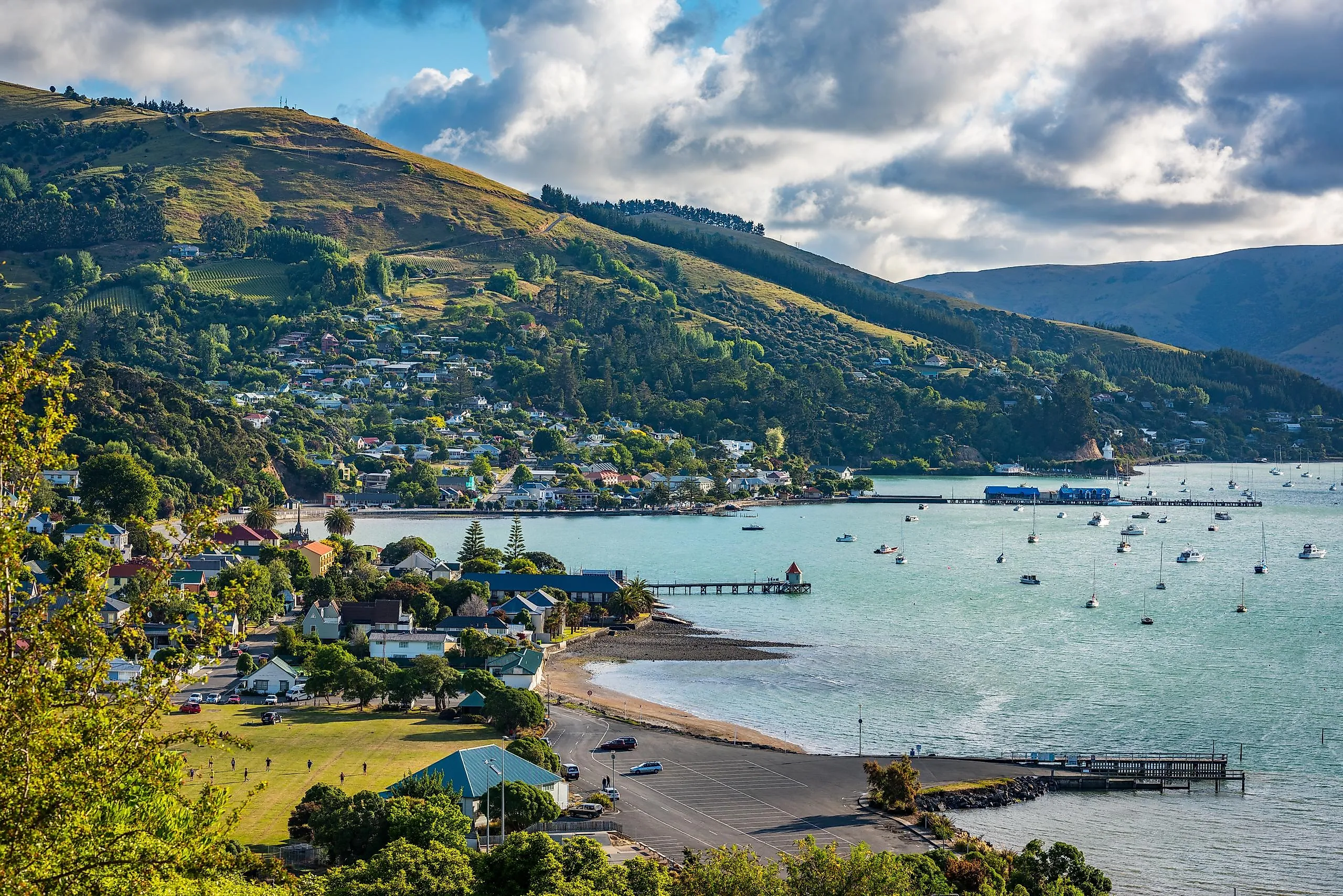
The remote town of Akaroa sits inside the collapsed caldera of an ancient volcano on the Banks Peninsula and has a population of around 750. Akaroa offers an escape from the nearest big city, Christchurch, and is accessible via a road that climbs over the crater rim. There are plenty of experiences to be had in Akaroa, including visiting the alpacas at Shamarra Alpaca Farm overlooking Akaroa Harbor and taking a cruise on the harbor to see Hector’s dolphins. These dolphins are among the world’s rarest sea creatures, with their unique black and white coloring. On land, there is the option to stay in Blythcliffe, New Zealand’s oldest inhabited home, which was built in 1857. The garden has its own stream, home to eels, and the house has lovely views of the harbor. There is also the Giant’s House, with mosaic animal sculptures and various art pieces. The on-site restaurant, The Artists Palate, offers light lunches and excellent tea.
Kohukohu

Kohukohu rounds out this list of tiny off-grid towns in New Zealand from its location on the Hokianga Harbor in the country’s far north. It is a preserved timber village featuring 19th-century colonial architecture and is only accessible by ferry or a long rural road. It is one of the best destinations for ‘slow travel’ in the country. Many of the historic buildings hang over the tides as they are built on stilts overlooking the harbor. The village holds a Category 1 Historic Place, the first stone bridge ever built in New Zealand, made using sandstone blocks brought over as ballast on ships from Sydney. The harbor reclamation buried most of the bridge over time, so it now sits 100 meters inland. Kohukohu also attracts creative souls, with the Village Arts Gallery featuring rotating exhibitions from painters, potters, and carvers.
The Enduring Allure of New Zealand’s Remotest Places
Time slows in New Zealand’s off-grid towns. Fresh air and days governed by sun and tide make for simpler living. Each of these settlements doubles as a lesson in community and self-reliance. In the far reaches of an already remote nation, the Kiwi spirit holds strongest.