10 Iconic Animals That Live Only In New Zealand
Perhaps no place on Earth is as unique as New Zealand. This island nation, comprising more than 600 distinct isles, was separated from the supercontinent Gondwana about 85 million years ago. Over those millions of years of isolation, New Zealand became an opposite land where birds run, mammals fly, and reptiles have three eyes. Only several hundred years ago did New Zealand's upside-down ecology get "righted" by humans, their pets, and their stowaways. Many native species were decimated by colonists, but certain creatures survived this onslaught to become icons of Kiwiland. Behold 10 iconic animals that are exclusive to New Zealand.
Takahē

Lacking native mammalian land predators, New Zealand is the flightless bird capital of the world. Dozens of avian species evolved with little chance of on-land predation, removing the need—and ability—for flight. One such flightless New Zealand wonder is the takahē. As the largest living member of the rail family, the takahē is a plump, brightly plumaged bird that flashes blue and green as it darts through alpine grasslands. But it barely ran fast enough to evade New Zealand's invasive land predators: humans and the dogs, rats, stoats, etc. that they intentionally and unintentionally brought during the last millennium. The takahē was considered extinct not once, but twice. Survivors were discovered far from the guns and jaws of island invaders, spurring a recovery program that increased its population to roughly 500 as of 2023.
Kea

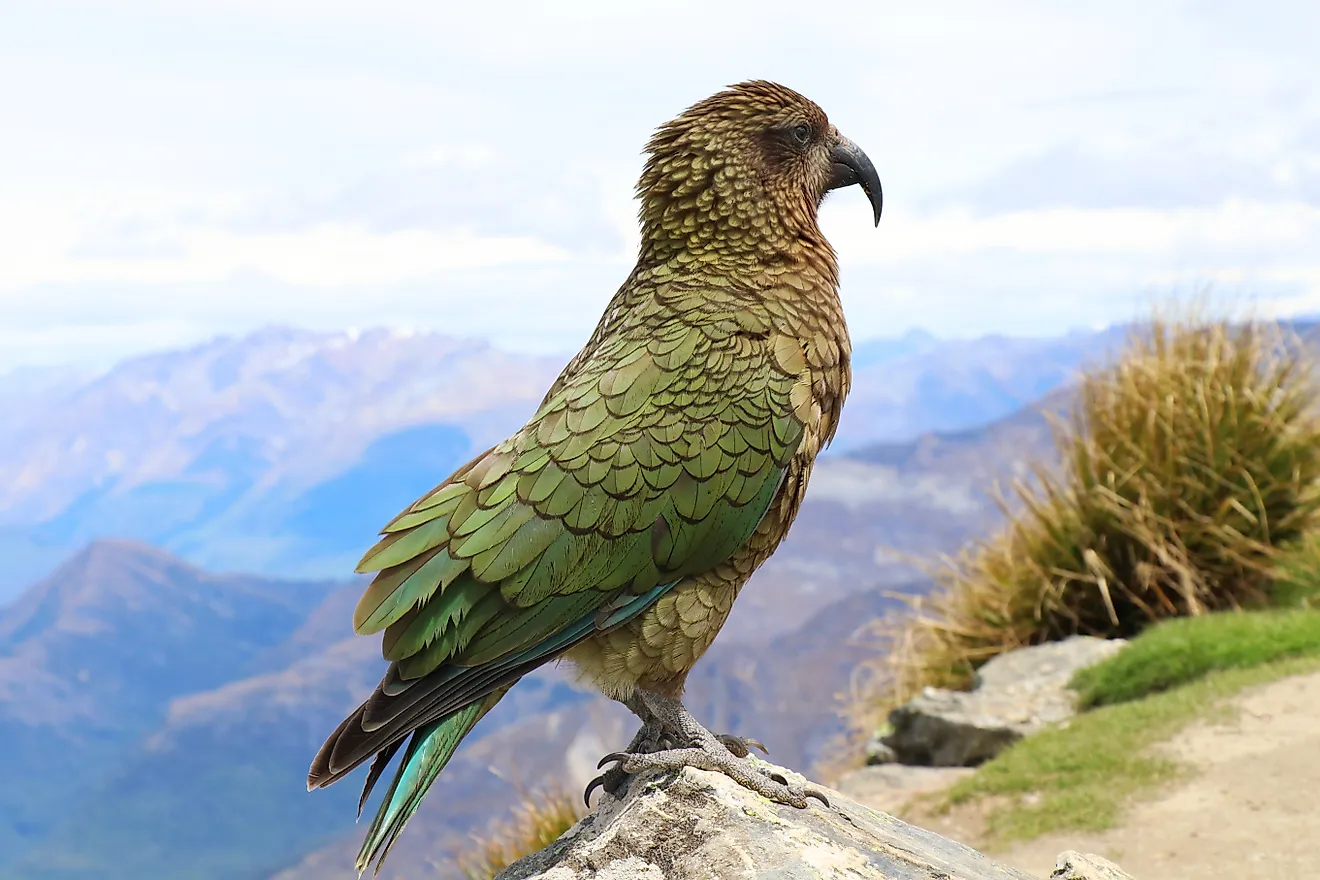
Different from New Zealand's other avian icons, the kea can fly. In fact, it flies so high (thousands of feet above sea level in the South Island mountains) that it has been declared one of the only alpine parrots in the world. It does come down from time to time, bringing its green-and-orange plumage to urban and pastoral areas. Besides coloration, the kea stuns with intelligence. It often pilfers food from bins and backpacks and even from the backs of sheep, tearing flesh off living lambs and making mortal enemies of farmers. Retaliatory slaughter of kea whittled down their numbers until the species was given full protection in 1986.
Hector's Dolphin

Though New Zealand lacks native land mammals, marine mammals are a different story. Various seals and sea lions inhabit New Zealand's waters, as do numerous whales, porpoises, and dolphins (comprising almost half the cetacean species on Earth). But only one cetacean is exclusive to New Zealand, and it happens to be the world's smallest dolphin. Named for Scottish-New Zealand naturalist James Hector, Hector's dolphin is roughly four to five feet in length and has two subspecies: South Island Hector's dolphin and the Māui dolphin. The former swims around New Zealand's South Island, while the latter is found along the west coast of New Zealand's North Island. The population of both subspecies is estimated at ~15,000, but only ~50 of those are the Māui dolphin, making it critically endangered.
Wētā

Just as islands can cause insular dwarfism, they can cause insular gigantism. Dwarfs and giants co-exist in many island nations, and New Zealand is no exception. Living alongside miniature dolphins are giant insects, most notable of which is the wētā. Stretching more than seven inches including legs and weighing 2.5 ounces, "wētā" comprises about 100 species of massive flightless crickets confined entirely to New Zealand. As a creature fit for a dark fantasy realm, the wētā lent its name to multiple New Zealand effects companies that, in turn, lent their talents to dark fantasy film franchises, chiefly The Lord of the Rings and The Hobbit.
Yellow-Eyed Penguin

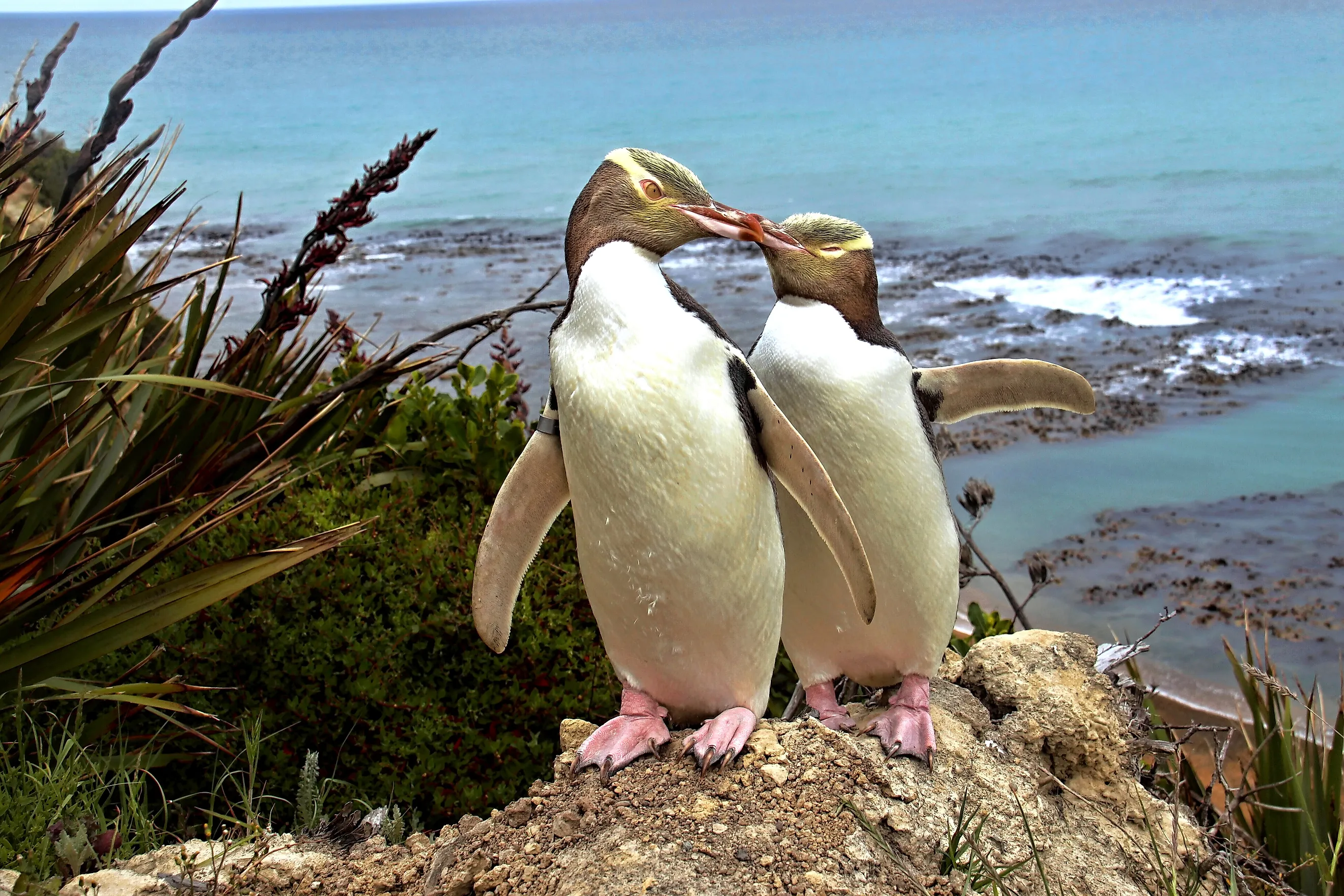
Naturally, the flightless bird capital of the world hosts the world's favorite flightless bird. Per the New Zealand Department of Conservation, 13 of 18 extant species of penguin have been recorded in and around New Zealand. Only a few of those are endemic, as in existing nowhere else on Earth, including the yellow-eyed penguin. With yellow eyes and feathers surrounding its eyes, this penguin has a particularly striking appearance. Even more striking is its size. Standing 2.5 feet tall and weighing about 15 pounds, it is the largest penguin that breeds on mainland New Zealand. It is also one of the rarest penguins, boasting a population of 4,000 to 5,000 mature individuals as of 2019.
Hamilton's Frog

Though bereft of snakes (aside from the odd adrift sea snake), New Zealand abounds with other reptiles and amphibians. One of the quirkiest among them is Hamilton's frog. Named after biologist Harold Hamilton, who collected some of the earliest specimens known to science, Hamilton's frog is considered primitive due to its lack of external eardrums, toe webbing, croaking ability, tadpole developmental stage, and other deficiencies of frogs from epochs past. This "living fossil" is limited to two small islands in the Marlborough Sounds and a few locales where they have been translocated, namely the Zealandia wildlife sanctuary in Wellington.
Kākāpō

The kākāpō is a parrot, though the one thing it cannot mimic is a parrot. Fat with textured, moss-green feathers framing owl-like, front-facing eyes, it is the heaviest parrot, one of the only nocturnal parrots, and the only parrot that cannot fly. An easy feast for introduced mammals, the kākāpō was hunted to the brink of extinction. By 1995, just 51 individuals were known to exist. Recovery efforts more than quadrupled the kākāpō population over the last few decades, but the unparrot-like parrot is still critically endangered and one of the world's rarest birds.
New Zealand Lesser Short-Tailed Bat

New Zealand's only native land mammals are bats. Generally, "land mammal" is misleading for bats, since they are the only mammals capable of true flight. But in New Zealand, where, for ages, the ground was safer and richer than the sky, bats were among many typically aerial animals that adapted to terrestrial life. The New Zealand lesser short-tailed bat, for instance, folds its wings and scrambles around quadrupedally, foraging for fallen fruit and terrestrial bugs and even digging for subterranean prey. Unlike numerous New Zealand birds, however, New Zealand bats did not lose their ability to fly. They still spend much time in the air hunting flying insects with echolocation.
Tuatara

New Zealand's most famous "living fossil" is the tuatara, a reptile that looks like a mini-dinosaur and has indeed retained the general appearance of its Triassic ancestors. If that is not sufficiently unique, the tuatara has a third eye on top of its head. Called a "parietal eye," this incredible organ has a quasi-cornea, lens, and retina, with which it ostensibly detects light and regulates circadian rhythm. The tuatara's parietal eye "opens" at birth and scales over after several months. Yet another unique feature of the tuatara is its lifespan. An individual named Henry, who lives in captivity in the city of Invercargill, is believed to be 135 years old.
Kiwi

So iconic that its name is shorthand for a human New Zealander, the kiwi is New Zealand's most recognizable animal and emblem. With a long, thin beak and fuzzy, brown body that is too plump for flight, this bird's singular look has graced everything from coins to postage stamps to rugby logos to the roundel of the Royal New Zealand Air Force. Yet even the kiwi's elevated status could not prevent invasive mammalian predation. Humans, dogs, cats, stoats, and ferrets have rendered all five kiwi species either "vulnerable" or "near threatened." Approximately 68,000 individuals are left in New Zealand.
In New Zealand, animals are iconic not just for existing nowhere else (in the wild), but for looking and acting like no other species. Thanks to tens of millions of years of insular evolution, Kiwiland sprouted animalian outliers like the straight-out-of-Middle-earth wētā, the primitive Hamilton's frog, the ground-dwelling New Zealand lesser short-tailed bat, the three-eyed tuatara, and the titular flightless kiwi. Which of those animals would you want to see in person?