9 Of The Most Adorable Small Towns In Spain
In Guadalest you reach the old town through a tunnel chiseled straight into the mountain. The reddish stone of Albarracín turns the color of a sunset because the houses were cut from the same hillside they stand on. Frigiliana keeps its history in twelve ceramic panels set into the walls of its Moorish quarter. Each of these villages grew into the rock or river that shaped it. That refusal to fight the landscape is what makes them worth the climb. Here are nine of the most adorable small towns in Spain.
Albarracín

The reddish-pink sandstone of Albarracín glows at sunset, and that color defines the town's entire visual experience. Houses built from the same local stone as the hillside itself blur the line between architecture and geology, as though the buildings grew out of the rock rather than were placed upon it. The Guadalaviar River curves around the base of the hill, and the surrounding mountains form a natural amphitheater that catches the changing light throughout the day.
The Murallas de Albarracín, a system of medieval defensive walls within a historic core declared a national monument in 1961, climb the slope toward the Torre del Andador, a 10th-century watchtower at the highest point. The ruined Alcázar of Albarracín, a Moorish alcazaba on a clifftop, remains the only fortress in the Sierra de Albarracín region open to visitors. Narrow cobbled streets wind upward past the 16th-century Catedral de El Salvador, its bell tower rising above the rest of the town. Nearby, the Casa Julianeta, a timber-framed house on a street barely wide enough for two people to pass, is among the most photographed corners of the village. Its leaning beams and irregular stone tell the story of centuries of adaptation to a steep and unforgiving site.
Alquézar

The Río Vero cuts a deep gorge below Alquézar, and the village clings to the hillside above, creating a site to behold. Houses of reddish stone and exposed wooden beams stack above one another, connected by narrow passageways that duck under archways and squeeze between walls. The color of the buildings matches the canyon rock, giving the whole village a cohesive, organic appearance.
The Colegiata de Santa María La Mayor dominates the skyline. Originally built as a Muslim fortress and later converted into a collegiate church after the Christian reconquest in the 11th century, the fortress-collegiate church remains the village's defining landmark. From the square below, visitors can follow winding lanes toward the Pasarelas del Vero, a series of metal walkways and bridges anchored to the canyon walls above the turquoise waters of the Río Vero. The entire settlement sits within the 80,000-acre Sierra y Cañones de Guara Natural Park, a landscape of limestone cliffs, deep gorges, and some of Spain's best canyoning terrain, making the village feel like a natural extension of its surroundings.
Cadaqués

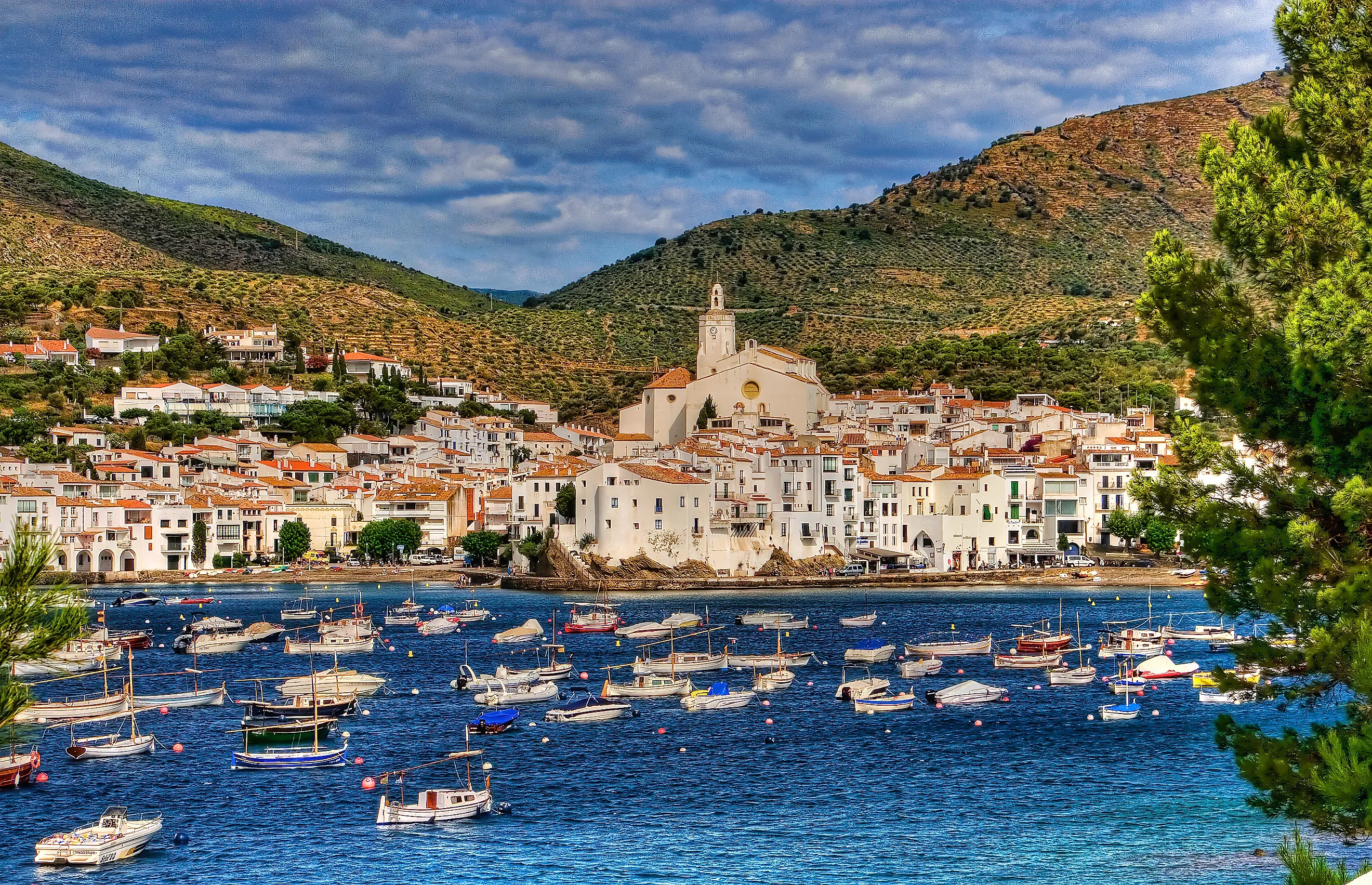
Moving down the Pyrenean foothills towards the Mediterranean, there are villages of white dotting the coast. In Cadaqués, whitewashed houses with blue doors and shutters wrap around a bay with a pebble beach, their reflection shimmering in the water. The narrow streets wind down to the harbor with the logic of a fishing village that grew over centuries, every turn offering a new composition of white walls and blue trim against the open sea.
The 16th-century Santa María Church rises above the rooftops, its bell tower visible from the water and serving as a landmark for boats returning to port. After wandering the narrow lanes below, visitors can continue north to Port Lligat, where the Casa-Museo Salvador Dalí preserves the artist's home and studio from 1930 to 1982. The interconnected whitewashed buildings contain original furnishings, artwork, and the eccentric touches that defined Dalí's life on the coast. Beyond the village, Cap de Creus Natural Park protects a rugged landscape of rocky headlands, hidden coves, and wind-sculpted formations at the easternmost point of the Iberian Peninsula, providing a dramatic backdrop to one of Spain's most striking seaside towns.
Frigiliana

Found on the southern coast of Spain, Frigiliana spills down a mountainside in whitewash and flowers, its old Moorish quarter a labyrinth of lanes so steep and narrow that most are pedestrian-only by necessity. The white walls, a practical response to the Andalusian sun, are the canvas for other colors: the deep blue of painted doors, the vivid pink of bougainvillea, and the red of geraniums bursting out of pots hung on every available surface.
The Moorish quarter, known locally as the Barribarto, holds twelve ceramic tile panels embedded in its walls. As visitors wander the steep lanes, these panels recount the story of the Moorish Rebellion of 1569 in a narrative frieze that rewards a slow walk through the historic center. Continuing uphill, the ruins of the 9th-11th century Castillo de Lizar overlook the village from above, a reminder of the strategic importance this mountainside settlement once held. Behind Frigiliana, the Sierras de Tejeda, Almijara, and Alhama Natural Park rises immediately, protecting more than 100,000 acres of rugged peaks and valleys. Its dramatic backdrop helps create one of the most recognizable views in inland Málaga.
Guadalest

Guadalest, officially known as El Castell de Guadalest, occupies a rocky pinnacle atop a mountain, and the approach alone announces that this is no ordinary village. Visitors enter the old town through the Portal de Sant Josep, a tunnel bored through solid rock that opens onto a maze of stone houses and medieval streets perched above the valley. Following these lanes leads to the Peñón de la Alcalá, a whitewashed bell tower and former Moorish watchtower that remains the village's most photographed landmark and a defining image of the Costa Blanca.
Higher up, the Castell de Sant Josep crowns the rock pinnacle, rewarding visitors with sweeping views across the Guadalest Valley and, on clear days, the Mediterranean Sea some 25 kilometers away. Access to the fortress passes through the 17th-century Casa Orduña, now a museum showcasing period furnishings and local history. Several smaller museums are scattered throughout the village, covering everything from miniature art to historic torture devices, giving visitors plenty to explore beyond the famous viewpoints.
Besalú

The Pont de Besalú, a medieval Romanesque bridge first documented in the 11th century, stretches 105 meters across the Río Fluvià. It has seven uneven arches and a fortified gateway tower, forming a zigzag silhouette that becomes a recognizable image of medieval Catalonia. The reflection of its stone arches in the river below doubles the visual impact before a visitor ever sets foot in the town.
Once across the bridge, the town reveals its layered history through cobbled streets and stone houses with Romanesque and Gothic details. As visitors wander deeper into the medieval center, they encounter the Mikvé, a late 12th or 13th-century Jewish ritual bath housed in a 2.5-by-1.5-meter stone chamber and one of the only surviving Romanesque mikvehs in Spain. A short walk away stands the Iglesia de Sant Pere, consecrated in 1003 and considered one of Catalonia's oldest Romanesque buildings.
Valldemossa

East of the mainland, on the island of Mallorca, is the town of Valldemossa. Sitting in the UNESCO World Heritage landscape of the Serra de Tramuntana, the village's stone houses with green wooden shutters line the cobblestone streets, and that combination of honey-colored stone and dark green trim gives the village its signature palette. Colorful tile plaques depicting the life of Santa Catalina Thomàs, Mallorca's only saint and a native of Valldemossa, adorn nearly every house facade, adding a touch of folk art to the stonework.
The Cartoixa de Valldemossa, a 14th-century monastery originally built as a royal palace, dominates the upper village. Within its walls, the cell where Frédéric Chopin and George Sand spent the winter of 1838 to 1839 now holds the Frédéric Chopin and George Sand Museum, with Chopin's piano on display and personal letters offering a glimpse into the couple's romantic relationship. Carrer Rectoria is popular as one of the most beautiful streets in the village because it contains everything that makes Valldemossa photogenic: the stone, the shutters, colorful flowers, and the saint's tiles.
Deià

About 10 kilometers north of Valldemossa, along the Tramuntana coast, is the village of Deià. Sharing similar aesthetics, Deià has honey-hued stone houses with green shutters. Bougainvillea blankets walls and terraces in vivid purple and pink, the color popping against the stone. The village is built into the steep terrain, its narrow cobbled streets winding upward past houses that seem stacked upon one another. The Serra de Tramuntana presses close on all sides, and the Mediterranean Sea glitters just three kilometers to the northwest.
Sant Joan Baptista, the church at the top of the village, provides panoramic views over the ravine and out to sea. Right north of town, the poet Robert Graves made his home, and the Casa de Robert Graves now operates as a museum preserving the writer's life and work. Below the village, Cala Deià sits at the foot of a steep path, a small rocky cove reached by a walk of about 30 minutes or a short drive. Puig des Teix rises to the southeast between Deià and Valldemossa, the mountain's bulk framing the village from behind.
Buitrago del Lozoya

In the Community of Madrid, Buitrago del Lozoya sits within a bend of the Río Lozoya in the heart of the Iberian Peninsula. The Río Lozoya surrounds the village on three sides, forming a natural moat that transforms the town into an island of stone walls and towers. The medieval walled enclosure is the best-preserved in the Madrid region, and the approach across the river reveals the full circuit of defenses. Within the walls, cobblestone streets lead past the Castillo de Buitrago del Lozoya, a 15th-century fortress with a coracha, a rare double wall descending into the river.
The Iglesia de Santa María del Castillo is known locally as the church of three cultures for its Christian, Islamic, and Jewish influences. The church and the Torre del Reloj, a clock tower mounted on a watchtower, define the skyline within the walls. Nearby, the Picasso Museum - Eugenio Arias Collection houses works by Picasso donated by the artist's barber. At the tip of the "island", the Jardín Medieval offers a quiet green space within the stone enclosure. The Sierra de Guadarrama rises to the southwest, completing the setting with all the important elements to enjoy from a distance or up close: river, walls, and mountains.
Spain's Most Adorable Towns
These nine towns exist on a scale that rewards slow walks, looking either up or down, and just stopping for a few breaths. Albarracín glows pink at sunset from sandstone that matches the hillside. Frigiliana dresses its white walls in geraniums and blue doors. The two Mallorcan villages, Valldemossa and Deià, share green shutters and honey stone but have different relationships with the sea and mountains. The constant across these villages is the idea that a location's architecture should complement the surrounding landscape.