The State Parks With The Best Kayaking And Canoeing
The best paddling in the country is not locked behind a national park entrance gate. Ohiopyle's stretch of the Youghiogheny is the busiest whitewater run east of the Mississippi, and it sits inside a Pennsylvania state park. The Wekiva River, where manatees drift up from the St. Johns on cool mornings, begins at a Florida spring you can launch from directly. Emerald Bay holds the only island in Lake Tahoe, its water clear enough to show a paddle blade ten feet down. This list runs through 11 state parks where the water earns the drive, whether the plan is a Class IV gorge or a slow float past bald eagles and quartzite bluffs. Grab a paddle, check the water levels, and get on the water.
Ohiopyle State Park, Pennsylvania

Ohiopyle State Park sits along the Lower Youghiogheny River in the Laurel Highlands of southwestern Pennsylvania, and it is arguably the toughest entry on this list. The Lower Yough, a 7-mile (11 km) stretch that begins just past Ohiopyle Falls, is the busiest whitewater run east of the Mississippi River, packed with Class III and IV rapids that run through undercut rocks, ledges, and swift currents. This is not water for a first-timer without a guide. The Pennsylvania Department of Conservation and Natural Resources requires a launch permit during the regulated April-through-October season and recommends guided rafting for anyone without whitewater experience.
For a gentler introduction, the Middle Yough runs upstream from town, an 11-mile stretch of Class I and II water suited to beginning kayakers and families. Several licensed outfitters based in the town of Ohiopyle work both sections, supplying rafts, guides, and shuttle transportation. Beyond the river, the park has more than 100 miles (160 km) of trails past waterfalls and scenic overlooks, enough to fill a full weekend around the water. Water levels depend on the gauge and change quickly after rain, so a check of the USGS Youghiogheny gauge before a trip is essential, especially for anyone running the river without a guide.
Lehigh Gorge State Park, Pennsylvania

Roughly two hours from Philadelphia and New York City, Lehigh Gorge State Park covers a 26-mile (42 km) gorge in the Pocono Mountains, with whitewater that is more forgiving than the Yough but still genuine. The Lehigh River here runs Class II to III, with the exact intensity set by scheduled releases from the Francis E. Walter Dam upstream, which the U.S. Army Corps of Engineers manages. On dam-release days, typically spring through fall weekends, paddlers can expect 17 to 19 named rapids, with drops like Triple Drop and Staircase marking the harder stretches.
The park runs between the towns of White Haven and Jim Thorpe, and both self-guided paddlers and rafting outfitters use launch points along the way. Trip lengths range from a family-friendly 8-mile Class II float to the full 13-mile Class III run. Below 250 cubic feet per second, sections of the river run too shallow for boating, so the Corps of Engineers' release schedule is worth checking ahead of a visit. Outside of paddling season, cyclists ride the gorge's rail-trail past waterfalls and rock outcroppings, and Jim Thorpe itself, a former coal town turned outdoor-recreation hub, makes a good base for a longer stay.
Housatonic Meadows State Park, Connecticut

For paddlers who want scenery over adrenaline, Housatonic Meadows State Park in northwestern Connecticut fits the bill. The park covers 452 acres (183 hectares) along a calm stretch of the Housatonic River, framed by the rolling hills of the state's northwestern uplands. It makes for a leisurely paddle and a solid choice for beginners and families, since canoes and kayaks move easily past pine-lined banks with little current to fight. Birdwatching is the bonus. The riverfront here ranks among the best birding spots in the state, and paddlers regularly see herons, osprey, and a range of migratory species depending on the season.
The park is a popular camping base, with sites under tall pines along the riverbank, and a two-mile stretch of the river is reserved for catch-and-release fly fishing only, so paddlers sharing the water with anglers should give that section a respectful berth. Only non-motorized boating is permitted. For paddlers who want more current, the Housatonic picks up genuine rapids farther downstream near Bulls Bridge in Kent, but that stretch falls outside the park's boundaries. Within Housatonic Meadows, the draw is quiet water, mountain views, and an easy afternoon on the river.
Devil's Lake State Park, Wisconsin

Wisconsin's largest state park at over 9,200 acres (3,720 hectares), Devil's Lake State Park centers on a 360-acre (146-hectare) lake in a gorge between two 500-foot (150 m) quartzite bluffs. Gas-powered motorboats have been banned here since 1964, which keeps the water calm, quiet, and well suited to kayaks, canoes, and paddleboards. Two no-fee boat landings, one on the North Shore near the historic Chateau and one along the road between the north and south shores, put paddlers on the water easily, and the park's concession stands rent boats for visitors without their own gear.
On land, the bluff trails draw serious hikers and rock climbers. Part of the route belongs to the Ice Age National Scenic Trail, and an afternoon scramble above the lake pays off with a view straight down to the water. The park's Nature Center runs seasonal guided kayak tours led by DNR naturalists, a good option for first-time paddlers who want some geological and ecological context along with the workout. The park lies in the Baraboo Range about 35 miles (56 km) northwest of Madison and sees well over two million visitors a year, so weekday mornings are the best bet for a quieter paddle.
Itasca State Park, Minnesota

There is a specific kind of bragging rights on offer at Itasca State Park in northern Minnesota: this is the headwaters of the Mississippi River, where the waterway that eventually reaches the Gulf of Mexico starts as a stream about 18 feet (5.5 m) wide and knee-deep. Minnesota's oldest state park, established in 1891, protects more than 32,000 acres (12,950 hectares) and over 100 lakes, with Lake Itasca itself as the main paddling destination. Canoe, kayak, and paddleboard rentals are available at the park's boat landings, and every summer a steady stream of ambitious canoeists sets off from here with dreams of reaching the Gulf.
Ranger-led canoe tours run seasonally on Lake Itasca, covering the lake's ecology and the park's conservation history for visitors who want the context. Beyond the headwaters, the old-growth pine stands at Preacher's Grove and the 2,000-acre Wilderness Sanctuary, one of Minnesota's National Natural Landmarks, are worth building into a longer visit. With more than 100 lakes inside the park boundary, paddlers looking for a quieter alternative to Lake Itasca have plenty of other water to explore without leaving the park.
Custer State Park, South Dakota

Set deep in the Black Hills, Custer State Park spans roughly 71,000 acres (28,700 hectares) and is best known for one of the largest publicly owned bison herds in the country. Its lakes, though, hold some of the most scenic flatwater paddling in the region. Sylvan Lake, often called the park's crown jewel, is a small 17-acre (7-hectare) reservoir that Theodore Reder created in the early 1890s with a dam across Sunday Gulch Creek. Ringed by granite cliffs and the spire formations known as the Needles, Sylvan Lake stays calm and motor-free, an easy, low-stakes spot for beginners to try kayaking or canoeing for the first time.
Legion Lake is the park's other main paddling destination, with similarly clear, quiet water and kayak, canoe, and paddleboard rentals on-site during the summer season. Both lakes sit at elevation in the Black Hills, so afternoon weather can shift quickly, and neither allows motorized boats, which keeps the water quiet for paddlers and swimmers alike. A South Dakota fishing license opens up trout, pike, and bass fishing on the park's lakes for anyone who wants to combine a paddle with an afternoon of casting. With Mount Rushmore about a 30-minute drive away, Custer fits neatly into a longer Black Hills road trip.
Elephant Butte Lake State Park, New Mexico

New Mexico's largest state park by acreage surrounds the state's largest lake. Elephant Butte Lake State Park centers on a 36,500-acre (14,770-hectare) reservoir on the Rio Grande, formed by a dam completed in 1916. The lake takes its name from a volcanic rock formation rising from the water that early settlers thought resembled an elephant. It runs some 40 miles (64 km) long with more than 200 miles (320 km) of shoreline, set against the stark, sun-drenched backdrop of the Chihuahuan Desert.
Morning conditions here tend to be calm, so early hours are the best window for kayaking and paddleboarding before afternoon winds pick up and draw the sailing crowd instead. Multiple boat ramps, courtesy docks, and marinas provide access, and rentals are available for visitors without their own gear. Beyond paddling, the desert setting has yielded compelling paleontological finds, including dinosaur fossils in the surrounding hills. A few miles north of the town of Truth or Consequences, the park sees over 1.5 million visitors annually, drawn as much by the 300-plus days of desert sunshine as by the water itself.
Emerald Bay State Park, California

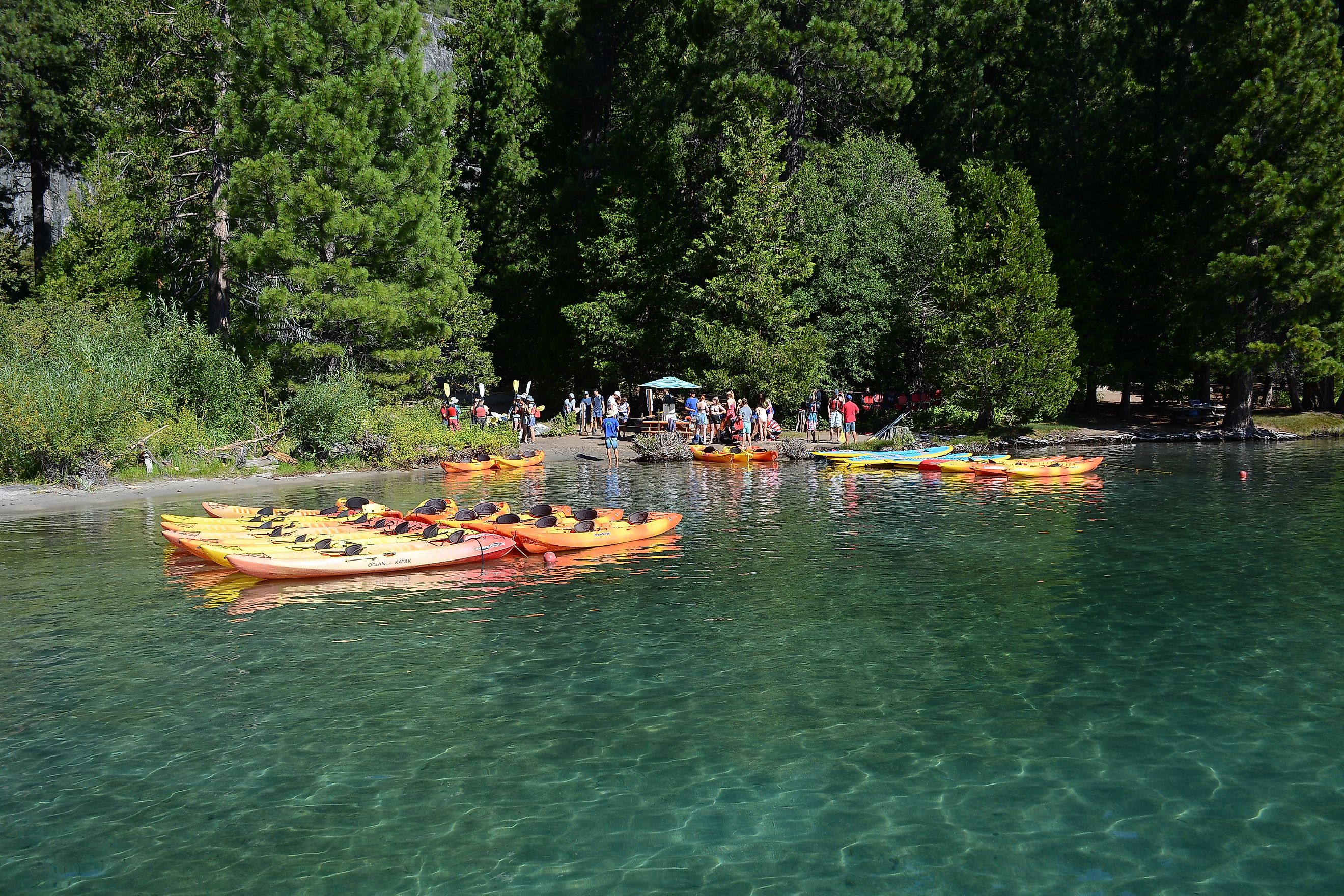
On the southwest corner of Lake Tahoe, Emerald Bay State Park surrounds one of the most photographed stretches of water in the American West, and paddling it is widely considered the best way to actually experience it. Kayakers and canoeists move past towering granite peaks and rocky cliffs toward Fannette Island, the only island in Lake Tahoe, and the bay holds California's first underwater state park, with sunken barges and boats visible beneath the surface for anyone willing to look. A 5 mph speed limit applies within 600 feet of shore throughout the bay, which keeps things calm for the kayaks, paddleboards, and swimmers that share the water in summer.
There is no easy vehicle-accessible boat launch directly on Emerald Bay itself. Most paddlers either rent kayaks near Vikingsholm, the historic Scandinavian-style estate at the bay's edge, or carry their own boats in on a steep trail. A boat-in campground on the bay's north side gives paddlers a place to stay overnight on the water, alongside the more traditional Eagle Point Campground. Wind can pick up quickly on Tahoe, so a marine forecast is worth checking before setting out.
Wekiwa Springs State Park, Florida

Just 30 minutes from downtown Orlando, Wekiwa Springs State Park sits at the head of the Wekiva River, one of only two federally designated National Wild and Scenic Rivers in Florida. Paddlers can launch directly from the spring, where cool, clear water feeds a shallow run before opening into the broader river. For a quieter route, Rock Springs Run is popular with canoe campers. On-site rental concessions supply kayaks, canoes, and paddleboards for visitors without their own gear, though motorized boats cannot launch from within the park.
Wildlife is part of the draw here. Alligators, turtles, and wading birds hunt along the banks, and manatees occasionally work their way up from the St. Johns River during cooler months. Two backcountry campsites, Otter Camp and Big Buck Camp, are reachable only by canoe or kayak, both set along Rock Springs Run for paddlers who want to extend the trip overnight. The spring basin also draws swimmers and snorkelers, so mornings are the best window for a paddle before the day-use crowds arrive, especially on summer weekends when the park sometimes reaches capacity and closes its gates.
Chattahoochee Bend State Park, Georgia

Chattahoochee Bend State Park, about 40 miles southwest of Atlanta, protects roughly five miles of frontage along a broad curve of the Chattahoochee River in northwest Coweta County, Georgia. Most of the water here is flat and easy, but paddlers putting in upstream at the Highway 16 bridge near Whitesburg will pass several shoals and Class I or II rapids, depending on current water levels, before reaching the first takeout roughly seven miles downriver. Kayak and canoe rentals are not available on-site outside the park's guided Hike and Paddle programs, so bringing your own boat is essential.
At 2,910 acres (1,177 hectares), Chattahoochee Bend ranks among Georgia's largest state parks. Its paddle-in campsites, reachable only by water with no road access, make a good remote overnight option for multi-day trips. A boat ramp in the day-use area serves as the main access point for shorter outings, and more than six miles (10 km) of wooded trails give non-paddlers plenty to do as well. There is no shuttle service, so most groups bring two vehicles to handle the point-to-point paddle rather than looping back to the start.
Lake James State Park, North Carolina

In the foothills of the Blue Ridge Mountains near the base of Linville Gorge, Lake James State Park surrounds a roughly 6,800-acre (2,750-hectare) reservoir known for exceptionally clear, cool water, the result of the largely forested watershed feeding it from the neighboring Pisgah National Forest. Duke Power created the lake between 1916 and 1923 with three dams across the Catawba River and two tributaries, and today the park splits across two recreation areas, Paddy's Creek and Catawba River, along more than 150 miles (240 km) of shoreline.
Canoe, kayak, and paddleboard rentals run seasonally from Memorial Day through Labor Day out of the Paddy's Creek area, and paddlers with their own boats can launch from several access points around the lake, including sites managed cooperatively with the state wildlife commission. For a different kind of overnight, paddle-in campsites on the Long Arm Peninsula give kayak campers a quiet stretch of shoreline to themselves. About 50 miles (80 km) northeast of Asheville, the park is an easy day trip from the city or a full weekend on its own, with over 30 miles (48 km) of hiking and mountain biking trails beyond the water.
Paddle Your Way Across America's State Parks
A Class IV drop through a Pennsylvania gorge and a slow float past Florida alligators sit on the same list here, and that range is the point: some of the country's best paddling asks for a state-park pass, not a national one. These 11 parks cover whitewater, spring runs, alpine bays, and desert reservoirs, most of them cheaper and quieter than their national-park counterparts. Pack a dry bag, check the local water levels before heading out, and let your paddles do the rest.