10 Best Places To Retire In Italy
Italy placed sixth overall in International Living's 2026 Annual Global Retirement Index. The ten towns below show why. Each offers a walkable historic center and a year-round calendar of local life, and each sits below the national average asking price of about 2,208 euros per square meter. Spoleto sets a Roman theatre against a stunning cathedral piazza. Bosa is lined with pastel houses above the Temo, the only navigable river in Sardinia. Sulmona, the birthplace of Ovid, fills one of the largest squares in Abruzzo with open-air markets. These are ten of the best places to retire in Italy.
Spoleto, Umbria

Spoleto sits on a medieval hilltop, its historic center ringed by open Umbrian countryside. With a population of about 36,000, it keeps a comforting small-town feel and an accessible cost of living, with residential asking prices averaging roughly 1,210 euros per square meter, a little over half the national figure. The town is architecturally defined by both its pre-roman and cyclopean masonry, as well as its Roman imperial structures, such as the Arch of Drusus and the Roman Theatre. Unlike other highly manicured tourist spots, Spoleto feels like an authentic, lived-in community with an atmosphere that blends historical grandeur with Italian cultural flair.
Some of the most prominent activities in the area include visiting the Duomo di Spoleto, also known as the Cathedral of Santa Maria Assunta, situated within a wide and flat piazza that maximizes accessibility. There is also the Roman Theatre, combined into a single complex with the National Archaeological Museum of Spoleto, the former hosting summer performances and the city's Festival of Two Worlds, the latter holding exhibitions on the town's ancient history.
Ascoli Piceno, Marche

One of the things that makes this town particularly interesting lies in its origins, which date back all the way to the 11th century BCE, making it older than Rome itself. Ancient legends say the territory was originally founded by Piceni, an ancient nomadic tribe of shepherds and warriors guided across the Apennines to this strategic wedge of land by a sacred woodpecker. Asking prices across the Marche average about 1,633 euros per square meter, comfortably under the national figure.
The main attractions in this area are old-town piazzas that serve as completely pedestrianized, smooth-stone squares. One of the more prominent ones is Piazza del Popolo, which houses the historic Caffè Meletti, celebrated for its exquisite house-made Anisetta Meletti, a traditional anise-flavored liqueur mixed into several drinks on the menu. There is also the Piazza Arringo, the oldest monumental square in the municipality. The Cathedral of Sant'Emidio, the baptistery, and a run of civic palaces surround the square.
Orvieto, Umbria

Being perched atop a volcanic cliff can add character to any city, but Orvieto has plenty more to offer. It is one of the most ancient cities in the entirety of Italy, with roots tracing back as far as the 8th century BCE and the pre-Roman Etruscans. Formerly known as Velzna, it fell to the Romans in the 3rd century BCE. The town holds a population of approximately 19,000, which allows a quieter and more intimate atmosphere than its livelier counterparts. Residential asking prices averaged about 1,578 euros per square meter in early 2026.
The crown jewel of the community is the Duomo di Orvieto, a sizeable Gothic cathedral renowned for its golden mosaic facade and its contrast to the surrounding dark, rustic architecture of private homes within the area. The city is also known for the tunnels and cisterns cut into the tufa beneath it, with guided tours providing manageable and low-impact ways to witness the geological history beneath the town's surface. Pope Clement VII commissioned the Pozzo di San Patrizio, or St. Patrick's Well, after taking refuge in Orvieto during the 1527 sack of Rome. Antonio da Sangallo the Younger began building it that year and finished in 1537, wrapping a double helix of ramps around the shaft so that pack animals carrying full and empty vessels never crossed paths. Today, it is a beloved local landmark and source of pride.
Bosa, Sardinia

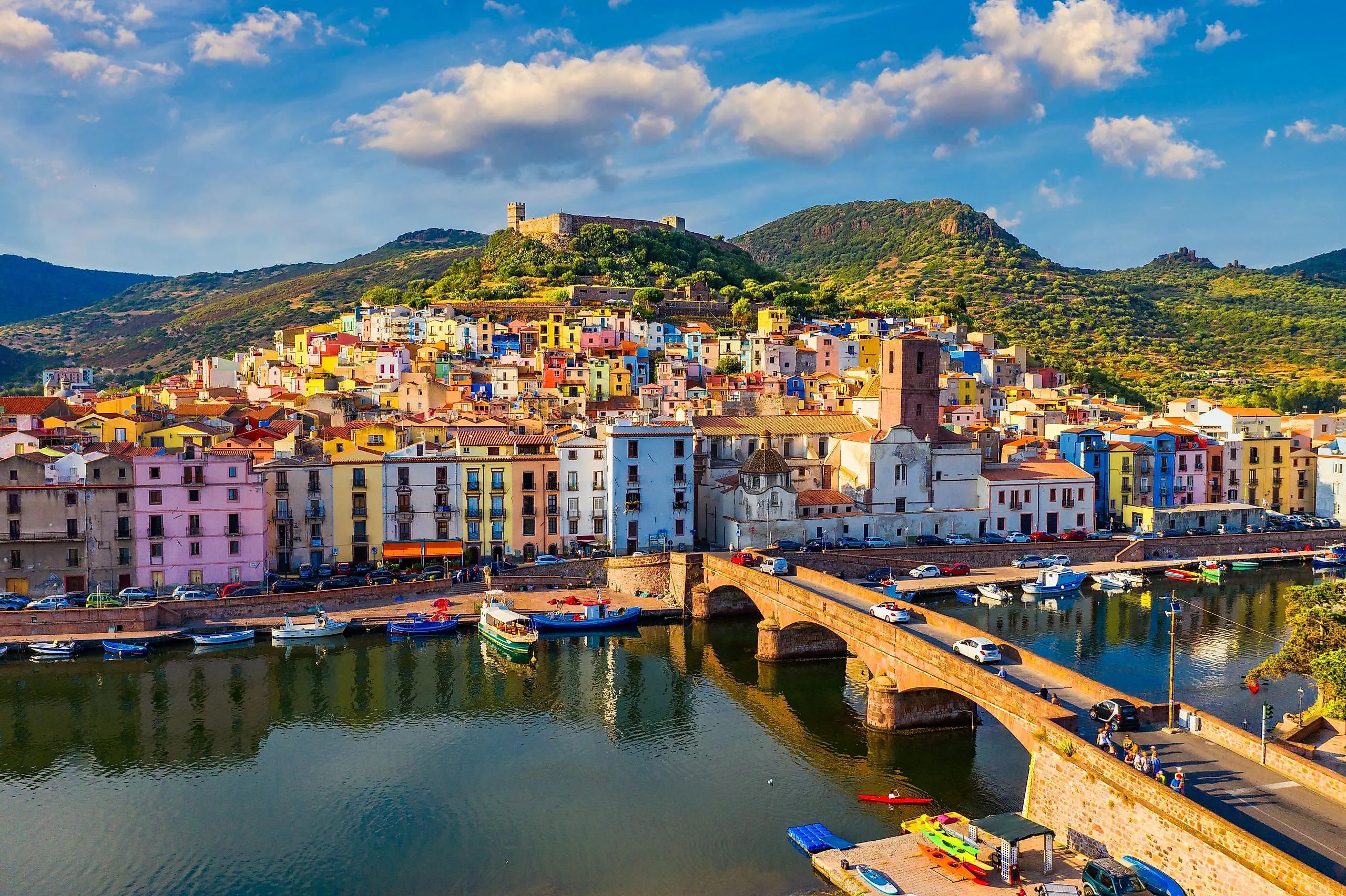
This town's history runs back roughly three thousand years, beginning as a Phoenician trading post before the Romans took it over. It has a small population of about 7,600 residents and asks far less per square meter than the Sardinian regional average of roughly 2,493 euros, a figure inflated by the Costa Smeralda resort market. It is situated on the west coast of Sardinia in the valley of the Temo River, featuring dramatic vertical cascades of pastel houses stacked beneath the 12th-century Malaspina Castle. It is also especially distinguishable as it is the only town within Sardinia with a navigable river running through its center.
Its layout is defined by narrow, cobblestone alleyways and ancient stone staircases, along with tower houses painted in a vibrant, close-packed palette. The Temo River Embankment offers a broad promenade perfect for viewing the colorful houses without having to navigate the hillside. The town's historic core is Corso Vittorio Emanuele II, home to cafes and artisan shops and lined with architectural marvels. And located directly in the heart of the city is the Cathedral of the Immaculate Conception, known for its elaborate design and colorful touches.
Scicli, Sicily

This municipality began as an ancient settlement perched on the rocky heights of Colle San Matteo until the catastrophic earthquake of 1693 forced a rebuild. It now sits at the intersection of three valleys and is surrounded by steep rock walls, creating what seems like a natural amphitheater. The town today reads as an open-air museum of the theatrical architecture that went up after the rebuild. In contrast to over-crowded tourist hubs, Scicli has managed to retain the unhurried Sicilian pace and is famous for its elegant street life and mouth-watering local food markets. Scicli is inscribed on the UNESCO World Heritage List as one of the eight Late Baroque Towns of the Val di Noto, listed together in 2002. Its population is about 27,000, and residential asking prices have averaged around 1,337 euros per square meter, close to the Sicilian regional figure.
Via Mormino Penna, the historic Baroque Street, is Scicli's main architectural stage showcasing palaces and churches alongside its scenic walkways. Piazza Italia is the main town square and perfectly exhibits the locale's social rhythm and low-stakes environment. And just a short distance from this center, coastal fishing villages like Donnalucata offer seaside promenades and flat boardwalks spanning along the Mediterranean coast, delivering gentle breezes and the pleasures of slow living.
Noto, Sicily

Ancient Noto, known as Netum, was founded and maintained on the Monte Alveria plateau until the same 1693 earthquake annihilated the settlement, forcing its relocation to the fertile plain of the Asinaro River. Noto is the priciest market on this list, with asking prices averaging roughly 1,760 euros per square meter in mid-2026. Its place on the UNESCO list, alongside the other Val di Noto towns, drives both second-home demand and seasonal crowds.
Noto is said to be the capital of Sicilian Baroque and is renowned for its palaces, churches, and iron balconies. The city's main promenade and focal point of the UNESCO label is Corso Vittorio Emanuele, which functions as the town's gallery. Alongside its thoroughfare stand some of the locality's most prolific religious and civic structures, including the Cathedral of San Nicolò and the Palazzo Ducezio. The town also maintains the Giardini Pubblici, the Municipal Gardens, near the town square, offering bench-lined paths and shaded views over the surrounding valley.
Sulmona, Abruzzo

The history of this municipality stretches deep into antiquity. Sulmo was one of the principal towns of the Paeligni, though Corfinium, seven miles away, was their capital, and Livy records Hannibal ravaging the territory in 211 BCE during the Second Punic War. It was also the birthplace of the poet Ovid in 43 BCE, and his bronze statue still stands on the main street that carries his name. The town holds about 21,600 residents, and housing across Abruzzo averages roughly 1,411 euros per square meter, well below the national figure.
Piazza Garibaldi is one of the largest public squares in Abruzzo, and regularly hosts open-air markets framed by extensive mountain views. Villa Comunale, the municipal park, sits towards the edge of the town's center, right by the historic Cathedral of San Panfilo. It offers many peaceful outdoor promenades with tree-lined walking paths suitable for both relaxation and enjoyment.
Lanciano, Abruzzo

Initially founded as Anxanum, a city of the Frentani, this town grew into a commercial power in the Abruzzo interior during the Middle Ages. It was known above all for the Fiere di Lanciano, trade fairs that drew merchants from across the Mediterranean. The town has a stable population of approximately 33,800 inhabitants, and property across Abruzzo averages about 1,411 euros per square meter, roughly two-thirds of the national figure and far less than the Adriatic resort towns nearby.
The Sanctuary of the Eucharistic Miracle is one of the most visited monuments in the town, in the Church of San Francesco, housing the miraculous relics of the 8th-century miracle on permanent display. The town is also visited for the Ponte di Diocleziano, a 40-meter structure the Romans raised in the late imperial period to bridge the Pietrosa ditch and connect two hilltop districts. It collapsed in the earthquake of 1088 and was rebuilt in medieval form in the 13th century, and the cathedral now rests partly on its arches above Piazza del Plebiscito.
Melfi, Basilicata

Melfi is a small town of nearly 17,000 residents in one of the least expensive housing markets in the country, with Basilicata averaging about 1,323 euros per square meter. Situated on the slopes of Monte Vulture, a volcanic massif, the area is defined by dark volcanic rock and mineral springs, which set the landscape apart from the arid clay hills typical of the southern interior.
The Norman-Swabian castle overlooks the town from a bluff, with wide stone courtyards and ramparts outside and the National Archaeological Museum of Melfi, holding Daunian material, inside. The main civic square is Piazza Umberto, and a short drive up is the Monticchio Lakes and Volcanic Park. What lingers is the density of the medieval fabric, block after block of stone buildings and Romanesque palazzi.
Città di Castello, Umbria

Sitting in a wide river basin in the upper Tiber valley, Città di Castello is a Renaissance town of grand loggias and expansive palaces. Despite the surrounding opulence, Umbria averages roughly 1,190 euros per square meter, among the lowest regional figures in Italy. Unlike its more medieval neighbors, the influence of the wealthy Vitelli family, alongside the work of countless Florentine architects, all contributed to the thorough planning and designing that took place while establishing this city.
The streetscapes are distinctly abstract, and the contemporary art scene the city is known for is almost entirely rooted in the legacy of Alberto Burri, a town native and renowned 20th-century artist. The Fondazione Palazzo Albizzini Collection Burri, located in the locale's center, provides the historical context for Alberto Burri's career, while the Ex Seccatoi del Tabacco houses the larger works in a series of former industrial tobacco-drying sheds. In many other Italian towns, contemporary art is confined to galleries and exhibition spaces, but in Città di Castello, the art is physically built into the town and its history.
Finding Your Place In Italy
If Italy has been sitting on your list as a someday, the math is friendlier than the famous cities suggest. Melfi and Sulmona sell space at a fraction of the national average, while Spoleto and Città di Castello trade a slightly higher price for a denser cultural calendar and better rail links, and Noto asks a real premium for its Baroque celebrity. Whether you want a navigable river at your door or a flat piazza to cross every morning, Italy rewards retirees willing to look past the flash of Rome and Florence.