Where People Are Moving To In Switzerland In 2026
Swiss families are trading city apartments for cantons with room to breathe. The pull is affordability, and the enabler is a rail network that keeps a downtown job within reach of a quieter address. Cantons like Aargau and Fribourg now post the country's strongest net gains from internal moves. Lower housing costs draw newcomers first, and steady local employers give them a reason to stay. The cantons below are the ones people keep choosing in 2026.
This piece looks at the demographics behind that shift: internal migration figures from the Swiss Federal Statistical Office (FSO), the major employers anchoring each cantonal economy, and the geography that makes the commute work. Together these factors explain where Swiss residents are relocating within their own country.
Aargau

Aargau sits inside the triangle formed by Zurich, Bern, and Basel, which makes it one of the easiest places in the country to live in one city and work in another. That location is the main reason it leads all cantons for net internal migration. Roughly 750,000 people live here, and FSO figures for 2024 show more residents arriving from other cantons than leaving for them, a gap that has held steady across the 2020-2024 period. Most of the inflow comes from neighboring Zurich, where housing has grown expensive enough to push residents into cheaper commuter territory. The irony is that the same demand is now lifting Aargau's own prices, since arrivals from Zurich tend to carry more buying power than locals.
Fribourg

Fribourg spent generations as dairy and cattle country, and food processing still runs through its rural economy. The University of Fribourg changed the picture, and a growing cluster of AI and technology firms now draws younger professionals to the canton. Its position between Bern and Lausanne puts both cities within a short train ride, so a Fribourg address does not mean giving up a city career. Housing costs less than in either neighbor, and the canton's tax rates sit below the national middle, which the FSO data reflects in a clear net gain of residents for 2024. Fribourg is officially bilingual, recognizing both French and German, a quality that makes it an easy landing spot for German speakers leaving Bern. About 350,000 people live across its 119 municipalities.
Solothurn

Solothurn built its reputation on precision, first in watchmaking and electronics, then in medical technology. The canton now anchors a large share of Switzerland's medtech and orthopedic manufacturing, and the specialized jobs that come with it draw skilled workers who might otherwise crowd into Zurich or Bern. That industrial base runs deep: about a third of residents work in industry, well above the national figure of roughly a quarter. The FSO recorded a solid net gain of new residents for 2024, placing Solothurn among the country's leading recipients of internal migration. For workers in engineering and medical fields, a canton of about 277,000 people offers the work without the congestion.
Thurgau

Thurgau is apple country, with hundreds of family orchards spread across the northeast on the shore of Lake Constance, the third-largest lake by surface area in Central and Western Europe. Its roughly 282,000 residents enjoy a low population density and more than 600 miles of cycling trails threading the countryside. The appeal for newcomers matches the pattern elsewhere: lower taxes, cheaper housing, and a manageable commute west to Zurich. The canton also borders Germany and sits close to Austria, which opens up cross-border work for those who want it. FSO figures for 2024 show a net gain of residents, continuing a trend that has run for several years. Large employers keep the local economy grounded, chief among them Stadler Rail in Bussnang, a major manufacturer of trains sold worldwide.
Valais

Valais is a high alpine canton where housing costs a fraction of what buyers pay near Lausanne or Geneva. That affordability shows up in the FSO's 2024 numbers, which record a healthy net gain of new residents. Most of the inflow arrives from the canton of Vaud and the wider Lake Geneva area, a single-year shift the FSO puts at close to a thousand people from Vaud alone. The tourism economy gives the move a practical footing, since skiing and mountain recreation account for about 15% of the canton's gross value added and a large seasonal share of its employment. The mountains themselves are the draw for many: more than 40 peaks top 4,000 meters here, among them the Matterhorn and Dufourspitze. The larger story is familiar across Switzerland, with city regions shedding residents to rural cantons even as those residents keep their city jobs by rail. In a country this compact, separating where you work from where you live is a short train ride, not a sacrifice.
Lucerne

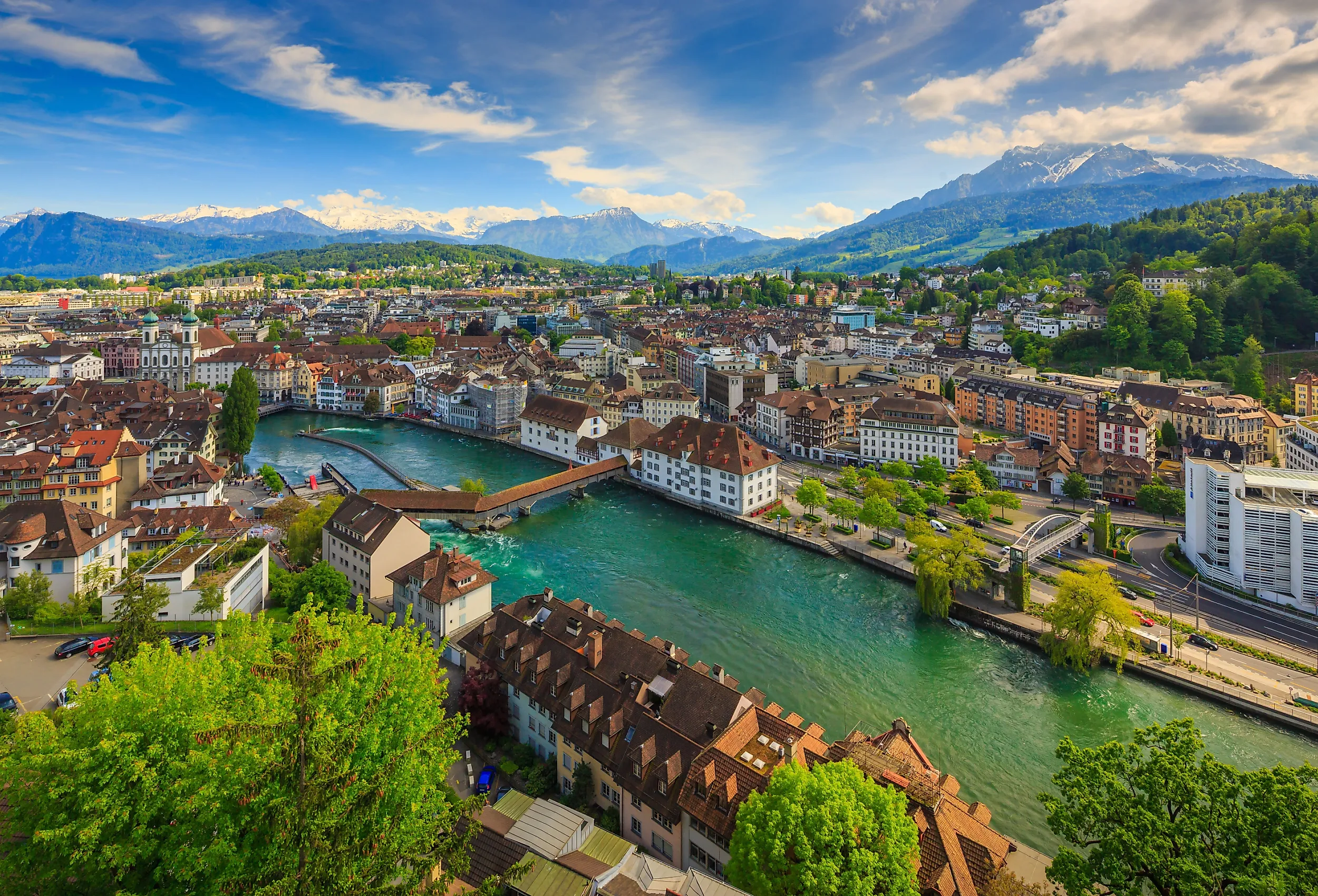
Lucerne now holds the lowest corporate tax rate of any Swiss canton, a title Zug had kept for years. A 2026 cut brought its effective corporate rate to 11.66%, edging just below Zug's 11.71%, according to PwC's tax comparison. That distinction pulls companies and the workers who follow them out of pricier city cantons. The city of Lucerne stays small at about 82,000 residents and is known for its medieval core, while the canton as a whole holds 440,000 people, the most in central Switzerland. Most of that population spreads across 78 municipalities beyond the city, giving newcomers access to the countryside without leaving the canton. FSO figures for 2024 show a net gain of new residents, modest in raw terms but part of the broader outflow from Zurich and Geneva toward smaller cantons.
Schaffhausen

Schaffhausen is the northernmost canton in Switzerland, set along the Rhine River and roughly 30 miles from Zurich. Its unusual shape leaves it surrounded on three sides by Germany, which shapes daily life for residents. Newcomers get the standard draw of cheaper housing along with two commuting directions: south into Zurich or north into Germany, where jobs are plentiful and the shared German language removes any barrier. FSO figures for 2024 record a net gain of residents, and both the capital and the smaller towns have grown since 2020. The canton also carries real corporate weight for its size, hosting Johnson & Johnson in pharmaceuticals, the longtime local firm Georg Fischer in industrial manufacturing, and the luxury watchmaker IWC Schaffhausen.
The Case for a Decentralized Switzerland
Zurich and Geneva still draw the largest raw numbers of arrivals each year, which can obscure what the migration data actually shows. Once departures are counted, the net figures reveal a steady drift outward, with Aargau leading the country on cheaper housing, lower living costs, and easy commutes. Immigration keeps the national picture growing, too: foreign nationals make up more than a quarter of the roughly 9 million residents, the largest groups coming from Germany and Italy, and the country still hosts tens of thousands of Ukrainians who arrived after 2022. That pressure lands hardest on housing in the big cities, which pushes more people toward the smaller cantons for space and value. Remote work and a dense public transit network make the choice easier every year, and the spread of population away from the urban centers looks set to continue.