9 Nicest Small Towns In Florida
Old Florida is still standing in these nine small towns. St. Augustine has kept its coquina streets in place since 1565. Apalachicola still shucks oysters on the docks where the boats tie up. Matlacha saved its fishing shacks and turned them into hot-pink galleries. Anna Maria capped its buildings at two stories to keep the towers away. The rest of the coast traded all of this for condos.
St. Augustine

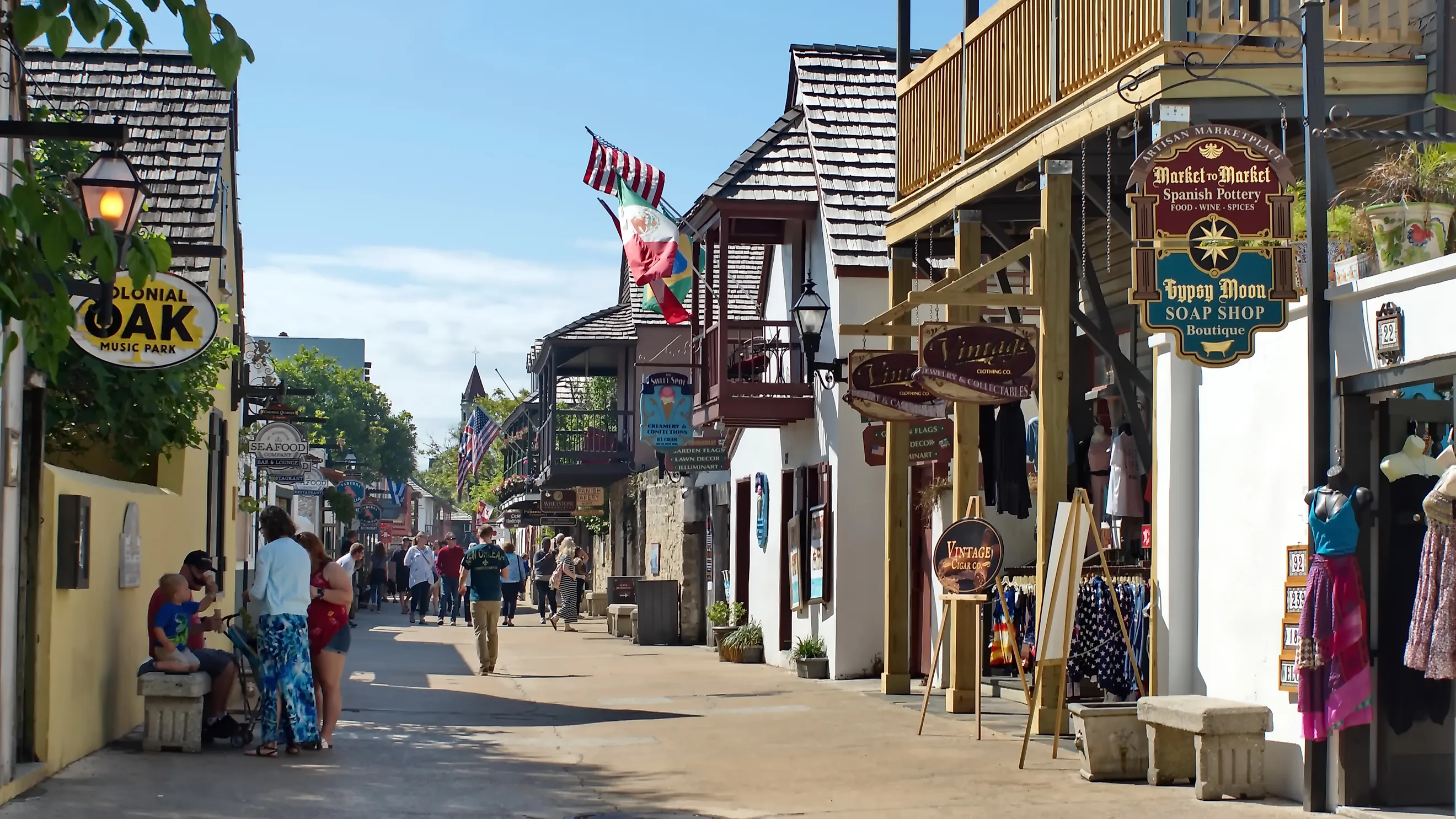
Established in 1565, St. Augustine is the oldest continuously inhabited European settlement in the continental United States. The coquina limestone walls, brick-paved lanes, and Spanish colonial architecture have weathered centuries of hurricanes and tropical storms. One of its best-known landmarks is the Castillo de San Marcos, built by the Spanish in the late 1600s as the oldest masonry fort in the continental United States, where visitors can tour the grounds and catch cannon firings and reenactments along the Matanzas River. Flagler College, formerly the Hotel Ponce de Leon, is a Spanish Renaissance landmark in the city center. Pedestrian-only St. George Street runs past local favorites like the Colonial Quarter, which houses multiple restaurants and shops. Nearby, the St. Augustine Distillery occupies Florida's oldest ice plant and offers free production tours in the restored 1907 building.
Fernandina Beach

Fernandina Beach, on Florida's Amelia Island, is the only U.S. municipality to have flown eight different national flags as ownership shifted over the centuries. Its multicultural character and Victorian architecture remain intact, giving the historic downtown a real, working feel with independent shops at its core. Oak-canopied trees are scattered across downtown, and Center Street holds independent businesses like the Book Loft and the Palace Saloon, recognized as Florida's oldest bar and known for its pirate's punch. At Fort Clinch State Park, you can watch monthly Civil War reenactments, hunt for shark teeth on the sandy beaches, or bike the trails. Every spring, the city holds the Isle of Eight Flags Shrimp Festival, which began as a shrimp boat race and now mixes local shrimp, art, live entertainment, and pirates.
Apalachicola

Apalachicola, set between the Apalachicola River and Apalachicola Bay near the Gulf of Mexico, has no high-rise condos or theme parks and still works as a historic fishing town. Downtown stays walkable, with tin-roofed warehouses that host local art galleries and the restored Sponge Exchange, home to artisan vendors. The 1907 Gibson Inn presides over the heart of the district with a wraparound veranda and Victorian woodwork, and has hosted guests for over a century. For a laid-back waterfront meal, Up the Creek Raw Bar serves fresh oysters off the dock with views of the Apalachicola River. Nearby, the John Gorrie Museum State Park honors the local physician who won the first U.S. patent for mechanical refrigeration in 1851, displaying a replica of his ice machine along with grounds to roam and the Gorrie Monument.
Safety Harbor

Along the western shore of Old Tampa Bay, Safety Harbor built its identity around an active arts scene and early roots in natural healing and citrus farming. Philippe Park is Pinellas County's oldest park, established on land once held by the French nobleman Count Odet Philippe, who is credited with introducing grapefruit cultivation and cigar making to the state. It also holds a Tocobaga Indian temple mound dating to the 1500s. Espiritu Santo Springs, long rumored to be a fountain of youth, feeds the mineral pools at the Safety Harbor Resort & Spa, associated for generations with therapeutic mineral baths. Main Street has brick-paved lanes and canopied oaks, home to local favorites like Crooked Thumb Brewery and Portkey Books. Every third Friday of the month, it turns into a family festival with local music, food trucks, and artisans. Nature seekers can take the Bayshore Linear Greenway, a route for biking, walking, and running with views of Tampa Bay sunrises and the occasional manatee.
Mount Dora

Mount Dora, sitting at 184 feet above sea level in Lake County, has brick-lined downtown streets and oaks draped in Spanish moss. The Lakeside Inn, opened in 1883, stands along the waterfront with a wraparound porch and grounds sloping directly to Lake Dora. A few blocks away is the bright yellow Victorian-era Donnelly House, one of the most photographed buildings in town. Less than 2 miles from downtown, Renninger's Antique Center and Flea Market is a massive open-air market that draws serious collectors from across Central Florida. Just south, Palm Island Park is a natural preserve with a wooden boardwalk that winds through cypress and palm trees, where you can spot birds, turtles, and alligators. Waterfront access to nearby Lake Dora also opens up sailing and fishing.
Dunedin

Scottish merchants renamed Dunedin in the 1880s after the Gaelic name for Edinburgh, planting it on the Pinellas County coastline. The town leans into its craft beer culture with more than eight independent breweries downtown, like Dunedin Brewery and Caledonia Brewing. At the center sits the Dunedin History Museum, housed in the original railway station, where you can trace the town's Scottish heritage and citrus boom. Running through downtown is the Pinellas Trail, a paved greenway built on a decommissioned railway bed and made for cycling, walking, and running. The Dunedin Causeway connects the mainland to Honeymoon Island State Park, with miles of white sand beaches framed by pine flatwoods. A short ferry ride onward brings you to Caladesi Island State Park, a boat-only beach far less crowded than the mainland.
Anna Maria

Where the Gulf of Mexico meets Tampa Bay sits the laid-back barrier island of Anna Maria. The town strictly enforces a two-story building cap and a 35 mph speed limit, keeping the colorful beach cottages, white sand, and green water clear of tall towers and busy streets. Pine Avenue is recognized as "the Greenest Little Main Street in America" for its eco-conscious architecture, and it carries a collection of boutiques and specialty shops, including the cult favorite Donut Experiment. Down the street, you can tour the restored Belle Haven Cottage, a 1920s Cracker-style home furnished with heirlooms and antiques that show early island life. At the island's northernmost point, Bean Point is a secluded, quiet stretch with no parking lots, so locals walk or bike out to hunt shells, take in the sand dunes, or spot dolphins.
Matlacha

Off the shores of Southwest Florida, Matlacha, pronounced "Matt-la-Shay," has a geography that makes large-scale construction impractical and has kept its small-scale character. After a net fishing ban shook the local economy, Matlacha turned its abandoned fishermen's shacks into colorful art galleries, quirky boutiques, and waterfront cafes. The bright streets feel like a walk through Andy Warhol's pop art, with galleries like the Leoma Lovegrove Gallery known for its polka-dotted walls, pink roof, and technicolor gardens. If you love fresh seafood, the Blue Dog Bar and Grill serves local fish with an Old Florida feel and water views. Paddlers can explore the Great Calusa Blueway, a roughly 190-mile trail for kayaks and canoes along the Southwest Florida coast with maze-like tunnels, oyster bars, and protected aquatic preserves.
Stuart

Set where the St. Lucie River meets the Atlantic Ocean, Stuart holds the title of Sailfish Capital of the World and draws anglers during its winter sailfish runs. The downtown is lined with independently owned boutiques and restaurants, such as the Waterfront - Sailfish Lounge & Grill, all centered around the restored 1920s Lyric Theatre, originally a silent movie house. A few miles away, the House of Refuge at Gilbert's Bar, built in 1876 as a lifesaving station for shipwrecked sailors, is now a maritime museum and the oldest building in Martin County. For time outdoors, Bathtub Reef Beach on Hutchinson Island has a natural rock reef that makes an ideal spot for swimming and snorkeling. The Florida Oceanographic Coastal Center is a 57-acre marine life and nature center with interactive exhibits and nature trails along the shore.
Old Florida At The Waterline
These nine towns share one habit: they kept the shoreline visible and the buildings low. Apalachicola turned away condos and theme parks and stayed a working oyster town. Anna Maria holds its two-story cap. Matlacha rebuilt its economy on galleries in the same shacks that once handled the day's catch. Safety Harbor still lets you soak in the mineral springs that drew visitors here more than a century ago, back when people called them a fountain of youth.