8 Prettiest Main Streetscapes In California's Sierra Nevada
California's Sierra Nevada is a region unlike any other. Between Lake Tahoe's northern rim and the western edge of Yosemite National Park, these eight towns kept their original commercial blocks largely intact. An unbroken row of iron balconies shades the sidewalk the length of Sutter Creek's Main Street, and Columbia's wooden boardwalks and false fronts stand where they stood in the 1850s. The area's gold rush history can be seen and felt on a stroll through these towns' prettiest Main Streets.
Truckee

Truckee's Commercial Row runs along the town's railroad tracks, lined with brick-and-timber storefronts built in the late 1800s. Here you'll see some historic facades and iron shutters designed to survive both fire and heavy snow loads. The old Southern Pacific depot stands at one end of the row and still works as a station, with Amtrak's California Zephyr stopping here and the Museum of Truckee History filling part of the building. Nearby, the Truckee River runs a block behind the shops, close enough that the Truckee River Legacy Trail can take walkers from perusing the sidewalk to a riverside path shaded by pines. A few miles west, Donner Memorial State Park is home to the deep blue water of Donner Lake and the imposing granite wall of Donner Summit, giving the whole town an unforgettable backdrop. One block north of Commercial Row, the Old Jail Museum holds the corner of Spring and Jibboom streets, and the Truckee Railroad Museum's caboose sits beside the depot, while bookstores, bakeries, and ski shops fill the rest of the block.
Downieville

More than a dozen buildings from the 1850s line Downieville's Main Street, among them the Craycroft and Hirschfeldter buildings, both raised in 1852. A block off the main road, the white steeple of the 1852 Methodist church shows above the rooflines from almost anywhere in town. A footbridge crosses the North Yuba just off Main Street, leading to river trails that pass swimming holes carved into granite, and Pauly Falls tumbles into a green pool on Pauly Creek, an easy walk up the Downie River side of town. The Jersey Bridge, a single-lane steel truss span built in 1938 and listed on the National Register of Historic Places, carries Highway 49 over the Downie River just past Main Street. General stores and a candy shop occupy the ground floors of Main Street's oldest buildings, selling supplies to hikers and mountain bikers who now outnumber the miners who once worked these banks.
Placerville

Placerville was once a rough gold rush town, earning the nickname "Hangtown." These days, it's a pure architectural time capsule rather than a frontier drama. The town's 1898 Bell Tower rises above the street, showcasing a fire bell cast in 1860. This piece of old-world technology was ordered after three fires in 1856 wiped out much of the business district, and it once served as the only warning system standing between the wooden town and disaster. About a mile north of Main Street, Gold Bug Park and Mine is home to gold-bearing hillsides and shaded picnic grounds built around an actual hard rock mine tunnel that visitors can walk through. Wildflowers fill the meadow in front of the entrance each spring. Placerville Hardware, in business on Main Street since 1852, has creaky wood floors and rolling ladders installed in 1900 alongside its modern inventory, and it still bills itself as the oldest hardware store west of the Mississippi. Brick facades from the 1850s and 1860s line the rest of the block.
Sutter Creek

Sutter Creek is one of Gold Country's most walkable towns, replete with an unbroken row of iron balconies shading the sidewalk along Main Street. Below the balconies, boutiques and tasting rooms fill buildings constructed in the mid 1800s, their brick fronts painted in the same soft palette the town has kept for generations. The creek that gave the town its name runs behind Main Street, following a green corridor of cottonwoods that visitors can walk on foot past old mining foundations. At the edge of downtown on Eureka Street, Knight Foundry, the last water powered foundry and machine shop still standing in the country, opens its doors on select Saturdays to demonstrate the way workers cast iron here starting in 1873. Amador County's wine country spreads across the oak-covered hills just beyond town, making Sutter Creek a base for vineyard visits between walks downtown.
Columbia

Columbia calls itself the Gem of the Southern Mines, and its untouched Main Street secures that title. Columbia State Historic Park has preserved the entire downtown as it stood in the 1850s. The wooden boardwalks, brick buildings, and false fronts along Main Street are the real deal, right down to the horse-drawn stagecoaches that roll past. The Fallon House Theatre, built in 1885 behind the old Fallon Hotel and home to Sierra Repertory Theatre since 1997, still hosts live performances on its original sprung floor. Past the last storefront, a nature trail winds through oak woodland to a cemetery set on a hill above town, with weathered headstones looking out over the rooftops below. Gold panning troughs run along Main Street for visitors willing to get their hands wet. The whole park is free to walk through, and historic shops along Main Street still sell rock candy and sarsaparilla the way they did more than a century and a half ago.
Sonora

Sonora's Main Street, known locally as Washington Street, runs up a slope that climbs toward St. James Episcopal Church at the top of the street. Brick buildings from the mid-1800s line both sides below, their upper floors topped with cast-iron balconies and cornices. St. James itself, built between 1859 and 1860 in the Carpenter Gothic style, still has its board and batten redwood walls painted a deep red. For a bird's-eye look at the town's architecture, the Dragoon Gulch Trail climbs directly from a downtown trailhead into oak and pine-covered hills, looping past old mining cuts before opening onto views back down over Washington Street's rooftops. Galleries, antique shops, and cafes fill the ground floors below, giving visitors plenty to explore.
Mariposa

A block off Mariposa's Main Street, on Bullion Street, stands an 1854 courthouse built from timber cut in the surrounding pines. The Mariposa County Courthouse still holds court today, making it the oldest courthouse in continuous use west of the Rocky Mountains. A tower added in 1866 to house a clock imported from England still stands above the courthouse, its crenellated top a Gothic Revival flourish on an otherwise Greek Revival building. A short walk away, Mariposa Creek runs along the edge of town. The 1858 Old Stone Jail, built from granite blocks quarried nearby at Mormon Bar, sits just off Main Street as a reminder of the town's gold rush law and order. Outside downtown, the Stockton Creek Preserve has more than five miles of trails through hills that fill with wildflowers and butterflies each spring.
Bridgeport

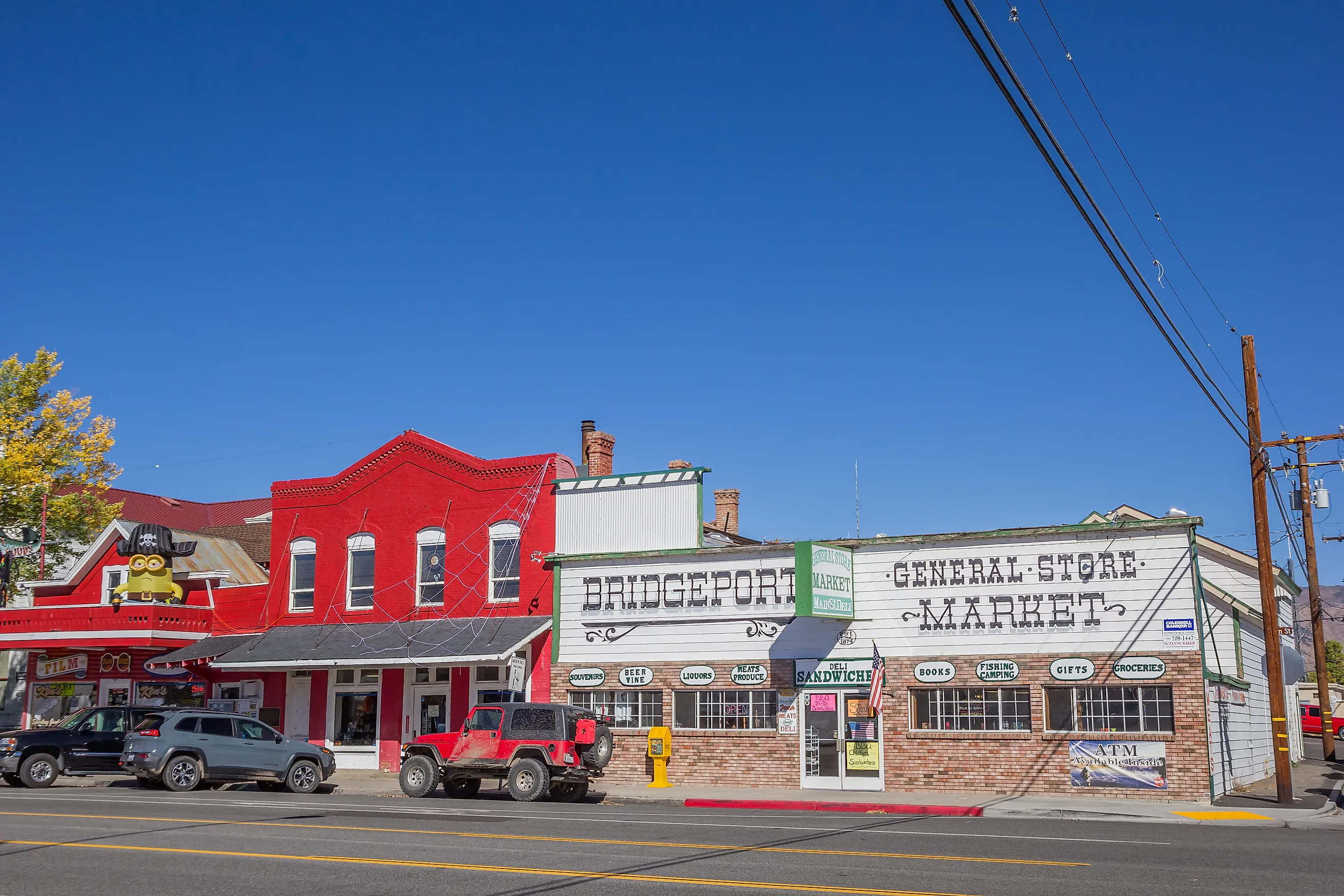
Bridgeport's Main Street runs along Highway 395 with views of the Sawtooth Range, whose granite spires rise directly behind the town's wooden and brick storefronts. The Mono County Courthouse is a white wooden building completed in 1881. It features Italianate lines topped with a square cupola and flagpole, with rooms floored in Oregon pine behind a redwood frame. It still serves as the county seat and California's second oldest courthouse in continuous use. North of downtown, Bridgeport Reservoir spreads across the valley floor. A short drive from town, Twin Lakes carries boats and anglers across cold alpine water framed by the same granite peaks that shadow Main Street. Twin Lakes Resort has a marina and cabins open through the summer season for visitors who want to stay closer to the water than downtown.
The Sierra Nevada's Surviving Main Streets
The towns' aesthetic grew out of practical decisions. Brick walls and iron shutters went up because the wooden versions burned first, and at Truckee's elevation, that same construction had to hold a winter of snow. Towns that stayed small stayed intact, since nothing arrived later that was worth tearing an old block down for. Columbia is the deliberate exception, held in place by the state park system since 1945. Everywhere else, the buildings simply kept working, and Mariposa's courthouse still hears cases while Placerville's hardware store still sells hardware. None of these blocks was built to be looked at, but the age and history make them some of the prettiest streetscapes in the state.
-L1006460.jpg)