9 Prettiest Small Towns In Northern California
Northern California saves its best scenery for its small towns. Many kept their nineteenth-century bones long after the rest of the state moved on. Some began as logging ports or dairy centers, others as Gold Rush mining camps or railroad stops. Preservation-minded residents have held onto the Victorians and the false-front Main Streets ever since. Each of the nine below pairs a walkable historic center with the kind of unhurried weekend that big cities rarely allow.
Mendocino

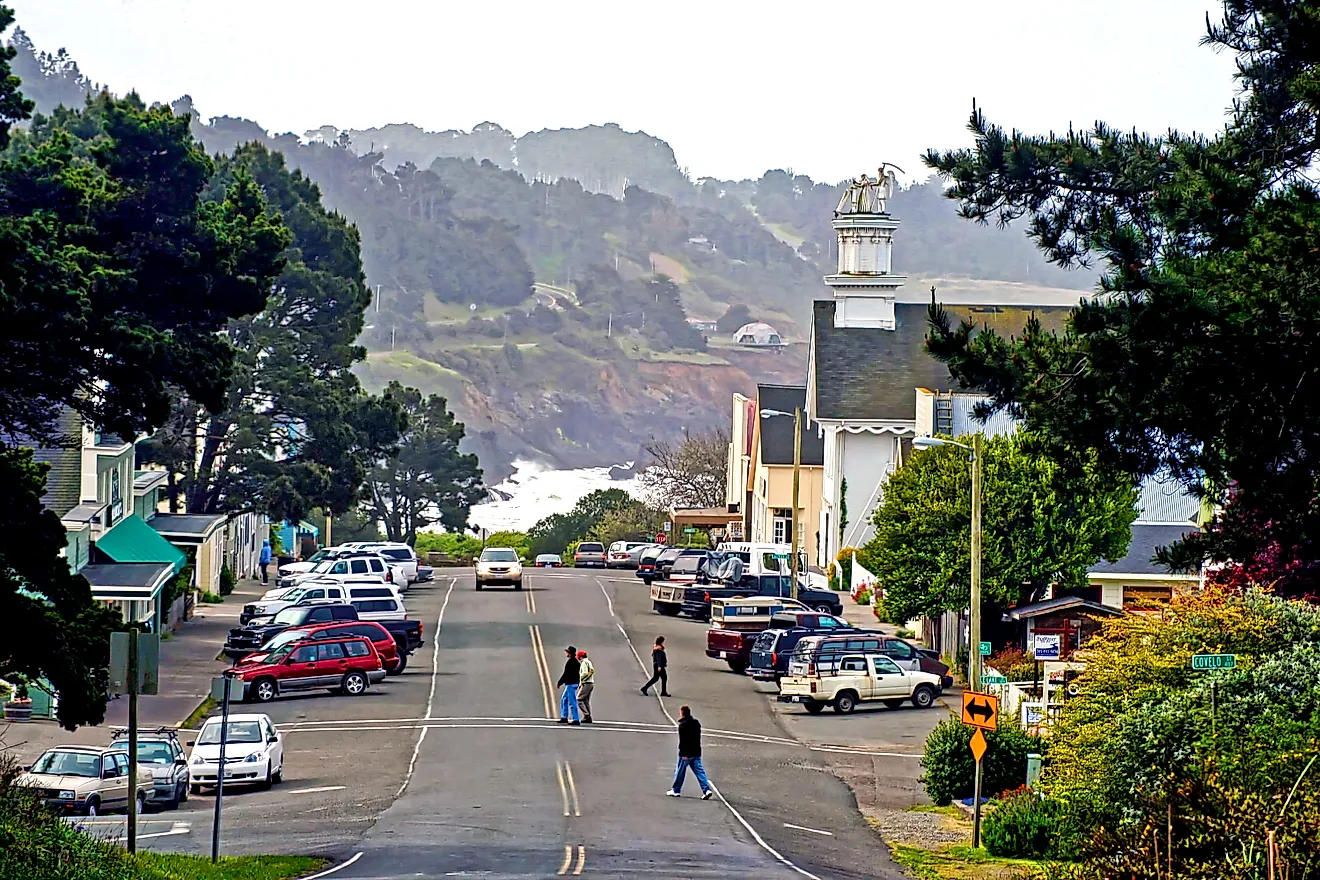
Mendocino sits on a headland jutting into the Pacific about 150 miles north of San Francisco, and the entire village of roughly 900 residents is a designated historic district. New England settlers built it in the 1850s as a redwood logging port, and the saltbox cottages, water towers, and gingerbread Victorians they raised still line the compact grid above the sea. When the timber trade faded, artists moved in. The town's galleries, bookshops, and the Mendocino Art Center carry that creative streak today. Mendocino Headlands State Park wraps the village on three sides with clifftop trails where gray whales pass offshore in winter and wildflowers open in spring. The Ford House of 1854 and the Kelley House of 1861 keep the logging history on display, while the 1854 Temple of Kwan Tai recalls the town's early Chinese community. A short drive south, Van Damme State Park holds a pygmy forest of stunted, century-old trees, and Russian Gulch State Park frames a 36-foot waterfall reached through a fern-filled canyon.
Ferndale

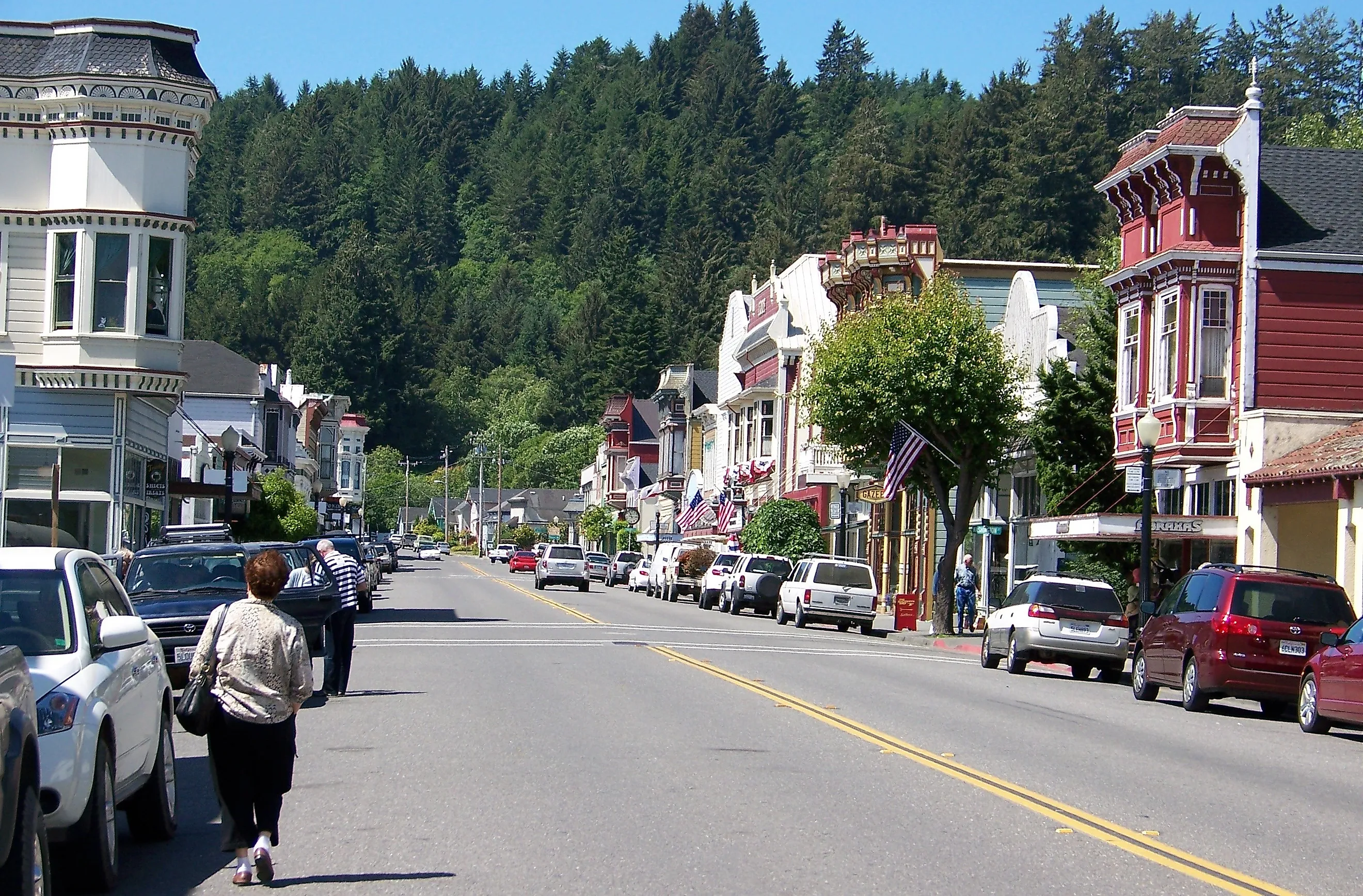
Ferndale, a town of about 1,400 in the Eel River delta of Humboldt County, is the most complete Victorian village in the state, with the entire town registered as California Historical Landmark number 883. Settlers founded it in 1852, and the fortunes that Danish and Portuguese dairy families later made in butter and cream built the ornate Main Street storefronts and gabled homes that locals nicknamed the Butterfat Palaces. The Gingerbread Mansion of 1899, with its dueling Queen Anne and Eastlake trim, is the most photographed of them, and the red-timbered Victorian Inn of 1890 anchors the far end of the shopping street. A five-block walk takes in nearly all of it. The route passes bookshops, a working blacksmith, and galleries where the owners often step out to talk. Above town, the Ferndale Cemetery climbs a redwood-shaded hillside to a viewpoint over the whole valley and the ocean beyond. Ferndale also marks the northern gateway to the Lost Coast and sits within a short drive of the redwood parks, and it hosts the finish of the three-day Kinetic Grand Championship each spring.
Trinidad

Trinidad may be one of California's smallest incorporated cities, with barely 350 residents, but it holds one of the most striking positions on the entire coast. The village perches on a bluff above a working harbor, sheltered by the great rounded promontory of Trinidad Head, with fishing boats bobbing below and sea stacks scattered offshore. It is among the oldest towns on the northern coast, named by Spanish explorers who landed on Trinity Sunday in 1775, and its later life as a Gold Rush supply port and whaling station still shows along the pier, the state's northernmost. Two lighthouses mark the town: the working 1871 Trinidad Head Light and a 1949 memorial replica overlooking the bay. Ten public beaches lie within reach, several part of the California Coastal National Monument, and the Trinidad Head Trail loops the headland for whale watching and wide ocean views. Just north, Sue-meg State Park frames tide pools and agate beaches, and the towering groves of Redwood National and State Parks begin only a short drive up Highway 101.
Nevada City

Nevada City rises across pine-covered hills about 60 miles northeast of Sacramento, and its downtown is the best-preserved Gold Rush townscape in California, a National Register historic district since 1985. Miners settled it in 1849, and the wooden balconies, brick storefronts, and gaslit streets of Broad Street have survived largely intact, thanks to a preservation ordinance the town adopted back in 1968. The Nevada Theatre of 1865 is California's oldest existing theater building, a stage that once hosted Mark Twain, and the gingerbread-fronted Firehouse No. 1 now holds a museum of Gold Rush and Nisenan history. Tahoe National Forest presses right up to the edge of town. A five-minute drive reaches trails, swimming holes, and the deep green ridges that ring the valley. The South Yuba River State Park nearby shelters the 1862 Bridgeport Covered Bridge, the longest single-span wood covered bridge in the country. Each December, the streets fill for Victorian Christmas, when residents dress in period costume and the historic core glows with lanterns.
Sutter Creek

Sutter Creek earns its nickname as the Jewel of the Mother Lode, a compact Gold Country town of about 2,500 spread along Highway 49 in the Sierra foothills of Amador County. It grew from an 1846 camp named for John Sutter into one of the richest quartz-mining towns on the Mother Lode, and its Main Street still lines up an unbroken row of high-balconied, false-front buildings from that era. The whole downtown is walkable in an afternoon. Its brick and clapboard facades now hold antique shops, galleries, and tasting rooms pouring the old-vine Zinfandel that Amador County is known for. Hotel Sutter has welcomed guests since 1858, and just off the main street stands the Knight Foundry, the last water-powered foundry in the United States. The surrounding foothills roll green in spring and gold by summer, and the Shenandoah Valley wine region begins about ten miles north. The nearby Kennedy Mine, once among the deepest gold mines in the country, offers surface tours of its towering headframe and stamp-mill ruins.
Mount Shasta

The town of Mount Shasta, home to around 3,000 residents, stands at 3,600 feet in Siskiyou County, and almost every street frames the snow-capped cone of its namesake volcano, which rises to 14,179 feet just to the east. It is among the most commanding town backdrops anywhere in the state, a solitary Cascade peak that holds snow deep into summer. Founded as a railroad and timber settlement in the 1880s, the small downtown keeps a low-key, pine-shaded main street of bookstores, cafes, and outfitters serving the climbers and hikers who use the town as a base. The Everitt Memorial Highway climbs the mountain's flank to the Bunny Flat trailhead, a scenic drive with pull-offs framing the peak. Below town, pine-rimmed Lake Siskiyou mirrors the summit on still mornings and draws swimmers and paddlers in summer. The headwaters of the Sacramento River bubble up in Mount Shasta City Park, where visitors fill bottles straight from the spring, and the granite spires of Castle Crags State Park rise a few miles south for hiking and rock climbing.
Truckee

Truckee spreads along the Truckee River in the High Sierra, about 20 minutes from Lake Tahoe's north shore, and its Old West downtown backs right up to the railroad tracks and the snow-dusted peaks beyond. Home to roughly 17,000 residents, it earned a California Cultural District designation in 2017 for the galleries and studios now filling its nineteenth-century buildings. The town grew during the 1860s as a logging center and a hub for the First Transcontinental Railroad. Commercial Row still lines up brick and timber storefronts along Donner Pass Road, anchored by the 1873 Truckee Hotel and the 1875 jail that served until 1964. Just west, Donner Memorial State Park rings sparkling Donner Lake and tells the story of the Donner Party and the Chinese laborers who built the railroad through these mountains. The paved Legacy Trail follows the river for walking and cycling, wildflowers line the trails by late spring, and a dozen ski resorts, including Palisades Tahoe and Northstar, lie within a short drive for winter visitors.
Calistoga

Calistoga anchors the quiet northern tip of Napa Valley, a town of about 5,000 framed by vineyards and the wooded slopes of Mount Saint Helena. The Gold Rush entrepreneur Sam Brannan founded it in the 1860s, modeling it on the spa resorts of Saratoga Springs, New York, and drawing on the geothermal springs that still bubble beneath the valley floor. Those mineral waters and volcanic-ash mud baths made Calistoga a wellness destination for more than 150 years, and the tree-lined length of Lincoln Avenue keeps an easygoing, low-slung character rather than a polished one. Tasting rooms, cafes, and the 1868 Calistoga Depot, the second-oldest rail depot in California, share the street. Just outside town, the Old Faithful Geyser erupts on a regular schedule, powered by the same volcanic heat, and the Petrified Forest preserves redwoods turned to stone by an ancient eruption. Hikers climb the trails of nearby Robert Louis Stevenson State Park, while sunrise hot-air balloons drift over the vineyards, a signature Calistoga sight on clear mornings.
Healdsburg

Healdsburg gathers around a leafy nineteenth-century plaza in northern Sonoma County, where three celebrated wine valleys, the Alexander, Dry Creek, and Russian River, all meet. A town of about 11,000, it was laid out by pioneer Harmon Heald, who established the central plaza in 1857, and the Mission-style and brick buildings framing it now hold tasting rooms, bookshops, and some of the most admired restaurants in the state. The plaza itself, shaded by mature trees and centered on an old-time band shell, hosts summer concerts and a farmers' market that has run since 1978. Beyond the walkable downtown, the vineyards roll over the surrounding hills, and the Russian River curls along the western edge of town, where Veterans Memorial Beach and local outfitters make for easy swimming, kayaking, and canoeing. The Healdsburg Museum occupies a 1910 Carnegie Library listed on the National Register, and the 150-acre Healdsburg Ridge Open Space Preserve offers trails to a Russian River overlook. The ancient groves of Armstrong Redwoods lie a fifteen-minute drive southwest.
Where the Setting Makes the Town
What ties these nine together is the way the setting and the townscape reinforce each other: a Victorian village only looks better against a headland of crashing surf, and a Gold Rush Main Street gains something from the pine ridges rising behind it. Big cities have their museums and their restaurants, but this kind of beauty asks for a slower pace, the sort measured in clifftop walks, porch conversations, and long looks at a mountain catching the last light. Northern California's roads make the journey part of the reward, threading the coast, the foothills, and the mountains between one town and the next. Pick a direction, plan an unhurried weekend, and let these small towns show you the version of the state that the freeways never reveal.