8 Nicest Small Towns In Germany
Germany's small towns preserve their medieval character as inhabited, working places rather than reconstructed museums. Centuries-old market squares still draw weekly crowds, and timber-framed houses still stand by the hundreds. Quedlinburg came through the Second World War with more than 1,300 of those houses intact and is now a UNESCO World Heritage Site. Dinkelsbühl has held the same ten-day Kinderzeche festival every July since the 19th century, reenacting a local legend in which children singing to a Swedish general saved the town from destruction during the Thirty Years' War. The eight towns below showcase the range of small-town German character, from Bavarian walled cities to Rhineland half-timbered villages.
Einbeck

A small town in southern Lower Saxony, in the area sometimes called the "heart of Germany," Einbeck sits between the larger cities of Hanover and Göttingen. The old town preserves hundreds of half-timbered houses dating largely to the 16th century, with cobblestone streets linking them. Einbeck is the birthplace of bock beer, a stronger, typically darker German lager brewed historically in the winter months and known for its rich, malty flavour. Einbecker Brauhaus has been brewing in town for centuries and offers tours and tastings, explaining how Einbeck beer influenced brewing traditions across Europe, including the later Bavarian adoption of the style (Munich's Hofbräuhaus began brewing "Ainpöckisch Bier" in the 16th century, which is where "bock" as we know it largely originates).
Einbeck offers a slower pace than the more heavily touristed cities. It serves as a good base for exploring Lower Saxony and the Harz Mountains to the east. The historic Altstadt contains over 400 half-timbered homes. Car enthusiasts should not miss the PS.SPEICHER, one of the largest collections of historic vehicles in Europe, covering automobiles and motorcycles from the early 20th century to the present day.
Monschau

In western Germany's Eifel region near the Belgian border, Monschau sits on the Rur River and is best known for the Eifel National Park and its exceptionally well-preserved half-timbered Altstadt. The park itself covers about 110 square kilometres as a barrier-free conservation area with hiking trails, guided nature walks, and wildlife-watching opportunities. Monschau is also known for its Historische Senfmühle Monschau (Historic Mustard Mill), where mustard has been produced since the 1880s using traditional methods. The mill produces Moutarde de Montjoie in over 20 varieties; guided tours visit the mill and the wine cellar below.
The town takes on a particularly distinctive character during the Monschau Christmas Market, held through the Advent period from late November to shortly before Christmas. The narrow Altstadt streets and timber-framed houses, decorated for the season and illuminated by traditional lighting, draw visitors from across Germany and the Benelux countries.
Michelstadt

Located in the Odenwald region near Frankfurt, Michelstadt is a historic town first mentioned in documents dating to the 8th century. The town sits between Darmstadt and Heidelberg and preserves its medieval character with a striking timber-framed Rathaus (town hall) built in 1484 that sits in the centre of the market square. Michelstadt Castle (Burg Michelstadt), of medieval origin, houses a museum, a tithe barn, and the Diebsturm (Thief's Tower).
The town's Easter Egg Market, held annually in the run-up to Easter, is one of its most recognized events. Handcrafted decorated eggs, chocolates, and artisan baskets fill stalls in front of the Rathaus, with musical entertainment and children's activities rounding out the festivities. The Michelstadt Synagogue, built in 1791 by the town's Jewish community next to the former city wall, is one of the few synagogues in the Odenwald that survived the Nazi period. A small museum on site covers Jewish life in Michelstadt before and after the Holocaust.
Quedlinburg

A UNESCO World Heritage Site since 1994, Quedlinburg sits in central Germany at the northern edge of the Harz Mountains in Saxony-Anhalt. Over 1,300 half-timbered houses spanning eight centuries line the town's narrow streets, and the medieval castle complex on the Schlossberg rises above the old town. The Marktplatz is the heart of Quedlinburg and has functioned as a market and public square since the Middle Ages. Local bratwurst, bread, fresh produce, and flowers are still sold here today, continuing a thousand-year tradition.
The Collegiate Church of St. Servatii on the castle hill contains the Romanesque crypt with the tomb of King Henry I, the first king of the East Frankish (Germanic) kingdom, who died in 936 CE. The castle hill and the Schlossberg defensive wall offer panoramic views of the entire old town. Quedlinburg was briefly featured in the 1979 East German film "Schneeweißchen und Rosenrot" (Snow White and Rose Red).
Rothenburg ob der Tauber

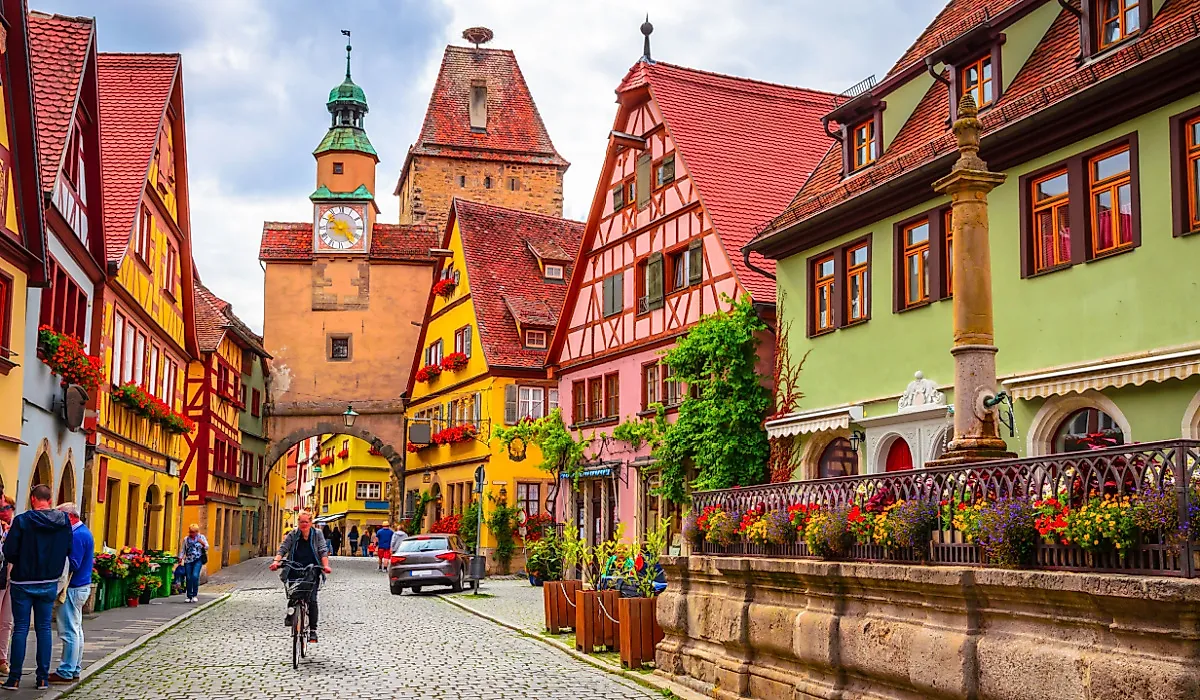
Rothenburg ob der Tauber is one of the best-preserved medieval walled towns in Germany and the most famous stop on the Romantic Road, a signed tourist route through southern Germany that links historic towns between Würzburg and Füssen. The town is encircled by its original 14th-century wall, which visitors can walk in sections for over two kilometres. Käthe Wohlfahrt's Christmas Village on Herrngasse is one of the largest year-round Christmas shops in the world, with multiple connected buildings of ornaments, nutcrackers, and Bavarian Christmas goods.
The Mittelalterliches Kriminalmuseum (Medieval Crime Museum) covers 1,000 years of European legal history with some 50,000 artifacts on display, including shackles, punishment masks, and early torture devices. Visitors should note that the famous "Iron Maiden of Nuremberg," often displayed as a medieval torture device, is now generally regarded by historians as an 18th- or 19th-century invention rather than an authentic medieval object. The Rathausturm (Town Hall Tower) requires climbing 220 steps but rewards with panoramic views of the town and surrounding Tauber Valley.
Lindau

For a distinctly different German small-town experience, Lindau sits on a small Bavarian island in Lake Constance (Bodensee in German), at the meeting point of Germany, Austria, and Switzerland. The town's architecture blends Baroque, medieval, and Mediterranean-influenced styles, reflecting both its Swabian heritage and its long history of Lake Constance trade. Liechtenstein sits a short drive to the east at the head of the lake region.
Lindau Harbour features a 33-metre-tall lighthouse (the "Neuer Leuchtturm") on one side of the entrance and a six-metre-tall Bavarian lion statue on the other, guarding the only fully Bavarian harbour on the lake. The harbour was expanded to its current form in 1856 and is one of the most photographed on Lake Constance; the lighthouse can be climbed (139 steps) for views across the lake to Austria and Switzerland. The older Mangturm tower, built in the 12th century, served as the original harbour lighthouse until the modern lighthouse replaced it in 1856. Maximilianstrasse, Lindau's 230-metre-long medieval main street, runs through the heart of the island with preserved Renaissance and Baroque buildings.
Meissen

Once the capital of the Margraviate of Meissen and a significant early centre of Saxon power, Meissen sits on the Elbe River about 25 kilometres northwest of Dresden. The town is globally known as the home of Meissen porcelain: the Meissen Porcelain Manufactory, founded in 1710, was the first European factory to produce true hard-paste porcelain, which had previously only been produced in China. The on-site museum and shop allow visitors to tour the production process and purchase pieces.
Albrechtsburg Castle, completed in the late 1400s, is considered the first castle in Germany built specifically for residential rather than primarily defensive purposes, and is an early example of late-Gothic Saxon architecture. It sits on a hill above the Elbe and now houses exhibits on Saxon history, including augmented-reality and 3D tours. Meissen Cathedral (Dom zu Meissen), begun in 1240, stands on the citadel hill next to the castle and is one of the finest examples of High Gothic architecture in Germany. The cathedral contains Lucas Cranach the Elder's triptych "Mourning of Jesus Christ" (Beweinung Christi), a significant work of early 16th-century Saxon Renaissance art.
Dinkelsbühl

Another walled medieval town on the Romantic Road, Dinkelsbühl sits between Rothenburg ob der Tauber and Nördlingen in the Franconia region of northern Bavaria. The town is celebrated for the annual Kinderzeche (Children's Festival), a ten-day July festival rooted in a local legend from the Thirty Years' War: in 1632, according to the legend, the children of Dinkelsbühl sang to the approaching Swedish general to spare the town from destruction. The festival includes a reenactment of this legend, a grand parade, pageants, traditional Franconian food and beer, and more. Modern Kinderzeche has been held in various forms since the 19th century.
The Haus der Geschichte (House of History) in the Stone House (also known as the Old Town Hall) is an interactive museum covering over 800 years of Dinkelsbühl history. The Wednesday and Saturday farmers' market (8 AM to 12 PM) sets up in front of St. Georg's Church, with fresh produce, flowers, and baked goods from local producers.
Eight German Towns, Eight Stories
From Quedlinburg's UNESCO-listed thousand-year market square to Meissen's birthplace of European porcelain to Dinkelsbühl's ten-day Kinderzeche festival, each of these towns tells a specific chapter of German history through a specific architectural and cultural identity. Walking their streets is closer to browsing a living archive than visiting a museum, and that balance of preserved character with genuine community life is what makes small-town Germany worth the trip.