The 10 Can't-Miss Towns In Wales
Wales is home to four UNESCO World Heritage Sites, three national parks, and around 600 castles. Most of that heritage sits in towns rather than cities. The ten below cover harbor communities and mountain destinations, with steam railways linking many of them. Each pairs a signature attraction with a wider set of reasons to extend the visit beyond an afternoon. Together they prove the best of Wales is discovered one town at a time.
Tenby

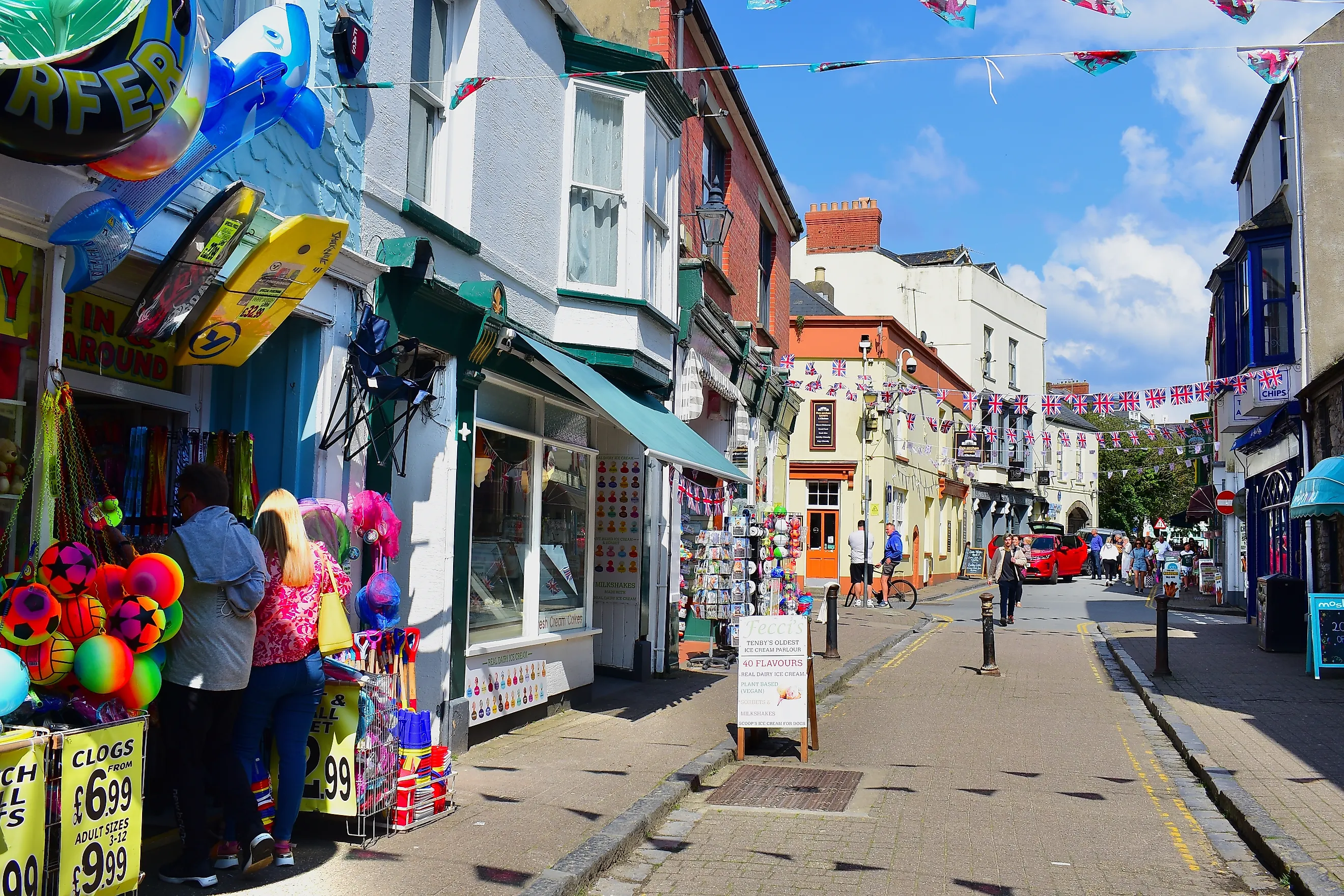
Tenby is a walled seaside town on the South Pembrokeshire coast, with a community population of 4,696 at the 2011 census. Its pastel-painted Georgian harbor terraces have become one of Wales's most recognizable images. The medieval town walls, built in the 13th century and reinforced by Jasper Tudor in the 1450s, still ring the older streets. The principal entrance into the old town remains the Five Arches gatehouse. Three beaches frame the headland: North Beach and Castle Beach to one side, and the longer South Beach (3 km of pale sand) stretching toward Penally to the other. From the harbor in summer, regular boats cross 4 km of water to Caldey Island, where a small community of Cistercian monks has lived since 1929 and still produces shortbread, chocolate, and perfume sold across the UK. The connection runs deeper into Welsh history at St Mary's Church on Tudor Square. The largest medieval parish church in Wales holds the tomb of Thomas White, the merchant who hid Henry Tudor in his cellar in 1471 before the future Henry VII fled to Brittany.
Conwy

Conwy is the obvious anchor for visitors heading anywhere in the north of the country, a walled medieval town of 14,753 residents (community, 2011 census) on the estuary of the River Conwy. Edward I commissioned Conwy Castle in the 1280s as one of four Welsh strongholds in his "iron ring," and the eight drum towers have dominated the skyline ever since. The climb to the battlements opens up views back across the rooftops to the Snowdonia foothills. The town walls, also 13th-century and included in the same UNESCO inscription, still surround the old core for roughly 1.3 km. Down on the quay, the Smallest House in Great Britain measures just 1.8 by 3 meters. The cottage operated as a residence until 1900, when the council found its 6-foot-3-inch-tall final tenant to be living in unsanitary conditions. A short walk inland, Plas Mawr (1585) is the best-preserved Elizabethan town house in Britain and still contains its original intricate lime-plaster ceilings.
Hay-on-Wye

Hay-on-Wye, a market town of 1,675 (community, 2021 census) on the border of Wales and England, has been the "town of books" since 1961. That year, the bookseller Richard Booth opened the first secondhand shop in what is now a town with more than 20 bookshops. Booth declared Hay an independent kingdom on April Fool's Day 1977 in a publicity stunt that drew international press. He installed himself as king, sold honorary titles, and the joke has outlived him as part of the town's identity. The Hay Festival of Literature & Arts, held over the last week of May since 1988, brings around 250,000 visitors and a roster of writers that has included former US presidents and Nobel laureates. The 12th-century Hay Castle, partially destroyed and rebuilt several times over the past 900 years, reopened in May 2022 after a £5.5 million restoration. The castle now houses exhibition galleries, a tower viewpoint, and a secondhand bookshop in its central courtyard. Outside town, the Wye Valley and the Black Mountains of Bannau Brycheiniog National Park provide a network of riverside walks and bike routes within minutes.
Caernarfon

Caernarfon is a royal town and former Roman fort site at the southwest entrance of the Menai Strait, with a population of 9,852 (2011 census, including Caeathro). The Caernarfon catchment is one of the strongest Welsh-language areas in the country, with 85.3% of residents recorded as Welsh speakers in the 2021 census. Caernarfon Castle, begun in 1283 as another of Edward I's Welsh strongholds, was inscribed on UNESCO's World Heritage list in 1986 and has hosted the investiture of two Princes of Wales, including the future Edward VIII in 1911 and Charles in 1969. The polygonal towers and banded stonework, modeled on the walls of Constantinople, set this castle apart from the others in the chain. The Welsh Highland Railway departs from the platform directly beside the castle for the 40 km narrow-gauge run through Eryri (Snowdonia) to Porthmadog, with steam services from April through October. The Roman fort of Segontium, on the hill above the town, was occupied by Roman troops between around 77 CE and 394 CE, and the partial walls and bath ruins remain free to visit.
Aberystwyth

Aberystwyth is a university town and seaside resort on the Cardigan Bay coast of mid-Wales, with a 2021 population of 14,640. During the academic year, nearly 8,000 Aberystwyth University students make up a substantial portion of the town's year-round daytime population. The town centers on a long curved Victorian promenade that links the ruins of the 13th-century Aberystwyth Castle at the south end to Constitution Hill at the north. From the foot of Constitution Hill, the Aberystwyth Cliff Railway has carried visitors to the summit since 1 August 1896. At 237 meters in length, it remains the longest electric funicular cliff railway in Britain. At the top, a Victorian camera obscura displays a live projected view across Cardigan Bay and 26 inland mountain peaks. Heading inland from the main station, the Vale of Rheidol Railway has run continuously since 1902, climbing 19 km in narrow-gauge steam through the Rheidol Gorge to Devil's Bridge, where three stacked stone bridges (the lowest dating to roughly 1075 to 1200) span the wooded ravine. The National Library of Wales, on a hilltop above the campus, holds the country's most significant manuscripts and the oldest existing copy of the Mabinogion.
Beaumaris

Beaumaris is a Tudor town (2021 community population 1,121) at the eastern entrance to the Menai Strait on the Isle of Anglesey. The views back across the water to the peaks of Eryri are among the most photographed in the north of the country. Beaumaris Castle, the last and most technically refined of Edward I's Welsh strongholds, was begun in 1295 to a concentric design by James of St George. It was never fully completed. It remains a UNESCO World Heritage Site and a textbook example of the symmetrical castle plan. Castle Street runs straight between the castle and the pier, lined with whitewashed Georgian buildings that include the Old Courthouse (1614) and the Tudor-built Bull's Head Inn, where Charles Dickens is reported to have once stayed. The pier itself extends 174 meters into the strait and dates from 1846. From its end, local operators run wildlife cruises out to Puffin Island and the strait waters where bottlenose dolphins and harbor porpoises are reliably sighted.
Llandudno

Llandudno is the largest seaside resort in Wales, a Victorian planned town of 19,700 residents (community, 2021 census) laid out in the 1850s between two limestone headlands. The crescent-shaped North Shore promenade extends for over 3 km along the bay. Llandudno Pier (built 1878, and at around 700 meters the longest in Wales) projects from the eastern end, still lined with shops, a fortune teller, and a small amusement arcade, much as it would have been in the 1890s. The Great Orme Tramway, opened on 31 July 1902, is Britain's only cable-hauled tramway on a public road, and it climbs 1,500 meters between Victoria Station in Church Walks and the summit station at 207 meters above sea level. The Great Orme summit itself is a Country Park and Nature Reserve, home to a herd of feral Kashmiri goats descended from a Victorian gift. The Bronze Age copper mines on its southern slope have produced more than 2,500 hammer stones since active excavation began in the 1980s.
Llangollen

Llangollen is a market town of 3,603 (community, 2021 census) on the steep banks of the River Dee in the Berwyn foothills of Denbighshire. It has been one of the busiest cultural and outdoor destinations in North Wales since the railway reached it in 1865. The Llangollen International Musical Eisteddfod, held every July since 1947, brings choirs, dancers, and folk musicians from around 50 countries into a permanent purpose-built venue beside the river. A 19-year-old Luciano Pavarotti won first prize here in 1955 with his father's Chorus Rossini of Modena, an experience he later credited with launching his singing career. He returned as a global star in 1995 for a sold-out concert. Llangollen Wharf, on the canal in the town center, offers horse-drawn narrowboat trips that have run for over 100 years and motorized trips out to the Pontcysyllte Aqueduct, a UNESCO World Heritage Site since 2009 that carries the canal across the Dee in a cast-iron trough 38 meters above the river. Between the wharf and the aqueduct, the Llangollen Railway runs restored steam services for 10 miles up the Dee Valley to Corwen.
Dolgellau

Dolgellau is the gateway town to Cader Idris in southern Eryri, a market town of 2,602 (2021 census) at the confluence of the River Wnion with the Mawddach. It is built almost entirely from local dark-gray dolerite. That single building material gives Eldon Square and the surrounding streets a uniform, low-roofed character unusual in Wales. Cader Idris itself, the 893-meter peak that dominates the southern skyline, has three main marked routes to the summit, with the Pony Path from Ty Nant on the southwest side covering the most gradual gradient. The Mawddach Trail, a 14.5 km flat path along the converted Ruabon-Barmouth railway bed, follows the estuary west between Dolgellau and Barmouth, passing through the RSPB nature reserve at Penmaenpool. The town was also the last Quaker stronghold in Wales before the 1696 mass emigration to Pennsylvania. The Quaker exhibition at Ty Meirion explains how Dolgellau Friends shaped the early development of Philadelphia and the surrounding county that still bears the Welsh name "Merionedd."
Harlech

Harlech, a seaside town of 1,263 (community, 2021 census) in southern Eryri facing Tremadog Bay, is best known for the 13th-century clifftop fortress that gives the town its name. Harlech Castle, the fourth of Edward I's UNESCO-listed strongholds, sits on a 200-foot crag that originally rose directly from the sea. A 108-step "Way from the Sea" leads down the cliff from the castle, ending at what was once the water gate. That stairway kept the garrison resupplied by ship during the siege, most famously during the seven-year defense of 1461 to 1468 in the Wars of the Roses, the longest known siege in the history of the British Isles. The unofficial Welsh anthem "Men of Harlech" traditionally describes that defense. The dunes and kilometers of unbroken sand at Harlech Beach are part of the Morfa Harlech National Nature Reserve. Ffordd Pen Llech, the steep cobbled street that climbs between the lower town and the castle plateau, briefly held the Guinness World Record for the steepest residential street on earth (37.45%), awarded in July 2019 and reassigned to a Dunedin street in April 2020 after the measurement method was revised.
Planning a Trip
The ten towns cluster usefully for anyone building a route. Beaumaris, Caernarfon, Conwy, Llandudno, and Llangollen anchor the north coast and Eryri foothills within an hour's drive of one another, and any two or three pair into a long weekend along the A55. Dolgellau and Harlech sit further south in the same national park and combine into a separate Mawddach-and-Tremadog loop. Aberystwyth covers the Cardigan Bay coast in mid-Wales and connects east to Hay-on-Wye through the Cambrian Mountains in about two hours. Tenby stands apart at the southwest corner of the country, closer to Cardiff than to any of the others, and rewards a separate trip built around the Pembrokeshire Coast Path. Castle entries (Conwy, Caernarfon, Beaumaris, and Harlech are all Cadw sites) come bundled in an Explorer Pass, and the major heritage railways at Caernarfon, Aberystwyth, and Llangollen run on schedules that the local TrawsCymru bus network connects to without needing a hire car.