13 Offbeat Georgia Towns To Visit In 2026
Georgia has a weird streak, and it's wonderful. Covington doubles as Mystic Falls, the vampire capital of TV. Helen rebuilt itself as a Bavarian alpine village, beer halls and all. Dahlonega hides gold-rush tunnels under its streets. Warm Springs keeps FDR's cottage just as he left it in 1945. Senoia sells zombie props from The Walking Dead. This is the Georgia beyond the guidebooks. Strange, surprising, and worth the detour. Here are 13 offbeat towns to put on your 2026 list.
Juliette

The 1927 building now occupied by the Whistle Stop Cafe still resembles the rural general store used during the filming of Fried Green Tomatoes. Plates of fried green tomatoes and chopped barbecue continue to draw drivers off of Highway 87, especially during weekend lunch hours. Behind the cafe, the Ocmulgee River moves past exposed shoals and wooded banks that separate the strip from the surrounding countryside. A short walk away, several early twentieth-century storefronts along McCrackin Street now house pottery studios, antique dealers, and small honey vendors operating out of narrow timber-frame buildings.
Madison

Madison escaped much of the destruction that accompanied Sherman’s March through Georgia, leaving behind one of the state’s largest concentrations of antebellum homes and nineteenth-century streetscapes. Broad avenues near the town center pass rows of towering Greek Revival mansions with fluted columns, iron balconies, and deep front porches that survived while many neighboring communities burned. Heritage Hall, completed in 1811, opens several of its formal rooms to guided tours beneath plaster ceilings and massive chandeliers tied to the town’s cotton-era wealth. Close by, the Rogers House and other preserved residences continue to line streets shaded by mature oak trees, only a short walk from the courthouse square.
Senoia

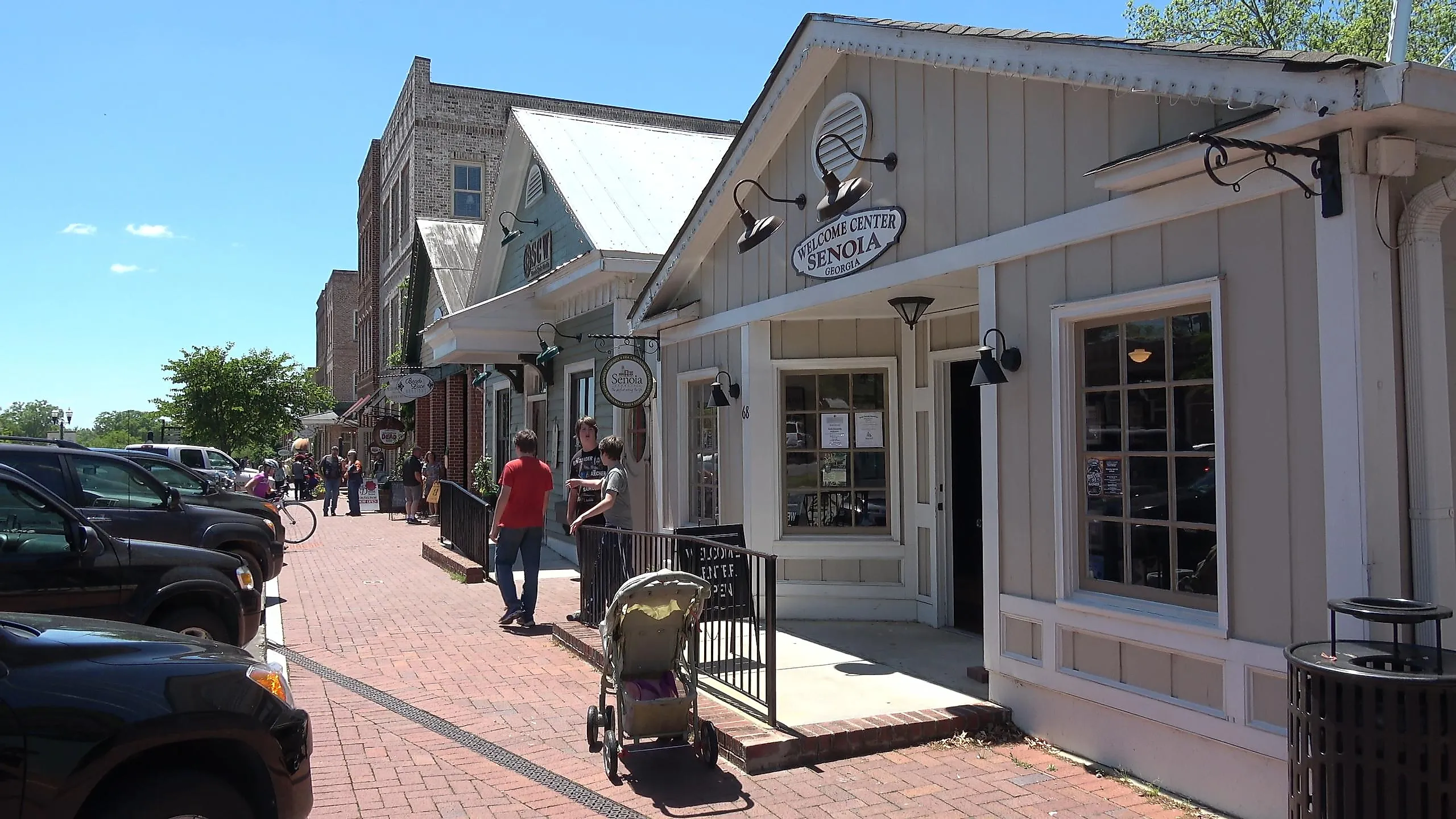
Woodbury Shoppe fills its shelves with Walking Dead props, production photos, replica weapons, and signed memorabilia tied to the television series filmed throughout town for more than a decade. Several other storefronts appeared directly in the fictional town of Woodbury, including brick facades and alleyways recognizable from recurring scenes in the show.

Away from the filming locations, the Senoia Area Historical Society Museum preserves agricultural equipment, household items, and handwritten records inside a restored nineteenth-century home near Main Street. A few blocks south, walking paths circle the twin lakes at Marimac Lakes Park beneath tall pine stands and wooden fishing piers.
Helen

Helen’s commercial district was rebuilt in 1969 around a strict Bavarian alpine theme, replacing the former logging town with steep-gabled storefronts and half-timbered facades beside the Chattahoochee River. German flags hang above Edelweiss Strasse, while bakeries, beer halls, and sausage restaurants operate beneath decorative balconies modeled after southern German mountain villages. During Helen Oktoberfest, the Festhalle fills with brass bands, communal tables, traditional dancing, and imported German beer across several weeks of celebrations rather than a single weekend. The Arts & Heritage Center documents the town’s unusual reinvention through exhibits on the 1969 redesign alongside regional folk art, pottery, and photographs showing Helen before its Bavarian conversion.
Plains

Much of Plains’ identity centers on the legacy of President Jimmy Carter as well as the peanut farming economy that shaped much of rural southwest Georgia during the twentieth century. Jimmy Carter National Historical Park preserves the former Plains High School attended by the thirty-ninth president, including original classrooms, basketball courts, and handwritten school materials connected to his early life in Sumter County. Nearby, the restored Plains Depot still displays campaign signs, photographs, and election memorabilia from the 1976 presidential campaign, when the small railroad station briefly operated as Carter’s headquarters during his rise to the White House. Just down the block, Plain Peanuts stacks shelves with boiled peanuts, peanut brittle, roasted pecans, and locally produced peanut butter tied directly to the agricultural industry that long dominated the surrounding farmland.
Dahlonega

Underground tunnels cut through solid rock beneath Dahlonega, where the first major American gold rush began in 1828. At Consolidated Gold Mine, guided tours move through narrow shafts blasted with hand drills and black powder, passing quartz veins and timber supports darkened by groundwater seepage. Gold panning stations at the entrance still operate in running troughs modeled after those used by early prospectors. A few blocks away, the Dahlonega Gold Museum displays locally minted coins and nuggets tied to the early branch mint that briefly operated in town.
Warm Springs

President Franklin D. Roosevelt spent years traveling to Warm Springs for hydrotherapy treatments, and the six-room cottage known as the Little White House still contains many of the furnishings left inside at the time of his death in 1945. His customized Ford convertible sits inside an adjacent museum gallery beside the unfinished portrait he was viewing shortly before he collapsed.
Located nearby, naturally heated mineral water continues to flow through the historic pools first promoted for therapeutic bathing during the early twentieth century. At the Warm Springs Regional Fisheries Center, public aquariums and outdoor ponds display endangered lake sturgeon and other freshwater species native to southeastern river systems.
Washington

Washington’s historic district contains several notable physical links to Georgia’s Confederate leadership. Robert Toombs House State Historic Site preserves the residence of the former Confederate Secretary of State beneath wide porches and mature oak trees, with interior rooms displaying original furnishings, political correspondence, and personal belongings tied to secession-era politics. Nearby, the Washington-Wilkes Historical Museum occupies a large antebellum home filled with Civil War weapons, military uniforms, and documents connected to both Confederate officers and local militia units active during the nineteenth century. The red-brick Mary Willis Library adds another unusual landmark to the town center with stained glass windows, carved wood interiors, and steep rooflines that stand apart from the surrounding courthouse square.
Covington

The clock tower of the Newton County Courthouse rises above a downtown district that has become deeply tied to supernatural television culture through years of filming for The Vampire Diaries, The Originals, and Legacies. Storefronts around Covington Square still display references to fictional businesses and characters from the series, while guided tours stop at recognizable alleys and restaurant exteriors repeatedly used as stand-ins for the fictional town of Mystic Falls. Television memorabilia fills several shops in the downtown area, including replica props, themed merchandise, and signed cast photographs collected during more than a decade of production activity.
Filming continues to shape the town long after the series ended. The Mystic Grill operates as a functioning restaurant modeled after the fictional gathering place from the show, drawing fans beneath exposed brick walls covered with production photos and cast signatures. Seasonal fan conventions and cast appearances regularly bring large crowds back to the square, where many of the primary filming locations remain intact.
Blue Ridge

Passengers board the Blue Ridge Scenic Railway inside a restored 1906 depot before vintage locomotives begin following the Toccoa River toward the twin border towns of McCaysville, Georgia, and Copperhill, Tennessee. The route passes old rail bridges, dense hardwood forest, and stretches of water running directly beside the tracks within the southern reaches of the Chattahoochee National Forest. Seasonal rides include fall foliage excursions and holiday-themed trains using restored passenger cars, while railroad cabooses, freight equipment, and historic signals scattered around downtown reflect the town’s long connection to the Marietta and North Georgia Railroad. The Mineral Springs Walking Trail leads to a natural spring once promoted for its mineral content during north Georgia’s early resort era.
Tallulah Falls

Tallulah Gorge cuts nearly one thousand feet into the northeast Georgia mountains, creating one of the deepest canyons east of the Mississippi River. Suspension bridges cross above the Tallulah River while steep staircases descend toward overlooks facing Hurricane Falls and the sheer rock walls surrounding the gorge.

Inside the Jane Hurt Yarn Interpretive Center, exhibits explain the rare plant species and hydroelectric history tied to the canyon. The nearby Tallulah Falls School spreads across a wooded hillside with stone academic buildings constructed during the early twentieth century.
St. Marys

St. Marys has become closely tied to the submarine fleet stationed at Naval Submarine Base Kings Bay, one of the largest submarine facilities in the United States. Inside the St. Marys Submarine Museum, glass cases display naval uniforms, sonar equipment, model submarines, torpedoes, diving gear, and cruise books documenting decades of Atlantic fleet operations. Several exhibits focus specifically on ballistic missile submarines based at Kings Bay, including control-room instruments, periscopes, and artifacts donated by former crew members. Along the waterfront, submarine imagery appears throughout town on murals, memorials, and naval displays facing Cumberland Sound, while ferries departing the municipal dock cross toward Cumberland Island National Seashore past the same coastal waters regularly used by naval vessels entering and leaving the base.
Cave Spring

Cold spring water pours directly from the limestone cave beneath Cave Spring Rolater Park at a rate estimated at two million gallons per day. Walking through the cavern entrance alongside mineral-stained rock walls leads toward the broad spring-fed waters of Rolater Lake, a hotspot for local swimming for generations. The grounds surrounding the spring include historic school buildings associated with Hearn Academy and the Georgia School for the Deaf, whose Fannin Hall later served as a hospital during the Civil War. Little Cedar Creek carries the spring water away from town through a narrow channel bordered by stone retaining walls and heavy tree cover.
When seeking a unique experience in Georgia, these towns have you covered. Whether aiming for film history and appropriately themed eats in Juliette, or unique geography through gushing springs and gaping gorges in towns like Cave Spring and Tallulah Falls, Georgia has something for everyone. Every town has its own unique character, quirks, and theme. Have a pint and brats in true Bavarian style in Helen, then delve through original gold-rush mine shafts in Dahlonega. Georgia’s offbeat towns offer a diverse set of experiences that you won’t soon forget.