12 Of The Most Captivating Small Towns In Tasmania
12 towns across Tasmania hold stories that predate settlement from Europe and outlast the convict era. Aboriginal nations managed this island for thousands of years before ships from the United Kingdom arrived in 1803. The colony, originally called Van Diemen's Land after a Dutch governor, became a prison for tens of thousands of transported convicts. This layered history of ancient landscapes, penal architecture, and modern reinvention still defines the smallest communities. Richmond guards the oldest stone bridge in Australia. Stanley rises from the sea on a volcanic plug. Sheffield covers its walls with murals. Each town offers a different window into the island's character, from Georgian streetscapes to stripped mining hills and orange lichen boulders. These are some of the most captivating small towns in Tasmania.
Richmond

Georgian cottages line the streets of Richmond, a village in the Coal River Valley. The Richmond Bridge still carries traffic across the river on sandstone arches built by convict labor between 1823 and 1825, making it the oldest stone bridge in Australia. Nearby, the Richmond Gaol, built in the same year and never expanded, is the oldest intact colonial prison in the country, with solitary confinement cells and the original flogging yard open to visitors.
Old Hobart Town recreates 1820s Hobart, the capital of Tasmania, in miniature inside a historic cottage, with 60 tiny buildings and costumed figures tracing the colony's first decades. The model village includes the original Government House, the wharves, and the customs house as they appeared when the settlement was barely 20 years old, giving visitors a scaled view of the colonial port town. St. John's Catholic Church, dating to 1836, is the oldest remaining Catholic church in Australia, with its stone walls and wooden pews preserved against the valley landscape. The church sits on a slight rise above the main street, and its simple Georgian facade has remained largely unchanged since convict stonemasons laid the foundations.
Stanley

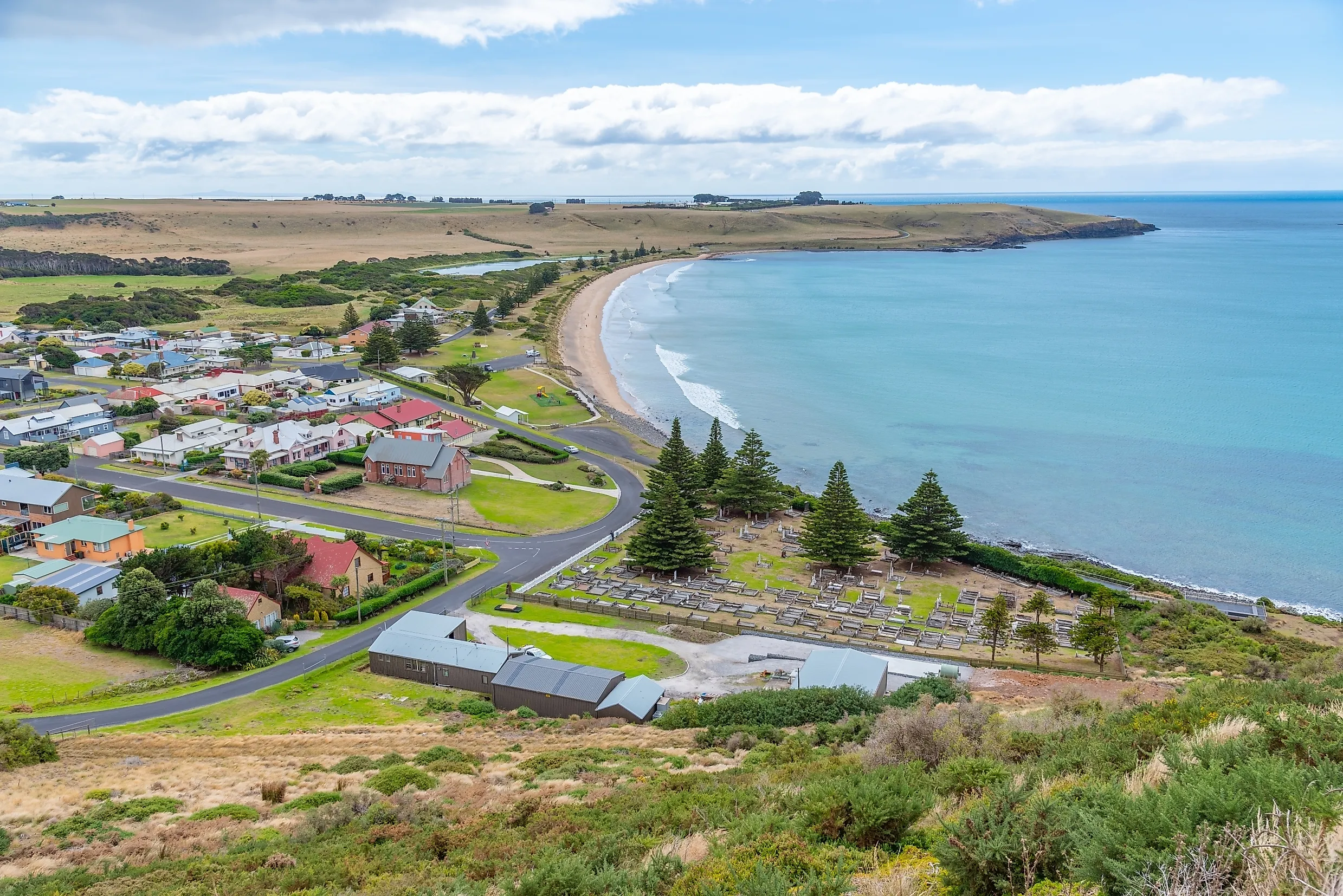
On Tasmania's northwest coast, Stanley sits beneath the Nut, a 143-meter volcanic plug that rises from the sea. The rock formation dominates the approach from kilometers away, visible long before the village comes into view. A chairlift climbs the face, or visitors can walk the steep track to the summit for views across the Bass Strait to the Victorian coast.
Below the rock, Godfrey's Beach stretches for kilometers with a penguin viewing platform where little penguins return to burrows at dusk. Highfield Historic Site, an 1830s homestead and outbuildings on the headland, preserves the colonial estate built by the Van Diemen's Land Company, with views across the strait and interpretive displays on the region's early European history. The village center gathers around the waterfront with 19th-century cottages, craft shops, and Hursey Seafoods, a restaurant that serves flathead straight from the boats with waterfront apartments above the kitchen.
Strahan

Rainforest meets the Southern Ocean at Strahan, where the Gordon River empties into Macquarie Harbour, a body of water six times the size of Sydney Harbour. Wilderness cruises depart daily into the Franklin-Gordon Wild Rivers National Park, passing through temperate rainforest to the Franklin River junction. This landscape galvanized Australia's environmental movement in the 1980s, when the proposed Franklin Dam sparked a blockade that led to the formation of the Greens political party and a landmark High Court decision.
The West Coast Wilderness Railway runs historic steam trains from Queenstown to Strahan, climbing through rainforest and crossing the King River on iron bridges built in the 1890s. Ocean Beach, a 40-kilometer stretch of wild surf, lies a short drive south and is one of the longest beaches in Tasmania. The harbor, the railway, and the beach create a community where wilderness and industrial heritage meet on the edge of the Southern Ocean.
Port Arthur

Between 1830 and 1877, the Tasman Peninsula held the most notorious convict settlement in Van Diemen's Land. Port Arthur operated as a prison for repeat offenders, and today the UNESCO World Heritage property includes more than 30 buildings and ruins: the penitentiary, the church, the prison itself, and the Isle of the Dead cemetery. Entry tickets remain valid for two days, allowing visitors to explore at the pace necessary for this site.
The Tasman Peninsula coastline surrounds the settlement with natural formations, including Tasman Arch, Devil's Kitchen, and the Blowhole, where the sea has carved tunnels and caverns into the cliffs. Please note that there are planned infrastructure improvements occurring at Tasman Arch and Devil's Kitchen and will be closed from April 15 to July 31, 2026. Coal Mines Historic Site, 20 kilometers north, preserves a secondary convict station where repeat offenders worked underground, extending the penal story beyond the main settlement. Lantern-lit ghost tours depart at dusk for walks through the historic grounds, adding a different layer to the daylight history.
Sheffield

Mount Roland rises 1,234 meters above Sheffield, but the mountain competes for attention with more than 40 murals that cover the buildings of this northern Tasmanian community. The paintings depict local history, fantasy scenes, and Tasmanian wildlife on shop walls, barns, and water tanks, transforming the village into an open-air gallery. November 1-7, 2026, the International Mural Fest brings artists from around the world to compete, creating new works from a single poem over the course of a week.
Lake Barrington, a world championship rowing course, sits nearby with waterskiing, canoeing, and fishing, adding an athletic dimension to the artistic atmosphere. The mountain, the lake, and the painted walls create a town where outdoor activity and creative expression share the same streets.
Deloraine

A four-panel tapestry of 20 meters long hangs in Deloraine, stitched by 300 volunteers over 10 years to tell the story of the Great Western Tiers escarpment that rises behind the town. The Yarns Artwork in Silk occupies a dedicated gallery and depicts the history of the mountain range, from Aboriginal presence to European settlement, in panels of hand-dyed fabric.
The Great Western Tiers themselves provide walking trails to waterfalls and lookouts that start at the edge of the settlement. Liffey Falls cascades through rainforest 40 minutes from town, accessible by a round-trip walk that passes giant tree ferns and myrtle beech. Marakoopa Caves, 40 minutes away, are limestone chambers with glow worms and stalactites, extending the natural landscape beneath the ground. Deloraine serves as a gateway to both the high country and the region's underground world.
St Helens

St Helens is the gateway to the Bay of Fires, whose southern end is at Binalong Bay, where orange lichen covers granite boulders along Tasmania’s north-east coast. The color contrast between the rock and the blue water has made the coastline famous, and the town functions as the gateway with boat ramps, fishing charters, and a fleet that supplies local restaurants like the Wharf Bar & Kitchen with crayfish and flathead.
St Helens Point also has a long beach with surfing breaks, while Peron Dunes rises behind the sand with slopes popular for sandboarding. The St Helens Conservation Area protects the coastal heath and the offshore islands that dot the water, maintaining the landscape that draws visitors to the bay. The town is a commercial hub for the east coast, with the services and supplies that make the surrounding beaches accessible.
Bicheno

Fairy penguins waddle ashore at dusk in Bicheno, and nightly guided tours depart from Bicheno Penguin Tours’ base in the town centre before a short bus ride to a private rookery. The walks offer one of Tasmania's most accessible wildlife experiences, with the birds crossing the sand in groups that number in the hundreds from September to January, the peak breeding season.
The Bicheno Blowhole shoots spray into the air when the Tasman Sea swell hits the granite coast, and the sound carries across the rocks. East Coast Nature World, seven kilometers north, houses Tasmanian devils, kangaroos, and quolls in a wildlife park with breeding programs. Governor Island Marine Reserve sits offshore, accessible by glass-bottom boat or diving to see kelp forests and sponges in the clear water. The town combines wildlife, marine environment, and coastal geology in a compact setting.
Evandale

High-wheel bicycles race through the Georgian streets of Evandale each February, when the International Penny Farthing Championships bring competitors from around the world to this northern Tasmanian village. The racers pedal the antique bicycles through the village center, past buildings from 1809 that form one of the best-preserved historic streetscapes in Australia.
The Sunday market fills Falls Park each week with local crafts, produce, and antiques, creating a gathering that has run for decades.” The Glover Art Prize, one of Australia's richest landscape art competitions, exhibits finalists in the town each March, bringing artists and collectors to the Georgian setting. The combination of preserved architecture, weekly markets, and annual competitions creates a town where heritage and community energy remain inseparable.
Ross

Temptation, Salvation, Damnation, and Recreation meet at the crossroads in Ross, where the pub, church, gaol, and town hall have defined the village since the 1830s. The Four Corners of Ross marks this layout, a deliberate colonial design that organized the town around moral categories.
The Ross Bridge carries traffic across the Macquarie River on sandstone arches carved in 1836 by convict stonemasons with 186 intricate figures of animals, birds, and Celtic deities. The Tasmanian Wool Centre occupies a heritage building and traces the region's merino industry from the 1820s to the present. The Female Factory, a ruin on the edge of town, preserves the site where one-fifth of all convict women sent to Van Diemen's Land lived and worked. The bridge, the crossroads, and the factory together tell the story of a penal town that became a wool town.
Derby

Tin mining built Derby; mountain biking transformed it. The Blue Derby trail network now runs more than 100 kilometres through the eucalyptus forest that surrounds this northeast Tasmanian community, with trails rated among the best in the world. The routes weave through fern gullies and across the Cascade River with purpose-built features for every skill.
The Mount Paris Dam, a concrete arch structure from the 1930s, now functions as a trail feature and swimming hole. The town's tin mining heritage survives in interpretive signs and old mine sites scattered through the forest, maintaining the connection to the industry that built the settlement. The transition from mining outpost to outdoor recreation hub has happened without losing the town's historic scale.
Queenstown

Copper ore trains once climbed from Queenstown through the rainforest to Strahan on a railway that still runs today. The West Coast Wilderness Railway follows the 1890s route across 42 bridges and through hand-carved tunnels, carrying passengers on the same tracks that transported ore from the mines.
The Iron Blow lookout reveals the vast open-cut mine that created the town's distinctive stripped hills, a landscape slowly regenerating after decades of acid rain. Lake Burbury, a hydroelectric reservoir, provides fishing and kayaking just a short drive from the town center. The town maintains the character of a working-class mining community, with the railway station, the mine lookout, and the surrounding wilderness all defining a place where industry and landscape have always been intertwined.
Captivating Towns of Tasmania
Tasmania's small towns carry the island's history in concentrated form. Richmond and Ross preserve the convict stonework that built the colony. Stanley and Strahan face the wild coasts where the Bass Strait and the Southern Ocean meet the land. Sheffield and Evandale fill their streets with murals and Georgian architecture, while Derby and Queenstown have reinvented mining communities as trailheads and railway terminals. St Helens and Bicheno line the east coast with penguins, blowholes, and orage boulders. Each town offers a different combination of landscape, heritage, and community, and each one proves that Tasmania's character captivates folks near and far.