8 Idyllic Small Towns In Michigan To Visit In 2026
The most idyllic towns in Michigan reward a slow afternoon more than a full itinerary. In Petoskey, you can browse gaslit Victorian shops and then watch the sun drop over Little Traverse Bay. In Traverse City, cherry orchards and sand beaches sit minutes from a walkable downtown. In Charlevoix, sailboats drift past the curved stone cottages that line the water. In Marshall, whole blocks of 1800s architecture look frozen a century back. Here are eight small Michigan towns worth an unhurried visit in 2026.
Marshall

Almost the entire downtown sits inside a National Historic Landmark District, the largest in the country in the small-urban category, with more than 800 buildings ranging across Greek Revival, Gothic Revival, Italianate, and later styles. The National Park Service has called it the best virtual textbook of 19th-century American architecture in the country. The 1860 Honolulu House is the strangest thing on the walk. Abner Pratt built it to mimic the homes he had known as U.S. consul to Hawaii, and he lived in it only about three years before he died in 1863.
The Governor's Mansion Museum tells the story of the capital that never came. James Wright Gordon put up the Greek Revival house in 1839 expecting Marshall to win the vote, and no governor ever lived in it, though Gordon himself went on to serve as the state's third governor. Down the street, the American Museum of Magic holds the largest collection of magic memorabilia in the United States open to the public, including a milk can used by Harry Houdini. Brooks Memorial Fountain anchors the town circle, and on the Fourth of July the crowd around it looks like something from an older America.
Petoskey

Petoskey sits on a bluff over Little Traverse Bay, and its Gaslight District keeps more than 100 preserved 19th- and early-20th-century buildings under old-style street lamps. Ernest Hemingway spent the summers of his boyhood and early adulthood on nearby Walloon Lake, and he did some of his early writing at the City Park Grill. Regulars still point out his stool, the second from the end of the 32-foot mahogany bar, and the burn marks said to be from his cigars. The building dates to 1875 and has worn several names since.
The bay gave the town its other signature. Beachcombers still hunt the shoreline for Petoskey stones, the fossilized coral that washes up along the water and takes the town's name. Bayfront Park opens straight onto the water for anyone who would rather sit than search. Bear River Valley Recreation Area and the Bubbling Springs preserve add quieter trails a short way inland.
Charlevoix

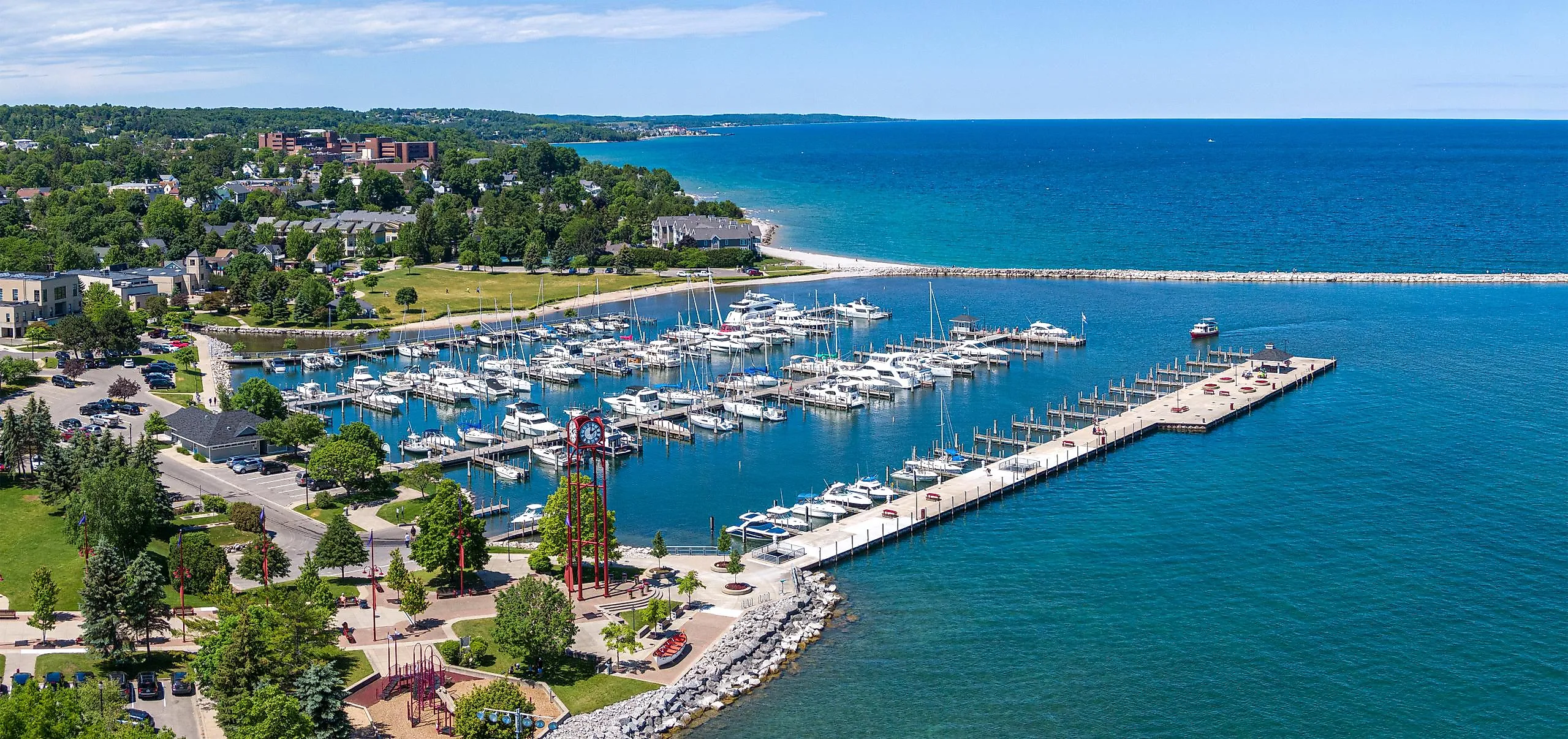
Charlevoix balances on a narrow neck of land between Lake Michigan and Lake Charlevoix, and the whole town is organized around the water passing through it. The US-31 drawbridge over the Pine River channel lifts on a set schedule through the season to let sailboats and yachts move between the big lake and the inland one. Boats wait on both sides while it does. That channel is the reason the town exists in the shape it does.
The other reason is Earl Young, a local builder who spent decades making houses out of glacial boulders and fieldstone. His low, curved "Mushroom Houses" are scattered through the residential streets and draw architecture enthusiasts who walk the neighborhoods to find them. Castle Farms, a stone estate built in 1918 as a working farm, now hosts gardens and events on the edge of town. Down at the water, the Charlevoix South Pier Light marks the channel mouth, and Michigan Beach Park spreads sand along the Lake Michigan side.
Traverse City

Front Street runs a few blocks of brick storefronts down toward Grand Traverse Bay, close enough that the water feels like part of downtown. The City Opera House opened in 1891 and still hosts performances, one of the oldest surviving opera houses in the state. Independent bookstores and restaurants fill the blocks around it, and the region's cherry harvest turns up everywhere, most obviously at the Cherry Republic flagship on Front Street, which sells a couple hundred cherry products under one roof.
The town has grown into one of the better food destinations in the Midwest without losing the harbor that started it. Sleeping Bear Dunes National Lakeshore lies a short drive west for anyone wanting the full scale of the shoreline. Closer in, East Bay's shallow, warm-water beach is the easy choice for an afternoon with kids.
Grand Haven

Grand Haven puts a working lighthouse, a boardwalk, and a walkable downtown in a single line along the water, so you can start at the pier and reach the shops without losing sight of Lake Michigan. The Grand Haven pier light is the classic photograph here, especially near sunset. The city beach and state park sit close enough that an evening walk covers most of them.
After dark in summer the town has its own ritual. The Musical Fountain, built in the 1960s across the Grand River from downtown, runs nightly shows of water and light set to music from Memorial Day through Labor Day, with the audience watching from the boardwalk. Kirby House, a restaurant in a Victorian building from 1873, overlooks the channel and keeps its antique interior intact.
Ludington

Ludington sits at the mouth of the Pere Marquette River, and its harbor still does real work. The S.S. Badger, a 1953 coal-fired car ferry and the last of its kind running in the United States, crosses 60 miles to Manitowoc, Wisconsin, on a roughly four-hour run through the season, and its horn carries across downtown in the morning. The ship earned National Historic Landmark status in 2016. Waterfront Park lines the marina with walking paths and sculpture, and Ludington State Park north of town opens onto dunes, forest trails, and the Big Sable Point Lighthouse.
The town's other institution is sweeter. House of Flavors has made ice cream on-site since the late 1940s and runs a 1950s-style parlor on Ludington Avenue. In 2016 the town set a Guinness record for the longest ice cream dessert, stretching a sundae eight city blocks down the main street for thousands of people to eat.
St. Joseph

St. Joseph has watched over its river mouth for almost two centuries. The town was the site of the second lighthouse ever built on Lake Michigan, put up on the bluff in 1832, and its harbor entrance is still marked today by the twin North Pier lights, a red inner tower and a black-and-white outer one that align to guide boats into the St. Joseph River. You can walk the pier out to them from Tiscornia Park, which also holds a beach and a picnic pavilion where the river meets the lake.
Downtown sits up on the bluff, compact enough that most of a day happens on foot. The Silver Beach Carousel below the bluff opened in 2010 with 48 hand-carved figures and two chariots, a modern ride built to honor the Coney Island-style carousel that spun here in 1910. Six of its white horses are replicas of ones carved by the original master, Charles Carmel. Lions Beach Park and the John and Dede Howard trail keep families and cyclists close to the shore.
Frankenmuth

Frankenmuth is the inland outlier that built its identity out of heritage rather than shoreline. German immigrants settled it in the 1840s, and the half-timbered architecture that runs through downtown is a direct nod to what they left behind. The Cass River gives the town its centerpiece, the Holz-Brucke, a covered wooden bridge finished in 1980 and built the old way with no metal fasteners. At 239 feet it is Michigan's largest covered wooden bridge and the youngest two-lane covered wooden bridge in the world, and people stop mid-span to photograph it.
The food is the other draw, and Zehnder's is the name everyone knows. The restaurant has served family-style fried chicken dinners in town for generations and can seat well over a thousand people at once. The same family behind it commissioned the covered bridge, connecting their properties across the Cass, so the town's two best-known attractions come from the same source.
Eight Towns, Eight Reasons
What ties these places together is less a look than a set of decisions. Marshall preserved a century of architecture by staying still. Ludington kept a coal-fired ship running long after the rest of the country moved on. St. Joseph has maintained its harbor lights since 1832, and Frankenmuth built a hand-joined bridge in 1980 as though the intervening century of engineering had not happened. Petoskey and Charlevoix and Traverse City and Grand Haven each made their peace with the water differently. Visit any one of them in 2026 and the town will tell you, through what it chose to keep, exactly what it thinks is worth keeping.