11 Prettiest Small Towns In The Netherlands
The Netherlands was a self-governing republic in 1588, two centuries before the United States wrote its constitution, and its small towns still carry that long history in their streets. Giethoorn replaced roads with canals, so a boat is the only way to reach many of its front doors. Thorn painted its brick houses white in the 1790s, when families bricked up windows to dodge a French tax on them. Naarden laid out its streets inside a six-pointed star fort that Allied bombers later used as a navigation marker. Veere spent the 16th century as the Dutch port for Scottish wool, and the merchants' houses on its quay still stand. These eleven towns reward a slow visit.
Giethoorn

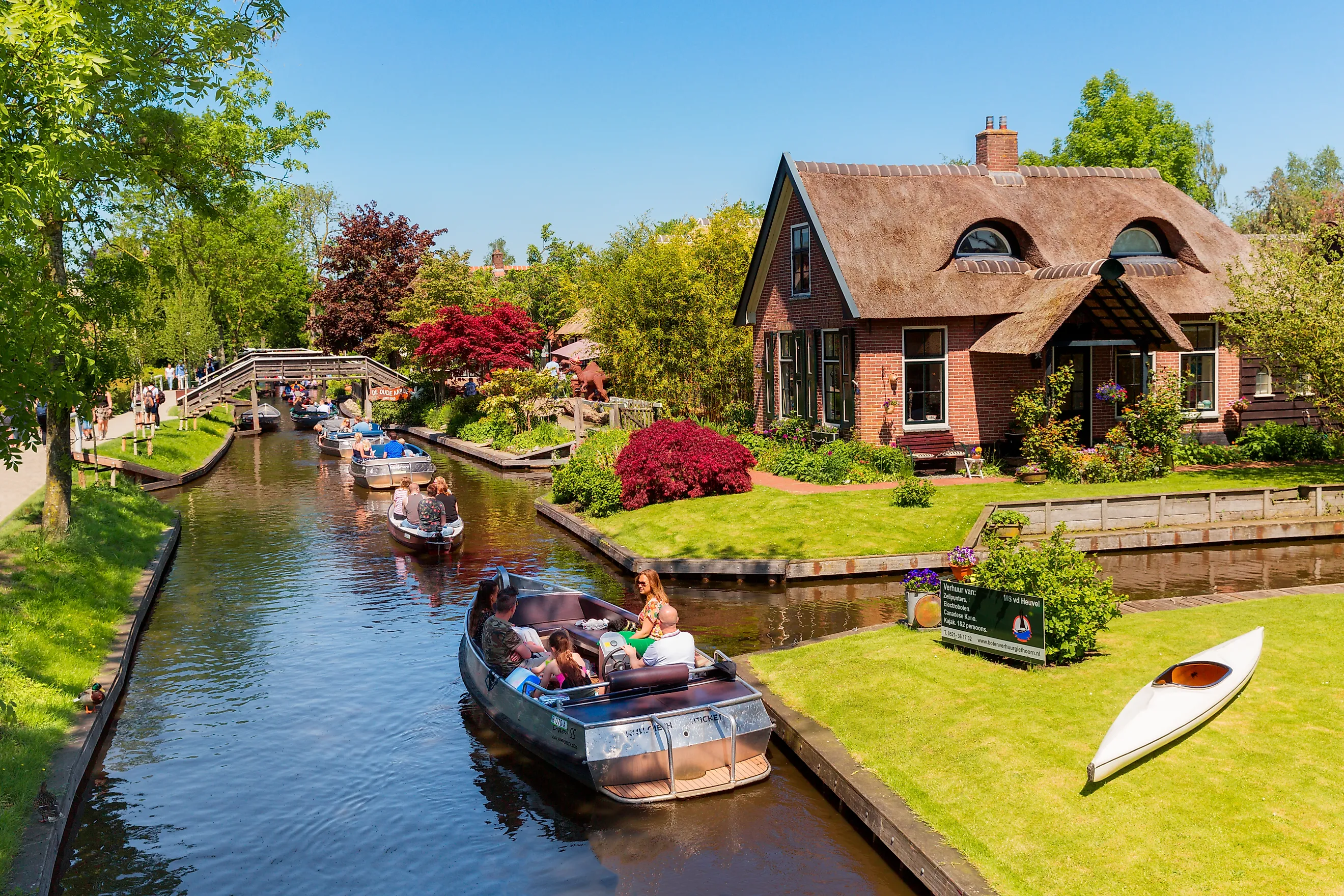
No cars reach the old center of Giethoorn. The village grew up around a canal network dug by medieval peat harvesters, and today footpaths, arched wooden bridges, and the water itself carry all the traffic. Visitors rent a near-silent electric whisper boat, hire a traditional flat-bottomed punt, or join a guided tour to pass the thatched-roof farmhouses and waterside gardens that line the route. The village also keeps three small museums. Het Olde Maat Uus recreates farm life from more than a century ago inside a period farmhouse. De Oude Aarde, the oldest museum in Giethoorn, fills its rooms with gemstones, minerals, and fossils gathered from around the world. The Histomobil rounds out the trio with a collection of vintage cars, carriages, and motorcycles.
Thorn

Almost every building in Thorn is painted white, and the reason is a tax dispute. When the French took over in 1794 and levied a tax based on the number of windows a house had, poorer residents bricked up their openings and whitewashed the brick to hide the patched-over gaps. The result earned the town its name, the "White Pearl of Limburg." For eight centuries before that, Thorn ran itself as a tiny principality governed by a princess-abbess and a chapter of noblewomen, centered on the Gothic Abbey Church that still towers over the rooftops. A walking tour led by a local guide covers a little more than a mile and passes 21 monuments along the way. Museum Thorn adds context through film, historical art, and multimedia displays. For open country, the town sits on the RiverPark Maasvallei, a nature reserve of stream channels, floodplains, and gravel ponds along the Meuse River that draws hikers and cyclists.
Naarden

Seen from above, Naarden forms a six-pointed star. The town gained its city rights in the 14th century, then became a military fortress in the 16th century to guard the eastern approach to Amsterdam. Its distinctive star-shaped design, with bastions, double walls, and gate buildings, took shape across the 16th and 17th centuries and survives largely intact. The Nederlands Vestingmuseum, set inside one of the bastions, explains the defensive works and what daily life was like for the soldiers stationed here. A second museum takes a narrower subject: the Weegschaal Museum traces the history of measuring and weighing and its role in Dutch trade. As in much of the country, a boat tour rounds the moat and offers a fuller look at the fortifications.
Volendam

Locals in Volendam still put on traditional Dutch dress on occasion, which is part of why the village earns its nickname, the "Pearl of the Zuiderzee." It sits about 12 miles northeast of Amsterdam and was founded in the 14th century, building a living first on fishing and later on tourism. The well-kept streets lead down to a harbor promenade lined with shops and cafés, and photography studios along the way let visitors pose for a portrait in classic Dutch costume. The road between Amsterdam and Volendam runs past cheese farms that hand out samples and demonstrate how the wooden clogs long tied to Dutch tradition are made.
Marken

Marken was cut off from the mainland as an island until a causeway connected it in 1957. Its brightly painted wooden houses stand on stilts and raised earthen mounds, a design shaped by centuries of flooding. The Marker Museum, housed in old smokehouses, displays models of the village's buildings, its fishing gear, and exhibits on daily life. The waterfront invites a slow walk past the harbor, with restaurants nearby serving the day's catch. At the edge of the village stands the Grote Kerk, a modest but handsome church several centuries old.
Elburg

Elburg still follows the grid its medieval planners laid down, one of the clearest surviving examples of a fortified town plan in the country. The Museum Elburg, set in a former monastery, walks visitors through that past. Nearby stands the Vischpoort, a defensive tower converted into a gatehouse in 1592, whose balcony now looks out over the town. Gardeners will want the "De Groene Kruidhof," an herb garden where the sick were once treated and where visitors now find a quiet corner away from the busier streets.
Broek in Waterland

In the 17th century, Broek in Waterland rivaled Amsterdam in wealth, its fortunes built on the shipping trade. Today it is a quiet village of about 2,500, known for the intricately carved facades of its wooden houses, including the one locals call The Famous House. The Broeker Church holds a finely worked interior, with a carved pulpit, a painted ceiling, and a large organ. Cyclists have their pick of routes: the Ae and Die loop runs through peat meadows, while the tea gardens route in Laag Holland threads across open landscape with stops at the gardens that give it its name.
Veere

Veere spent the 16th century as the staple port for Scottish wool, holding a monopoly on Scottish goods coming into the Netherlands. The Schotse Huizen, two merchants' houses built on the quay by Scottish traders, still stand and now form part of Museum Veere, one marked by a carved lamb for the wool trade and the other by an ostrich for the exotic goods that passed through. The bond between the town and Scotland outlasted the trade itself, and the connection to the wider British Isles remains part of the town's identity. The Grote Kerk anchors the skyline with an unfinished tower that visitors can climb for a view over the harbor and the water. Two cycling routes reward a longer stay: the Veerse Meer loop circles the adjacent lake, and the De Manteling and Historic Veere routes pass through wooded ground lined with old townhouses.
Doesburg

The name Doesburg once described a fortified settlement in a marshy stretch of land, and the town has held onto its layered past. Its historic center holds more than 150 protected historical buildings, a district that reads more like the Middle Ages than the present. The Martinikerk dates to the late 15th and early 16th centuries, and its tower rises about 308 feet, ranking among the tallest church towers in the Netherlands. A prime example of Late Gothic architecture, it still holds services and doubles as a performance venue. The Podium Doesburg, a second former church, now hosts operas, poetry festivals, workshops, open mic nights, and cabaret.
Bourtange

Bourtange began as a fort. Built in the late 16th century during the Eighty Years' War, its defenses of bridges, moats, and raised earthworks survive in full and give the settlement its star shape. The Museum De Baracquen occupies a reconstruction of 1742 barracks and displays the everyday items a soldier of the period would have carried. For a broader picture, Terra Mora runs interactive exhibits that dig into the wider history of the area.
Sloten

Sloten is one of the eleven historic cities of the Dutch province of Friesland, and among the smallest, with roughly 700 residents inside its old walls. Frisians call it sipelstêd, or "onion city," for its shape, and each year at the end of June the town holds Sipelsneon, "onion Saturday," when residents gather in the center to sell their goods. Museum Sloten, set in the former town hall, lays out what makes the community distinct, past and present, and keeps a "magic attic" of lanterns and dioramas that rewards the climb. Just outside stands the De Kaai corn mill, a smock mill in working order since 1755. Mills are close to the Dutch identity, and this one still grinds and sells its flour, which makes for a fitting souvenir.
Small Towns, Long History
What sets these eleven towns apart is how visibly they wear their history. A window tax turned Thorn white, a wool monopoly built the houses on Veere's quay, and a war planted a star-shaped fort at Bourtange, and all of it is still standing to walk through. A few hours in any one of them connects the visitor to the centuries that shaped the country as a whole.