11 Prettiest Small Towns In New Zealand
New Zealand is still under construction. Its mountains are rising faster than weather can wear them down, its volcanoes are live, and the glaciers pulled back recently enough that the valleys they gouged are still filling with water. A country roughly the size of Britain ended up with this much scenery because almost none of it has had time to settle.
That matters for the towns, because the pretty ones are nearly all sitting on the evidence. Akaroa occupies a drowned volcanic crater. Picton is at the head of a flooded river valley. Tekapo's water is turquoise because glaciers ground rock into powder fine enough to stay suspended in it. Kaikoura has whales offshore all year because a canyon runs almost to the beach.
These eleven are the ones where the geology produced something worth going out of your way for, and where the town built on top of it is worth the stop in its own right.
Lake Tekapo

The colour is not a filter. Glaciers above the lake grind rock into a powder so fine it never sinks, and that suspended flour scatters light back as the turquoise Tekapo is known for. The shade shifts through the year depending on how much meltwater is coming down.

The Church of the Good Shepherd has stood on the shore since 1935 and does something clever: instead of an altarpiece there is a plain window framing the lake and the mountains behind it. The village is also inside the Aoraki Mackenzie International Dark Sky Reserve, one of the largest in the world, so lighting is restricted and the night sky is spectacular enough that people book observatory tours months ahead. In December the Russell lupins come out along the shore in purple and pink, which photographs beautifully and is, strictly speaking, an invasive weed.
Arrowtown

Gold was found in the Arrow River in 1862, the rush came and went, and Arrowtown was left with around 60 miners' cottages nobody had any reason to demolish. Buckingham Street still runs between them, and the whole settlement is one of the most complete gold rush townscapes in the country.

The famous part is April. Settlers planted poplars, larches and sycamores that have no business in the Southern Hemisphere, and every autumn the valley turns gold and red in a way nowhere else in New Zealand manages. The town runs a festival around it and the crowds are substantial. On the riverbank, the restored Chinese settlement preserves the stone huts of miners who were pushed to the edge of town and taxed for arriving, which is a harder and more honest piece of history than the main street suggests.
Akaroa

Akaroa Harbour is a volcanic crater that the sea broke into, which is why the hills drop straight into deep water on three sides with the town curled along the rim. Akaroa is also the only French settlement New Zealand ever had. The settlers arrived in 1840 to claim the South Island and discovered the British had beaten them by a matter of weeks.
They stayed, and the street names never changed. Rue Lavaud and Rue Jolie carry bistros and bakeries between weathered cottages trimmed in pastel. The Giant's House, a hilltop villa turned mosaic garden, buries every terrace in tile and sculpture. Out on the water, Black Cat Cruises and Akaroa Dolphins go looking for Hector's dolphins, the smallest marine dolphins in the world and found nowhere outside New Zealand.
Glenorchy

The drive from Queenstown is 45 minutes along the edge of Lake Wakatipu and is routinely called one of the best roads in the country. At the end of it sits Glenorchy, a settlement of a few hundred people at the head of the lake where the Dart and Rees rivers braid down out of the mountains.

The small red boatshed on the wharf is one of the most photographed structures in New Zealand, largely because of what stands behind it. Up the valley is a locality genuinely named Paradise, which has stood in for Middle-earth and several other invented worlds on film. Horse trekking across the flats is the local speciality, and the braided rivers and beech forest give the whole basin a scale that photographs never quite carry.
Kaikoura

The Kaikoura Canyon reaches within about a kilometre of shore and drops more than 1,000 metres, which brings deep-ocean conditions almost to the beach. That is why Kaikoura has resident sperm whales all year when most of the world sails for hours to find them, and why a town of 2,000 between the Pacific and the snow-capped Seaward Kaikoura Range became a wildlife destination.

Dusky dolphins arrive in pods of hundreds, and operators including Encounter Kaikoura run out to both. Plenty is visible without a boat: the Kaikoura Peninsula Walkway follows limestone headlands past a resident seal colony to South Bay. After dark the town's International Dark Sky Sanctuary status takes over and the sky does the rest.
Russell

Russell was once the Hellhole of the Pacific, a whaling port with a reputation for drink and lawlessness that would astonish anyone standing on its waterfront now. Russell today runs on colonial timber buildings, palms, and cafes spilling onto The Strand.

The Duke of Marlborough holds New Zealand's first liquor licence, granted in 1840, and sits on the bay. Up the hill, Christ Church is the oldest surviving church in the country and still carries musket-ball holes from the fighting of 1845. The walk up Flagstaff Hill takes minutes and opens the entire harbour beneath you. Cross the ridge to Long Beach and the old reputation stops making any sense at all.
Te Anau

Lake Te Anau drops 417 metres, deep enough that its floor sits below sea level, and the town occupies the one flat shelf between that water and Fiordland National Park. Fiordland is the largest national park in the country at roughly 1.2 million hectares and almost none of it is reachable by road, which makes Te Anau the front door to a very large amount of nothing.

The Te Anau Glowworm Caves are reached by boat across the lake, and the larvae lighting their ceilings are Arachnocampa luminosa, found only in New Zealand. The Kepler Track starts just outside town and climbs out of mossy forest onto open ridgelines above the water.
Picton

The Marlborough Sounds are river valleys that drowned, which is why the sea reaches so far inland and the hills come down so steeply on either side. Picton sits at the head of one of them, a harbour town where the marina glitters against slopes wrapped in native bush.
Boats leave daily with operators such as Beachcomber Cruises, threading bays glassy enough to mirror the hills. Kaipupu Wildlife Sanctuary across the harbour is a predator-free peninsula that shows what the country sounded like before rats and stoats arrived. For the overview, the Tirohanga Track climbs to a ridge in about an hour and lays the whole narrow bay out beneath you.
Oamaru

Oamaru was built out of the ground it stands on. The local limestone, soft enough to cut with a saw and hardening on exposure, let 19th-century builders carve columns and cornices cheaply, and the result is a Victorian commercial precinct of uniform creamy stone that is among the best preserved anywhere in the world.

What the town did with that inheritance is the unexpected part. Oamaru adopted steampunk as a civic identity, and Steampunk HQ fills a former grain store with brass machinery and invented contraptions. Penny-farthings turn up on the street. At dusk, little blue penguins come ashore at the harbour colony, the smallest penguins in the world, and waddle up the rocks past an audience.
Oneroa

Forty minutes on a ferry from downtown Auckland puts you somewhere that behaves nothing like a suburb. Oneroa is the largest village on Waiheke Island, arranged around a crescent of white sand where people swim before work.
The main street runs above the beach with cafes on sunlit decks and galleries wedged between wine bars. Big Oneroa Beach sits steps from restaurants including The Oyster Inn; walking past Jade Rock to Little Oneroa Beach gets you somewhere quieter in ten minutes. Owhanake Recreation Reserve carries a stretch of the Te Ara Hura trail along the clifftops, and Waiheke's vineyards, Stonyridge among them, are a short drive east.
Wanaka

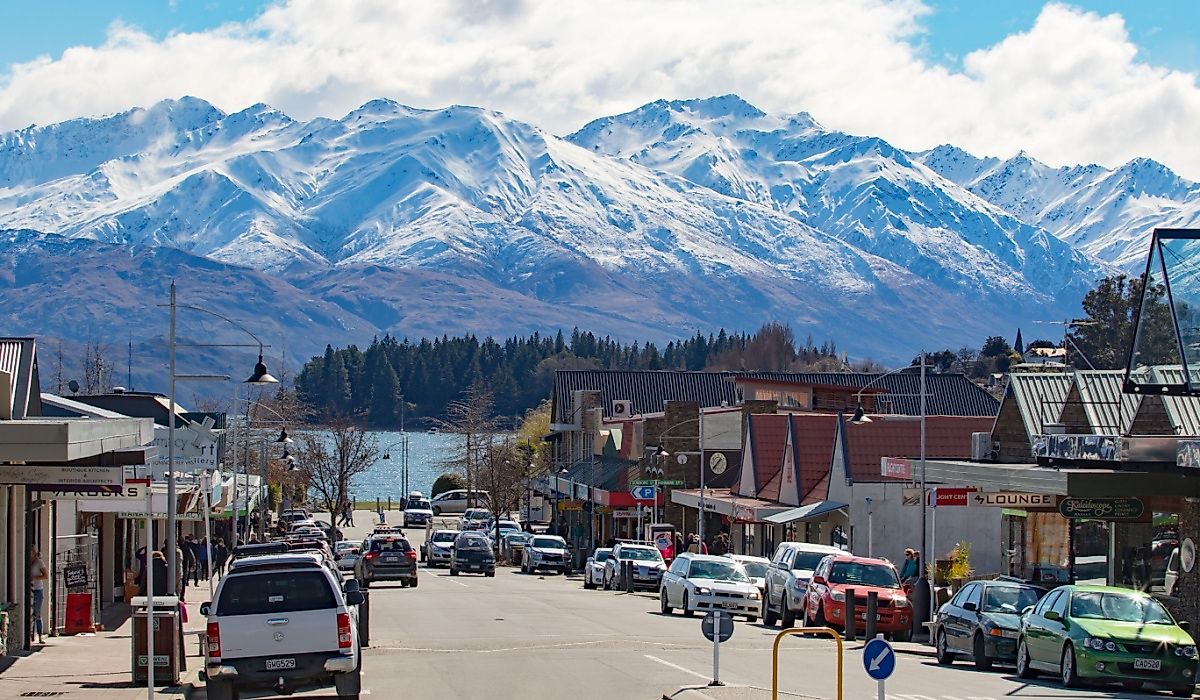
That Wanaka Tree, the lone willow standing in the shallows and photographed more than almost anything else in the country, is there by accident. It began as a fence post, cut from a willow and driven into the lakebed, and it took root. A piece of farm infrastructure became the image people associate with the entire southern lakes.

Wanaka sits where the mountains drop into deep glacial water, and every street in town ends in a peak. The Wanaka Lavender Farm adds rows of purple a few minutes inland each summer. In winter the hills above become Treble Cone and Cardrona, and the town swaps one set of visitors for another without changing much else.
Where Each One Gets Its Looks
Geology wrote most of this list. Akaroa is pretty because a volcano collapsed and the sea came in. Picton is pretty because river valleys drowned. Tekapo is turquoise because of rock ground to powder, Kaikoura has whales because a canyon runs almost to the beach, and Te Anau sits at the edge of country the ice carved and no road could follow.
The rest is history and accident. Arrowtown kept sixty cottages because the gold ran out before anyone redeveloped them, and its autumn colour comes from trees that belong in another hemisphere. Oamaru is cream-coloured because that was the cheapest stone to hand. Akaroa kept French street names because its settlers arrived a few weeks late. And the most photographed tree in New Zealand is a fence post that refused to die.