The Arizona Lodge You Can Only Reach On Foot, By Mule Or By Raft
There is no road to Phantom Ranch. As the only lodging below the rim of the Grand Canyon, it's difficult to get to. Since 1922, the ranch has only been reachable three ways: a hike of more than seven miles down the South Kaibab Trail, a five-and-a-half hour mule, ride, or a raft trip down the Colorado River. These stone cabins sit beside Bright Angel Creeek, 4,714 feet below the trailhead, and everything that reaches them — from steaks dinners to the mail — comes down by trail. Or at least, it usually does.
As of November 2026, nobody is arriving at all. On August 29, 2026, A flash flood closed the ranch, destroying footbridges and closing routes. Its operator lists it as closed until at least January 31, 2027. Here's how this remote Arizona lodge works, and how to reach it once it reopens.
A Lodge Is Built

After Grand Canyon National Park was established in 1919, the National Park Service chose Fred Harvey, whose hospitality firm managed the hotels and restaurants of the Santa Fe Railway, to build a tourist camp at the bottom of the Grand Canyon. The stone cabins and canteen at Phantom Ranch were designed by Mary Colter, the architect also responsible for Hopi House and the Desert View Watchtower on the South Rim.
Construction began in early 1922. Colter built with rounded river rock from the site, and everything else, from boards to windowpanes, came down the trail on pack mules. The ranch opened that year with five buildings at a cost of $20,000.
It wasn't the first camp on the site. David Rust, who built trails for a company promoting North Rim tourism, pitched tents here in the early 1900s, and by 1907 had strung a cable tramway across the Colorado River, with a cage that hung 60 feet above the water on a 450-foot cable. Former president Theodore Roosevelt rode it several times during a hunting trip in 1913, cranking the winch himself, and the place became known as Roosevelt Camp.
Phantom Ranch Takes Shape

The Fred Harvey company planned to call the park's new resort Roosevelt Chalet, but Colter preferred Phantom Ranch, a name thought to come from nearby Phantom Canyon. Bright Angel Creek had been named in 1869 by the explorer John Wesley Powell, who wanted a name to contrast with the muddy Dirty Devil River upstream.
Colter added more cabins in 1925 and 1927, and the early ranch supplied much of its own fresh food from an orchard, a chicken house, and rabbit pens. During the Great Depression, the Civilian Conservation Corps, the federal work-relief program for unemployed young men, built the nearby campground, the Clear Creek and River trails, and a swimming pool completed in 1934 and filled in in 1972.
Guests have included Senator Robert F. Kennedy, who spent four days here with his family in 1967. Phantom Ranch joined Historic Hotels of America, a program of the National Trust for Historic Preservation, in 2012, and the canteen's dinner bell, in use since 1922, still rings at mealtimes.
Getting There On Foot

The shortest way to Phantom Ranch is via the 7.4-mile South Kaibab Trail from the South Rim's Yaki Point. The trail crosses the Colorado River on the Black Bridge, a 440-foot suspension bridge completed in 1928 from parts carried down the trail by mule or on foot. That included the 550-foot main cables that were walked down the switchbacks by a line of 42 men, most of them members of the Havasupai Tribe, whose reservation is west of Grand Canyon Village.
The Bright Angel Trail from Grand Canyon Village is longer at 9.9 miles, but is less steep, with a campground at Havasupai Gardens, 4.5 miles down. It crosses the river on the Silver Bridge, which was built in the 1960s for the Transcanyon Waterline, the pipeline that brings water from Roaring Springs, below the North Rim, to the South Rim. The two trails are linked by the 1.7-mile River Trail.

A common route is down the South Kaibab and up the Bright Angel, 17.3 miles in all. From the North Rim, the North Kaibab Trail starts at 8,241 feet and takes 13.6 miles to reach the ranch, which is what makes a rim-to-rim crossing possible.
According to Xanterra Travel Collection, the concessioner that operates the ranch for the Park Service, temperatures at the bottom of the canyon in the summer months can reach 120 degrees Fahrenheit. The Park Service doesn't recommend day hikes below Havasupai Gardens. Xanterra's rule of thumb is that the climb out takes twice as long as the descent, and it estimates four to five hours down the South Kaibab and six to 10 hours up the Bright Angel.
Getting There By Mule

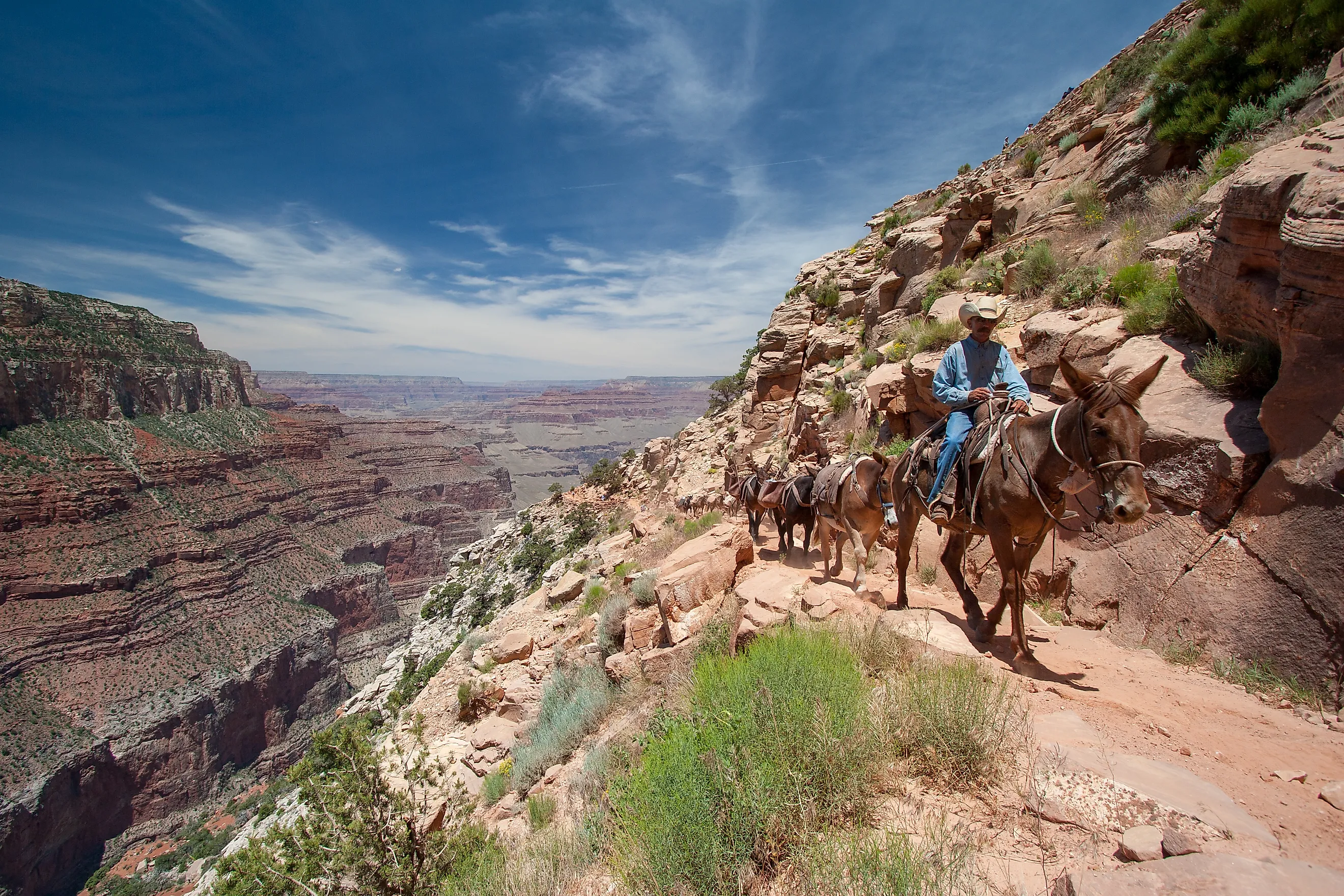
Mule rides into the canyon were first offered in 1887, and more than 600,000 people have taken one since. Xanterra's overnight trip to Phantom Ranch leaves from the stone corral beside Bright Angel Lodge in Grand Canyon Village and covers 10.5 miles on the Bright Angel and River trails, a ride of 5.5 hours with a lunch stop at Havasupai Gardens.
Riders cross the Colorado River on the Black Bridge, the only crossing open to mules and horses, and the package includes a cabin, a steak dinner, and breakfast before the ride back up.

The rules are strict. Riders must be at least nine years old and four feet nine inches tall, weigh less than 200 pounds fully dressed, and speak English fluently. Each trip is limited to 10 riders. Although Xanterra has canceled the Phantom Ranch rides through February 2027 because of trail conditions, its Canyon Vistas Mule Ride, a three-hour outing along the rim, is still operating.
The company's mules do much more than just deliver guests. When the ranch is open, a string of 10 pack mules and two packers go down the trail most mornings with food and supplies and come back up with the garbage. The loads they carry have included bedding, windows, and even Christmas trees. The mail travels the same way, and postcards sent from the canteen are marked "Mailed by Mule."
Getting There By Raft

River trips reach Phantom Ranch at Boat Beach, the landing just downstream of the Black Bridge, and the canteen is a walk of less than a mile up Bright Angel Creek from there. Most raft trips launch at Lees Ferry, the boat ramp below Glen Canyon Dam in northern Arizona, 88 miles upstream. Authorized river concessioners include OARS, Arizona Raft Adventures, Hatch River Expeditions, and Western River Expeditions, while private boaters need a permit from the park's weighted lottery.
The full trip from Lees Ferry to Diamond Creek, a take-out point farther downstream, covers 226 river miles, and commercial trips last from three to 18 days depending on the route and on whether the boats are motorized rafts, oar rafts, or dories, which are hard-hulled rowboats.

Phantom Ranch is where shorter trips begin or end. An upper-canyon trip with OARS, for example, takes five to seven days to cover the first 88 miles and finishes at Pipe Creek, just downstream of the ranch, with a 7.7-mile hike up the Bright Angel Trail to the South Rim. Lower-canyon passengers hike down to meet the boats instead.
For boaters passing through, Phantom Ranch is a chance to buy a cold drink. When the ranch is open, the canteen's side window sells snacks and beverages, including lemonade. Arriving by raft doesn't come with a bed, though. River trips camp along the shore, and a cabin still requires a reservation. The flood changed this stretch of river, too. As of November 2026, Boat Beach is closed except for emergencies and for boaters scouting a new rapid that formed at the mouth of Bright Angel Creek.
Cabins, Steak Dinners, And A Lottery
Beds at Phantom Ranch have been assigned by lottery since 2017. Entries are free and are accepted online from the 1st to the 25th of the 15th month before the stay, so advance planning is necessary. On Xanterra's published schedule, a hiker hoping for a night in October 2028 enters between August 1 and 25, 2027, hears back in September, and can try for any unsold space from October 1, 2027. One entry can cover up to nine hikers and four nights, and guests must reconfirm two days before they set out.
The cabins include the originals Colter designed in the 1920s. They sleep between two and 10 people in bunk beds or a queen bed, and come with bedding, a cold-water sink, a toilet, electricity, heating, and cooling, with showers in a separate building. There are no phones or televisions. The ranch also has four hiker dormitories, which have been closed in recent years; check their status when booking.
Meals are served in the Phantom Ranch Canteen, Colter's dining hall, and must be booked in advance. Dinner is a choice of steak, stew, or a vegetarian meal. Breakfast and packed lunches for the hike are available. Hikers who would rather not shoulder their gear can send a duffel of up to 30 pounds by mule. For those who miss out in the lottery, 30 small sites and two group sites are available at Bright Angel Campground, less than half a mile from the ranch, though camping there requires a backcountry permit.
The Flood Of August 2026

On the afternoon of August 29, 2026, a flash flood came down Bright Angel Canyon and through the Phantom Ranch area. According to the National Park Service, it destroyed nearly all of the footbridges across Bright Angel Creek, washed out a section of the North Kaibab Trail, and swept metal structures and debris into the Colorado River, which was temporarily closed to boats. Three hikers on a backpacking trip were killed, and more than 80 people were rescued, many of them by helicopter.
Colter's original buildings are still standing, with no known damage. The routes into the ranch fared worse. Black Bridge and Silver Bridge are closed, the entire North Kaibab Trail is closed, and Phantom Ranch, its canteen, and Bright Angel Campground are closed through at least January 31, 2027.

The flood also broke the 12.5-mile Transcanyon Waterline and damaged a new water intake being built near the ranch as part of a $208 million project to replace the waterline. With the rim relying on stored water, every lodge on the South Rim stopped stopped taking overnight guests within days of the flood, and El Tovar, Bright Angel Lodge, and the others didn't reopen until November 20.
Hikers can once more walk to the river, since the South Kaibab Trail is open as far as the Black Bridge and the Bright Angel Trail as far as the River Resthouse, 7.7 miles down. But they can't cross it. With the ranch and campground closed, any trip to the river is now a day hike, which the Park Service advises against below Havasupai Gardens. Closures are updated on the park's Key Hiking Messages page and Xanterra's alerts page before making any plans.
On Foot, By Mule, Or By Raft
For 104 years, the only way into Phantom Ranch has been on foot, by mule, or by raft. The flood of August 29, 2026, closed all three at once by shutting the bridges, the North Kaibab Trail, and Boat Beach. But Mary Colter's stone cabins and canteen are still standing, and repair work is under way so guests can return to Phantom Ranch. When that time comes, the lottery will still open more than a year ahead, the steak dinner will still need a reservation, and the walk out will still be uphill.