The Most Famous Grizzly In America Lived In Grand Teton
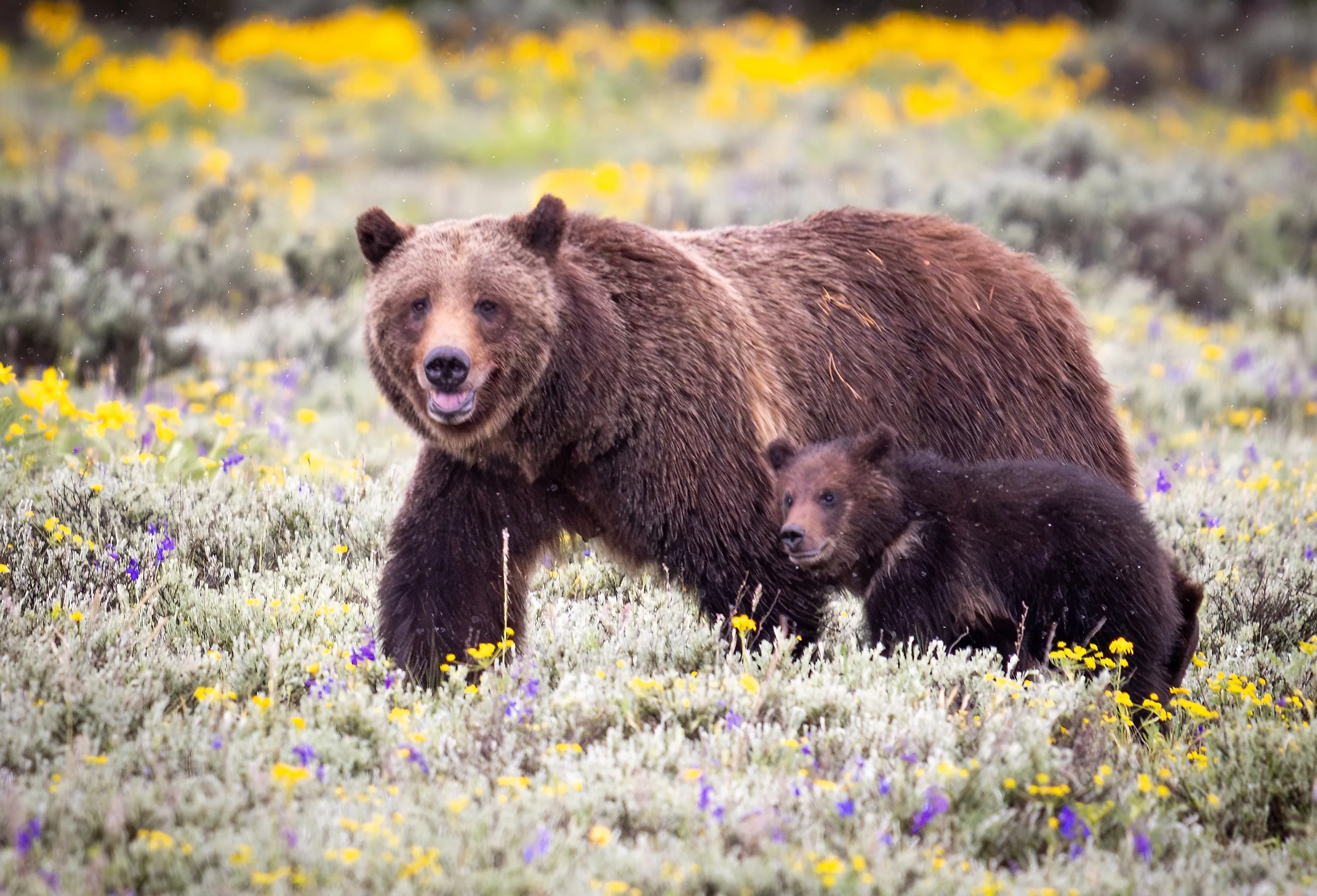
For more than two decades, Grizzly 399 was among the most recognizable wild animals in the United States. This female grizzly spent much of her life in and around Grand Teton National Park and Yellowstone in northwestern Wyoming, where generations of visitors watched her raise cubs against the gorgeous backdrop of the Teton Range. Her remarkable longevity, reproductive success, and frequent roadside appearances earned her an international recognition that's still in the minds of many today. But beyond her celebrity status, Grizzly 399 became a prominent symbol of grizzly bear finally populations bouncing back in the American West.
The Early Life of Grizzly 399

Grizzly 399 was born in the winter of 1996 in the Pilgrim Creek drainage of Grand Teton National Park. Late in the summer of 2001, at the age of 5, she was captured by biologists from the Interagency Grizzly Bear Study Team, fitted with a radio collar, and assigned the identification number "399."
Upon release, her territory encompassed portions of Grand Teton and the surrounding Bridger-Teton National Forest, where seasonal food availability and a few other factors which we will touch on later influenced her movements.
Reaching maturity during a period of significant grizzly bear recovery in the Greater Yellowstone Ecosystem following decades of federal protection, by 2004, researchers had finally observed 399 with the first known offspring of her own.
How She Became Famous

Regularly appearing along roads near Jackson Lake Junction, Oxbow Bend, and Pilgrim Creek, Grizzly 399 frequently allowed sightseers to observe her without the need to venture far into the backcountry. It is believed that female grizzlies sometimes remain near busy roads because adult males, who have been known to kill cubs, seem to prefer avoiding human activity altogether.
Wildlife photographer Thomas D. Mangelsen began extensively photographing 399 in 2006, documenting her behavior and successive generations of her offspring. His photographs, books, and exhibitions helped introduce the bear to an international audience, with social media further increasing her popularity later on. For example, dedicated accounts were made to track her movements and springtime emergences from hibernation.
Her fame eventually extended to television as well, with the PBS documentary "Grizzly 399: Queen of the Tetons," premiering on May 8, 2024.
An Extraordinary Example of a Mother

Female grizzlies typically give birth to one to three cubs per litter, with offspring remaining alongside their mothers for more than two years. Throughout her storied lifetime, 399 produced 18 known cubs across eight litters, an exceptional reproductive record for a wild grizzly.
In May 2020, at age 24, she emerged from hibernation with a rare litter of quadruplets. Despite the considerable nutritional demands of raising four cubs, she still managed to successfully raise all of them to independence over the next couple of years. Several of her offspring, including Grizzly 610, have even gone on to produce healthy litters of their own since.
In May 2023, Grizzly 399 yet again emerged from her winter den this time with another, single cub, named "Spirit." At 27 years old, this made her the oldest documented female grizzly to reproduce in the Greater Yellowstone Ecosystem.
The Many Challenges of Living Alongside Humans

399's familiarity with developed areas presented considerable problems for wildlife managers. Her appearances along park roads tended to attract large crowds, creating traffic congestion and requiring rangers to repeatedly enforce minimum viewing distances of 100 yards (91 m).
During autumn, when grizzlies must consume large quantities of food in preparation for hibernation, 399 started ventured beyond national park boundaries and into residential areas. In 2021, she and her four cubs began feeding on garbage, livestock feed, and beehives around Jackson Hole. Because of that, federal and state wildlife agencies intensified monitoring efforts and encouraged residents to secure potential food sources, reducing the likelihood of any local critters becoming dependent on human-related foods.
The Death of Grizzly 399

At 28 years old on October 22, 2024, Grizzly 399 was struck and killed by a vehicle on U.S. Highway 26/89 in the Snake River Canyon, just south of Jackson, Wyoming. Her yearling cub, Spirit, was accompanying her at the time but thankfully is not believed to have been injured.
Authorities determined that the collision was accidental. Regardless, her passing prompted widespread mourning, including a public vigil in Jackson. On November 1, 2024, federal wildlife officials announced that her ashes had been scattered throughout the Pilgrim Creek area of Grand Teton, a place that was clearly her favorite.
Her Legacy and Overall Effect on Grizzly Bear Conservation

This extraordinary individual's legacy goes beyond her longevity and numerous descendants. Her popularity brought international attention to grizzly conservation in general, including the importance of habitat protection, dedicated animal crossings, and responsible food storage all throughout their ranges from Alaska to the southern Rockies. This has protected a variety of other wildlife too, as a result, but also the people who travel into the outdoors year over year to see them.
Following her death, the Grand Teton National Park Foundation established the Grizzly 399 Memorial Fund to better support these bear conservation initiatives. Her life also highlighted the growing need for cooperation between federal agencies, private landowners, and communities throughout Yellowstone and the surrounding regions as ilthey becomes more developed.
A Touching Story of Loss and Rebirth
Grizzly 399 lived through a period in which grizzlies began to truly reclaim portions of their historic range after almost being hunted to nonexistence. Her death underscored the dangers bears still face outside of protected areas. On the other hand, her many descendants continue to inhabit the location she called home, contributing greatly to the recovery of a species once threatened with regional extinction.