The Oldest Tree Ever Found Was Cut Down In What Is Now A National Park
A tree can preserve a history that no written record could ever capture, and for almost 4,900 years that was the case for a Great Basin bristlecone pine growing beneath Wheeler Peak in Nevada, dubbed 'Prometheus'. During the summer of 1964, one single decision brought this ancient life and all the history stored within its wood to an end. The site where this tree once stood lies within Great Basin National Park, a protected landscape known for its millennia-old bristlecone groves. The destruction of Prometheus remains a stark reminder of how scientific curiosity and human intervention can permanently alter the natural world, even to the point of erasing a living thing that has outlived entire civilizations. Either way, it is astounding to see how some things can take thousands of years to become extraordinary, but only mere moments to disappear.
The Land Before the Park

The history of the Great Basin stretches back thousands of years prior to the creation of its national park. Archaeological evidence places the earliest inhabitants of the region to more than 12,000 years ago, when Paleo-Indigenous hunters tracked mammoths and bison across the terrain. As the climate warmed and the landscape dried, subsequent generations in the area adapted their survival strategies to the changing seasons, relying on wild game, native plants like wild onions and pinyon pine nuts, and natural materials, utilizing them to create a sustainable livelihood. Somewhere between 700 and 1,500 years ago the Fremont people established villages in the area where they conducted semi-sedentary ways of life. Named after the Fremont River in Utah where archaeologists first discovered their artifacts, these Indigenous farmers cultivated corn, beans, squash, and more. Maintaining adobe granaries for food storage and underground pit houses for shelter, while supplementing their diets using traditional hunting and gathering methods.
For these communities survival was dependent on understanding the natural rhythms of the land rather than simply taking from it, thus the Indigenous relationship with the Great Basin was seemingly shaped by an extensive understanding of its natural resources and seasonal shifts. Generations developed an intimate knowledge of these patterns and complexities, knowing when plants would produce edible seeds, when pine nuts could be gathered, and where animals could be found throughout the year. This relationship with the environment reflected the people's deep connection to their surroundings, seeing themselves as a part of nature rather than separate from it. Known today as Traditional Ecological Knowledge (TEK), this is perhaps why reverence for the natural world endured even as new populations arrived.
While generations of people learned to adapt to the area, the aging bristlecone pines endured those same changes over many centuries. Prometheus was already growing long before the Fremont people were around, and it would continue to persevere through environmental shifts, and the arrival of completely new peoples and populations. Its existence connected the present to the past, much of which is beyond the reach of any single written record, all of which made its eventual loss that much more devastating to the people who had connections to the many generations it has lived to witness.
Why Do Bristlecone Pines Live So Long?

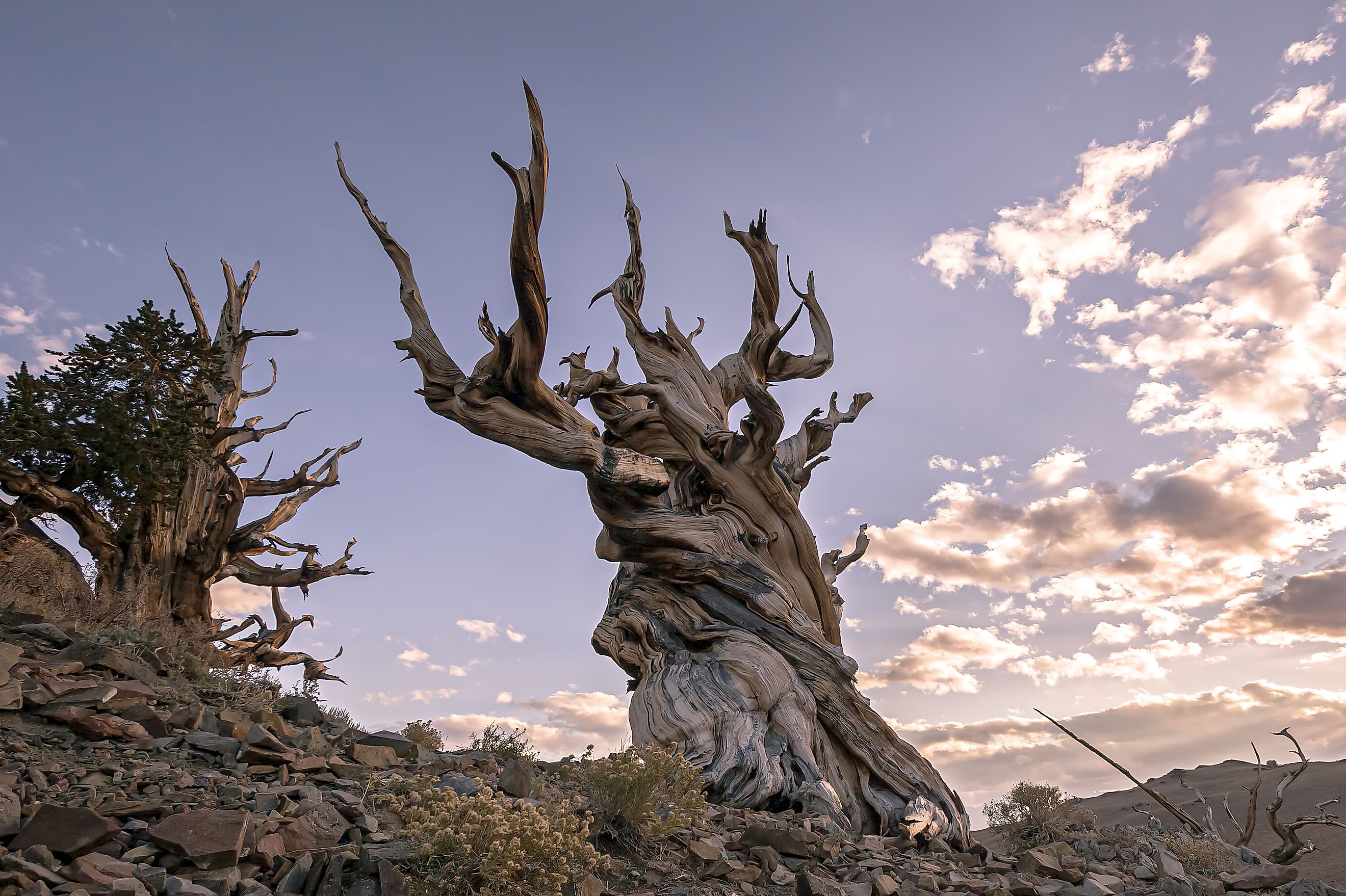
The bristlecone pines of the Great Basin do not reach staggering ages in spite of their harsh surroundings. In fact, they owe their elongated life span directly to the brutal environments they inhabit. Rooted high on exposed mountain ridges near the timberline, these weather-beaten forest elders have to endure bitter freezes, relentless winds, and shallow, rocky dirt. Their growing season is supposed to take place during the warmer months, but the summer season tends to be so brief that the trees sometimes skip adding a new growth ring altogether. This remarkably slow growth results in their wood having incredible density, thus making it resistant to boring insects, rot, and hungry fungi. Even after sections or branches of the trunk die the weathered timber can remain standing for centuries, giving these trees their quintessential twisted, almost skeletal appearance.
Stranger still is how a bristlecone clings to life long after most of its body has turned into stone-hard timber. Utilizing an internal survival strategy called 'sectored architecture', single roots feed isolated veins of bark and foliage rather than the whole organism. That way if one root snaps or starves only the narrow slice of wood it nourishes dies off, leaving the rest of the canopy alive and active. Some of these trees manage to survive with only narrow strips of living bark winding across trunks that appear entirely lifeless. Their longevity is not defined by uninterrupted growth or an untouched form, but through adaptation that endures even at the cost of losing parts of themselves to remain alive. For many millennia Prometheus stood as a testament to that resilience, outliving generations of people and witnessing changes to the landscape very few living things could ever record. Yet even a tree capable of surviving for thousands of years through countless climate shifts, seasons, and natural hardships could not withstand the destructive power of one human decision.
The Story Behind The Destruction

During the summer of 1964, a geographer named Donald R. Currey was examining the ancient glacial deposits sitting beneath Wheeler Peak. This led Currey to become increasingly interested in the bristlecone pines growing along the mountain slopes because their growth rings held a natural diary of past environmental conditions. By examining variations in the rings, researchers could identify periods of favorable and unfavorable growing conditions and utilize the information to help figure out the age of the glacial features on which the trees had grown. With approval from the USFS, Currey began collecting core samples from the trees, hoping to gain a deeper understanding of the history of the mountain and its terrain. Among the trees he came across was known to local mountaineers as Prometheus, rumored to be more than 4,000 years old.
Extracting a sample from Prometheus proved to be unexpectedly difficult. The usual instrument, a hollow drill called an 'increment borer' designed to pull out a narrow cylinder of wood without harming the tree, could not penetrate deep enough into its massive trunk. In a 2001 PBS documentary, Currey recalled that even the longest borers available at the time were too short to collect a sample from the tree at many different angles. Some accounts suggest that the drill got stuck or even snapped inside the wood, while others say Currey felt he needed a complete cross-section of its trunk to examine the rings thoroughly. The precise circumstances remain disputed, but the fact that remains clear is that Currey eventually obtained permission to have the tree cut down. Although Prometheus was not necessarily a towering giant at only 17 feet tall, its battered, irregular trunk measured an astounding 21 feet around near its base. After organizing a chainsaw crew and a pack train to carry the men and equipment up the mountain, the Forest Service cut down the ancient relic in massive sections. Thus, a tree that had withstood nearly five millennia of nature's forces had been reduced to pieces that could be transported away.
Only after the tree had fallen did the full scale of its loss become apparent. Currey took a cross-section of the trunk and started counting the rings, in which he found 4,862 of them. As aforementioned, bristlecone pines can occasionally skip a ring during brutal years, so researchers eventually placed the tree's true age to roughly 4,900 years. It was the oldest living tree ever found at the time, a record nobody knew it held until after it was already dead. In an effort to understand the history preserved within the mountain, a scientist destroyed a living witness that sprouted before the rise of ancient civilizations. Because of the whims of an ambitious researcher, Prometheus would never grow another ring. No amount of scientific knowledge could ever bring back the thousands of years that vanished in a single afternoon.
What Was Lost

The surviving accounts of the incident do not establish any large, organized campaigns conducted to save Prometheus, but they do preserve one reported moment of resistance. According to a later recollection by his widow, Milan (Mike) Drakulich, a seasonal Forest Service employee who was said to have been assigned to chainsaw duty, refused to help cut down the tree. Although the project was inevitably completed, the widow recalled that her late husband placed a hand on its trunk and said, "I'm not cutting down this tree". Although the Forest Service had signed on the removal, the decision would become a lasting source of controversy and debate once people realized how old and rare the tree truly was. But Prometheus was not forgotten after it fell. Artist Jeff Weiss eventually held a memorial service to mark the 50th anniversary of its death, and surviving pieces of its trunk went on display for visitors at Great Basin National Park. Unfortunately the reported refusal of that first foreman could not save the tree, but it captures a glimpse of the gut-level hesitation that surrounded its destruction. Oftentimes, we only see the true worth of something after the chance to save it has already slipped through our fingers.
What was lost that day cannot be measured by numbers alone. Locked inside the timber of the ancient tree lied thousands of years worth of clues about the climate changes, providing scientists with a clear picture of how weather shifted long before modern tools existed. According to the National Park Service, studying Prometheus contributed to the advancement of climate science and the understanding of radiocarbon dating, which helps researchers establish the ages of organic materials and remains used in paleontological and archaeological research. The tree's surviving slabs still remain in collections today, but the dead wood is no substitute for the living organism that produced them. Prometheus will never feel another turn of the seasons, push through another freezing winter, or lay down a fresh ring after a rare wet spring. Scientists can keep reading its wood, but its story remains frozen in time. Cutting down Prometheus did more than just destroy a prized scientific sample. It erased a life whose particular history, formed over thousands of years, could never be recreated.
The question of what humanity chooses to preserve has not become any less urgent. During the current Trump administration, the United States withdrew from the Paris Agreement, with its exit taking effect on January 27, 2026. More recently, the Senate passed the Bipartisan American Affordability and Jobs Act, which despite its favorable name also includes provisions that expand the land available for mining operations of eligible federal property while shortening the window for certain legal challenges to environmental reviews. This bill has yet to be signed into law, still needing to clear the House before reaching the President, but it is still crucial to note that it is in process. Meanwhile, the Department of the Interior's 2026-2030 strategic plan outlines efforts to decrease federal land holdings by offering some properties to state, local, and tribal governments. Supporters describe these measures as opportunities for more efficient land management and economic development. However, conservationists warn these changes could lead to reduced environmental oversight and expanded access for commercial activities that could expose more forests, wildlife habitats, and other currently preserved areas to resource extraction. Although none of these developments directly threaten Prometheus' former grove now protected within Great Basin National Park, they raise an enduring question about what happens when economic interests are made to compete with the preservation of natural landscapes. Prometheus was lost before the full measure of its value was understood. The trees that are still standing deserve better than to become yet another lesson learned too late.
Protecting What Remains

Thankfully, Prometheus was not the last of its kind. Ancient Great Basin bristlecone pines still cling to the high ridges scattered throughout the western United States. Wheeler Peak, Eagle Peak, and Mount Washington all harbor trees that have weathered millennia, while California's White Mountains hold an elder alleged to be 5,065 years old in 2012, outliving even Prometheus. Today, these trees receive protections that extend beyond their living trunks. Within Great Basin National Park, visitors are prohibited from gathering or burning bristlecone wood, climbing on the trees, or hanging from their branches. Even dead branches lying on the ground must remain exactly where they fell, since a single log can contain thousands of years of climate clues. These rules honor what was made painfully clear by the destruction of Prometheus. An ancient tree does not lose its worth when it dies, and guarding its history means protecting the entire landscape in which it grows. Up in Great Basin National Park, a low stump is all that remains in the spot where Prometheus once towered beneath Wheeler Peak. Its wood can still be studied, its rings can still be counted, and its story can still teach anyone willing to learn about a world that existed long before our own. But no scientific breakthrough can restore the living tree or return the centuries of growth it might have otherwise experienced.
Nearly 4,900 years of survival came to an end in 1964, leaving in its wake a reminder of just how fragile even the most extraordinary natural wonders can be when placed in human hands. The bristlecones still rooted along the mountain's windy slopes are living chronicles that continue to take in the landscape's history as they have for thousands of years. Their final chapters remain unwritten and their stories have not yet reached their final rings. People of today still hold the opportunity to shield these groves and ensure future generations inherit something more than the remains of what we failed to save. Prometheus cannot be brought back, but what happened that day does not have to happen ever again.