8 Best Natural Wonders To Visit In New Zealand This Year
Geothermal fields and active volcanoes shape New Zealand's North Island, while deep fiords and descending glaciers define the South. Blowholes send seawater high into the air, and tiny glow worms use bioluminescence to illuminate the darkness in the depths of their caves. Milford Sound, the country's wettest inhabited place, receives more than 20 feet of rainfall each year. Aoraki, whose Māori name means "cloud piercer," rises 12,218 feet as the nation's highest peak. Here are 8 of the best natural wonders to visit in New Zealand this year.
Milford Sound

Milford Sound is a striking glacier-carved fiord located in Fiordland National Park. Milford Sound is best visited from December to February, and it is known for its cascading waterfalls and abundant marine life. Truly one of a kind, Milford Sound is the country's wettest inhabited place and one of the wettest places on Earth, receiving more than 20 feet of rainfall each year.
With so much water, the fiord creates new waterfalls that are sometimes born and disappear overnight. However, its permanent waterfalls, Lady Bowen Falls and Stirling Falls, are still staples for year-round visitors. Explorers can take a closer look at the natural wonder through boating tours, such as Milford Sound Cruises, where they can cruise past sheer cliffs and directly under cascading waterfalls. Many also enjoy kayaking and diving to see the fiord's marine life and rare black coral. There are even helicopter rides that offer bird's-eye views of the fiord and its surrounding valley. However, access to flights is only available when weather permits.
Aoraki

Aoraki is New Zealand's highest mountain, standing at 12,218 feet in the country's South Island. Aoraki is most visited from October to April and is surrounded by alpine landscape laden with glaciers and bordered by the shimmering blue waters of Lake Pukaki. It is so tall that its name literally means "cloud piercer" in the local Māori language. Considered the most sacred ancestor of the Ngāi Tahu iwi tribe, visitors are discouraged from climbing to its direct summit. Surrounded by glaciers in Mount Cook National Park, it is a top-tier destination for international explorers.
The Aoraki Mackenzie International Dark Sky Reserve is a favorite for stargazing. There are also several walking tracks for hikers to enjoy. Hooker Valley Track is the most popular, with a 3-4-hour walk along alpine meadows and large rivers. The Sir Edmund Hillary Alpine Centre & Planetarium is also a notable attraction, featuring a 2D/3D cinema, a full-dome planetarium, and the history of Sir Edmund Hillary and mountaineering in the region. Even more exciting is the Aoraki Mount Cook National Park Visitor Centre. The world-class museum houses a collection of Māori artifacts, historical climbing gear, and information on safety concerns in the area.
Waitomo Glowworm Caves

The Waitomo Glowworm Caves are a subterranean labyrinth known for being illuminated by thousands of bioluminescent glowworms hanging from limestone ceilings. The hungry larvae glow to lure insects into their sticky threads. The Waitomo landscape is most popular from December to March and consists of more than 300 caves carved out of limestone over thousands of years. Its very name, Waitomo, translates from Māori as "water passing through a hole."
Throughout the cave system, there are a number of experiences to enjoy. The Waitomo Cave has a high density of glowworms in the cave system. Visitors can walk along walking trails or enjoy the scenery on a silent boat ride. The Ruakuri Cave is known for its stunning spiral entrance. The walkways feature deep underground rivers and close-up views of the glowworms. The cave also offers high-adrenaline adventures, including sliding down rubber tubes while black-water rafting, jumping off underground waterfalls, and zip-lining in complete darkness.
Wai-O-Tapu Thermal Wonderland

Wai-O-Tapu Thermal Wonderland is a geothermal area known for its bubbling mud pools, Champagne Pool, and bright green Devil's Bath. Wai-O-Tapu sits on the edge of a massive volcanic caldera within the Taupō Volcanic Zone. With its dazzling colors, it acts as a map of intense mineral activity heated from the Earth. The iconic Champagne Pool is a hydrothermal crater that was formed up to 900 years ago. At 65 meters wide and 62 meters deep, it is a natural wonder filled with geothermal water reaching up to 165°F.
Wai-O-Tapu is best visited from March to May and has interconnected boardwalks that allow visitors to explore the area. The first walk, known as the Highlights, takes up to 45 minutes and features the Primrose Sinter Terrace and the front of the Champagne Pool. If explorers want to go further, the Panoramic Extension adds 20 minutes and takes hikers to higher ground for panoramic views of the steaming landscape. The Full Circuit walk is the longest, taking up to 90 minutes in total. On this trail, visitors travel deep into the park to see the Lake Ngakoro Waterfall and the accompanying volcanic lake.
Fox And Franz Josef Glaciers

Fox and Franz Josef Glaciers are maritime glaciers located in the Westland Tai Poutini National Park. These glaciers are unparalleled because they descend from the Southern Alps into temperate rainforests. Since they are fed by massive amounts of alpine snowfall, they move ten times faster than normal glaciers. This creates the glaciers' vivid blue ice caves and deep crevasses. Though they are often called twin glaciers, the year-round attractions are actually quite different.
Fox Glacier is an 8-mile wonder that inclines gradually down a river valley. It is known for being quiet, laid-back, and surrounded by natural landscapes. Franz Josef Glacier, on the other hand, is 7.5 miles of action. It is known for its steep and dramatic drop. Its exhilarating pace makes it a tourist hub for international travelers, with several restaurants, lodges, and travel accommodations available. Since both glaciers are highly unstable, visitors are not allowed to walk onto the ice from the valley floor.
One of the more popular ways to experience the ice is through heli-hiking tours. Companies like Fox Glacier Guiding fly explorers via helicopters onto the upper icefall. On arrival, guides cut stairs into the ice so people can hike through the blue formations. There are also flights that offer aerial views of the alpine forest, glaciers, and mountains. For those who want to keep their distance, there are walking trails where people can walk through rainforest valleys to public viewing points.
Tongariro National Park

Tongariro National Park is New Zealand's oldest national park. A UNESCO World Heritage Site, it is celebrated for its active volcanoes, crater lakes, and sacred Māori heritage. Established in 1887, the mountain core was gifted to the Crown by Māori paramount chief Horonuku te Heuheu Tukino IV. The sacred park is best visited from December to March and has three active volcanoes: Mount Ruapehu, Mount Tongariro, and Mount Ngauruhoe.
Mount Ruapehu has the highest peak and acts as a popular ski resort. Mount Tongariro is the park's namesake, known for its massive size, while Mount Ngauruhoe is a steep cone known for its role as "Mount Doom" in the Lord of the Rings film series. Alongside these volcanoes are shimmering mineral lakes, ancient lava flows, and a lush alpine desert. Explorers enjoy hiking through the park and taking in the wondrous landscape. With so much to see, there are many trails to choose from. The Tongariro Alpine Crossing is a single-day hike that guides hikers past volcanoes, lakes, and alpine meadows. Multi-day hikes, like the Tongariro Northern Circuit, are also available, giving hikers a more in-depth look at the world-class natural attraction.
Pancake Rocks and Blowholes

The Pancake Rocks and Blowholes are heavily eroded limestone formations at Dolomite Point in Punakaiki. Sculpted by the sea, they resemble stacked pancakes topped by surging saltwater blowholes. The popular Pancake Rocks started forming around 30 million years ago when water pressure compressed sediment and dead marine life into alternating solid rock and soft mudstone layers. They were pushed above ground due to earthquakes. Later, rain and wind washed away the softer layers and left harder limestone sticking above ground like pancakes. Underneath, compressed air and water became trapped and forced violently upward through air shafts in the rock, creating blowholes that shoot sea spray up to 20 meters into the air. To experience the natural wonder, visitors can take the free Punakaiki Pancake Rock and Blowholes Walk. The 0.7-mile loop takes about 20 minutes and features panoramic views, wildlife spottings, and the blowholes in full force during high tide, making it the best time to visit.
Cathedral Cove

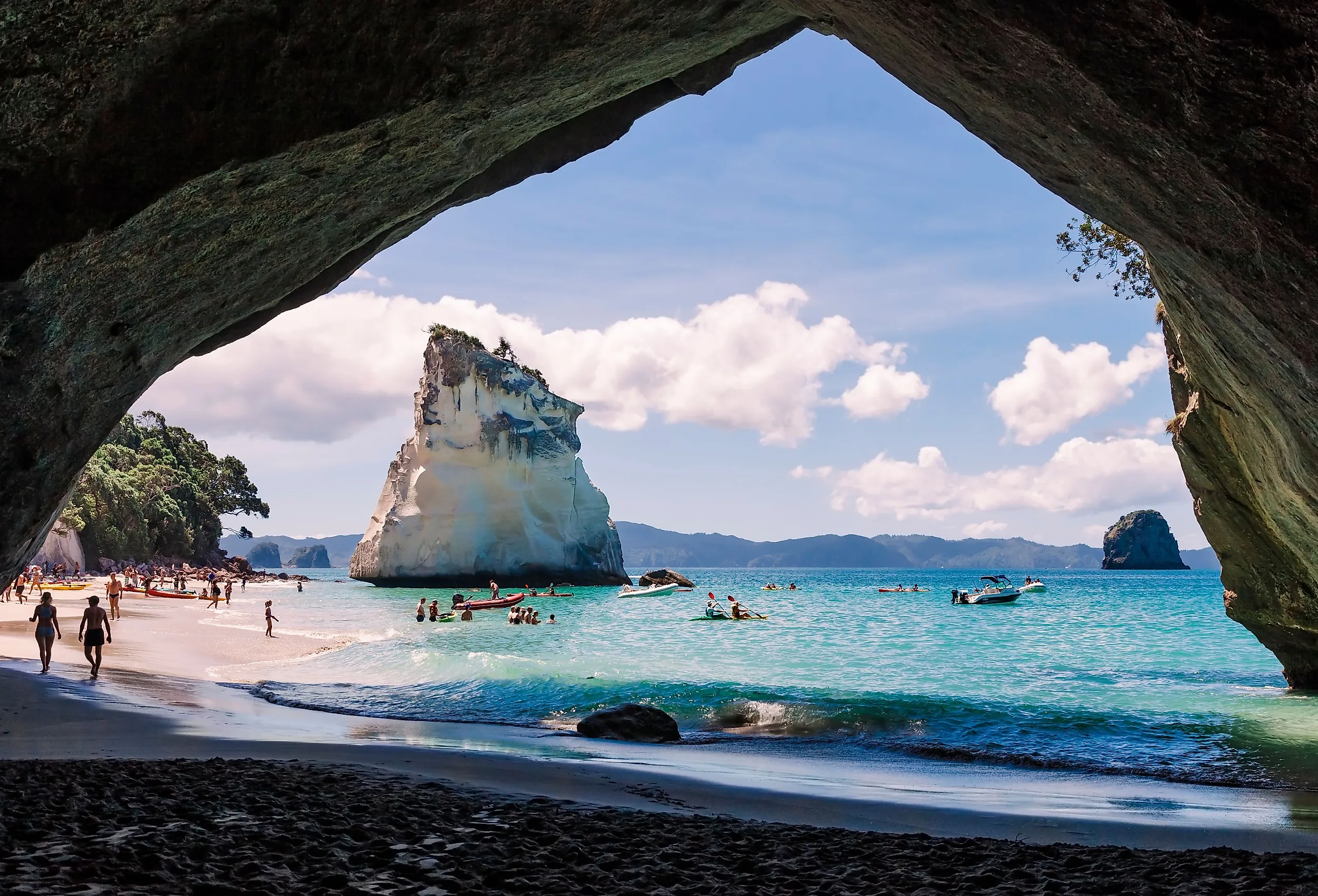
Cathedral Cove is protected as the Te Whanganui-o-Hei (Cathedral Cove) Marine Reserve on the Coromandel Peninsula of New Zealand's North Island. Cathedral Cove is best visited from December to April and is most known for its naturally formed white rock archway that connects two white sand beaches. Full of striking cliffs and dramatically shaped rocks, it is a natural wonder that is worth exploring. Since the reserve is protected, visitors are not allowed to fish on the grounds. However, people can walk through the popular archway from Mare's Leg Cove to Cathedral Cove Beach. On arrival, tourists can take pictures of iconic formations, like the Te Hoho Rock, and its beautiful surroundings. Adventurers also enjoy swimming in the sheltered bays, sea kayaking in hidden sea caves, and snorkeling alongside the cove's abundant marine life.
Wonder-full New Zealand
When it comes to natural wonders, New Zealand has it all. With everything from its glaciers to glowworm caves, it offers visitors an unforgettable experience. Just one visit to these breathtaking destinations showcases why nature is so remarkable. With unimaginable beauty, New Zealand easily stands apart as one of the most fascinating destinations in the world.