US Towns That Look Like Bavaria
Leavenworth, Washington, looks about as Bavarian as it gets right now. Snow sits on the half-timbered storefronts, and Christmas lights hang across them. Horse-drawn carriages jingle down Front Street, and the lights stay on every night from Thanksgiving to the end of February. Leavenworth is one of six American towns built to look like Bavaria, and none does it halfway. Two wrote the German look into local law, down to the lettering on a chain store's sign. The rest built it around a clock tower or a covered bridge. They run west to east, starting in Oregon.
Mount Angel, Oregon

Mount Angel is a farm town of about 3,400 in Oregon's Willamette Valley, with Bavarian-style storefronts and a four-story glockenspiel on East Charles Street. Its figures are wood carvings of real people from the community. Four times a day they step out of the tower, and a boy and girl in Bavarian costume swing out on a garden swing for the finale. The town bills it as the largest glockenspiel in the United States. At the southeast corner of Charles and Garfield streets, the town's maypole, Der Maibaum, goes by the name Tree of Trades.
The monks of Mount Angel Abbey own and run Benedictine Brewery, one of only a few breweries in the country operated by monks. Touch of Bavaria, in a building that once held a blacksmith shop, sells lederhosen and dirndls Wednesday through Sunday, and Mt. Angel Sausage Company sells more than 15 kinds of bratwurst. Each September, the town's four-day Oktoberfest, billed as the largest folk festival in the Northwest, opens at noon with local schoolchildren dancing the Webertanz around a maypole.
Leavenworth, Washington

Up in Washington's Cascades, the Bavarian look in Leavenworth extends to the chain stores, whose logos are allowed in the commercial districts only after they are redrawn with Bavarian colors and lettering. Neon and backlit signs are kept out of the downtown core, and buildings in the commercial districts must fit what the city code calls the Old World Bavarian Alpine theme as far as practicable. After dark, the lights also cover the trees in Front Street Park, and this year's Christmastown festivities run November 27 through December 24. Stein, a brick-walled beer hall on Front Street, pours from 55 taps, and down the same street the Nutcracker Museum fits more than 9,000 nutcrackers into a small storefront. Carolers walk downtown in the early evening through December 23, and when snow falls, kids sled down the hill in Front Street Park.
Vail, Colorado

A walk into Vail Village starts at the Covered Bridge, the official entrance, where the view runs straight up cobblestone Bridge Street. The buildings on both sides are white stucco with dark wood trim, balconies, window flower boxes, and steep roofs, a composite Alpine style that critics once called pseudo-Bavarian. In winter the cobblestones are heated, so snow melts off the street on the walk up to Gondola One.
Pedestrian streets follow Gore Creek from Vail Village to Lionshead. Steins and soft pretzels cover the outdoor tables at Alpenrose, and keg bowling and stein hoisting are part of Vail Oktoberfest, held in both villages on back-to-back September weekends. In Lionshead, the Arrabelle at Vail Square was modeled on classic Bavarian architecture, down to its clock towers and colorful shutters.
New Ulm, Minnesota

In New Ulm, Minnesota, a town of about 14,000, the Bavarian look is concentrated in a 45-foot glockenspiel on North Minnesota Street, one of the world's few free-standing carillon clock towers. From Thanksgiving until mid-January, a nativity scene fills it. The rest of the year, a cast of three-foot figures appears at noon, 3 p.m., and 5 p.m., among them a brick mason, a flour miller, a beer drinker, and a three-piece polka band.
Peacocks roam the gardens at Schell's brewery, where deer share the grounds and the biergarten opens in summer. Schell's Bier Halle pours every day of the week.
Back downtown, the Rathskeller in Turner Hall has murals of Germany that artists painted on its walls more than a century ago. At Domeier's German Store, an animatronic gnome named Heinz sits among the imported goods, and the playground in German Park is built as a Bavarian castle. Every July, dachshund races and strongman competitions are part of Bavarian Blast.
Frankenmuth, Michigan

In Frankenmuth, the Michigan town that bills itself as Little Bavaria, Zehnder's and the Bavarian Inn sit directly across the street from each other, and both serve family-style chicken dinners. Above the Bavarian Inn rises its glockenspiel tower, with a carillon and figures imported from Germany that act out the legend of the Pied Piper of Hameln. Horse-drawn carriage rides leave from beside the tower, and the shops along Main Street are in timber-framed buildings.
Bronner's CHRISTmas Wonderland is open 361 days a year, with a Christmas Lane lit every night. A blue-and-white-striped Oktoberfest tent goes up across the Cass River from Main Street in September. Walkers cross the river on the Holz-Brücke, a covered wooden bridge.
Helen, Georgia

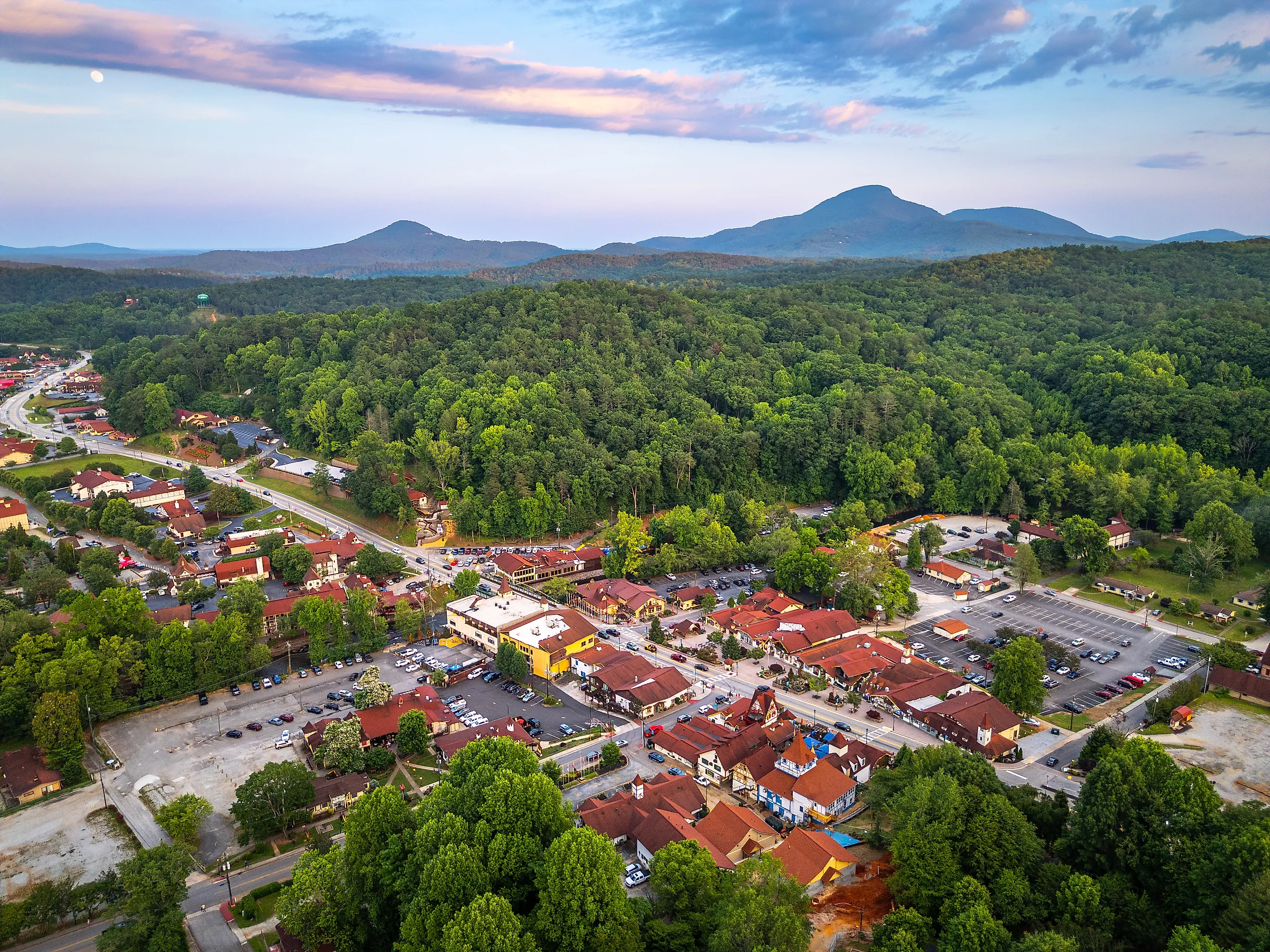
In Helen, the best view of the Bavarian look comes from an inner tube. From Memorial Day weekend through Labor Day, Cool River Tubing sends tubers down the Chattahoochee River and straight through downtown, under the balconies of the Bavarian-style buildings along the banks. The long ride takes two to two and a half hours.
Helen's Oktoberfest runs longer than most, from September into early November, at the Festhalle on Edelweiss Strasse. It opens with a parade and the tapping of the first keg in the Fussen Biergarten.
On land, the city's architectural guidelines state that the general motif of all commercial developments shall be Alpine Design, with sections on arches, awnings, balconies, and Bavarian color schemes. Cobblestone alleys run between the buildings. At Hofer's of Helen Bakery and Cafe, Old World breads come out of a stone hearth oven, and the pastry case holds Linzer cookies and apple strudel.
The look holds up best in the two towns that enforce it. In Leavenworth and Helen, the design rules reach every storefront, so the Bavarian front never drops between one landmark and the next. Where a single landmark carries the effect instead, a visit tends to be planned around it, whether that means waiting for Mount Angel's carved townspeople to step out of their tower or walking Vail's heated cobblestones up to the gondola. Winter is a good season to catch both kinds at work. In New Ulm, the nativity scene keeps its place in the glockenspiel until mid-January, when the carved brick mason and the three-piece polka band roll back out over the street.