11 of the Most Charming Towns in The Rockies to Visit in 2026
There is a town in the Rocky Mountains where you are not allowed to live unless you work there, a town whose main street is named after a gold strike, and a town where the elk treat downtown as part of their commute. The Rockies run some 3,000 miles down western North America, and the communities wedged into their valleys have as much personality as the peaks above them. The eleven below earn the title the honest way, with working steam trains, thousand-year-old pueblos, hot springs, and at least one bank Butch Cassidy personally robbed. Here they are, from the Idaho sheep parades to the Alberta bagel line, for 2026.
Hailey, Idaho

Hailey sits in Idaho's Wood River Valley, a few miles down the road from Sun Valley, where America invented the destination ski resort and the chairlift in 1936, and it plays the role of the valley's genuine, lived-in main-street town. Winters bring serious snow and skiing, summers bring trailheads and bike paths, and the Draper Preserve puts riverside walking distance from downtown.
The calendar is where Hailey shows off. The Days of the Old West rodeo has anchored the Fourth of July here for generations, and every October the Trailing of the Sheep Festival marks the flocks' annual move out of the high country, complete with Basque dancers, sheepdog trials, and 1,500 sheep marching through the valley like they own it, because historically they did.
Salmon, Idaho

Salmon, a town of about 3,000, is the last real outpost before one of the wildest places in America: the Frank Church-River of No Return Wilderness, the largest contiguous wilderness area in the lower 48. The Salmon River, the "River of No Return" itself, runs straight through town, and local outfitters run rafting and fishing trips that range in ambition, with the multi-day Middle Fork runs among the most coveted river trips anywhere.
This is also the birthplace of Sacajawea, born to the Lemhi Shoshone in this valley, and the Sacajawea Interpretive, Cultural and Educational Center tells her story on 71 acres along the river. Cap the visit the local way: the hike up to Goldbug Hot Springs, where natural pools terrace down a canyon with a view that no resort spa will ever beat.
Helena, Montana

Helena is a state capital whose main street is named Last Chance Gulch, because the street sits on the spot where four down-on-their-luck prospectors took one last chance in 1864 and struck gold. The strike built one of the richest towns of the Montana gold rush, and the mansions, the soaring Cathedral of Saint Helena, and the ornate storefronts still show the money.
Today the wealth is recreational. Mount Helena rises directly behind town with a trail network locals use before work, the Montana Historical Society and ExplorationWorks cover the past and the sciences, and the Last Chance Tour Train rolls visitors through the highlights. A capital city where the hiking starts downtown and the main street commemorates a gamble is a capital doing it right.
Jackson, Wyoming

Jackson greets visitors with four archways built entirely of shed elk antlers, one on each corner of its town square, which is the most Wyoming architecture imaginable. The antlers come from next door: the National Elk Refuge hosts thousands of wintering elk on the edge of town, and local scouts gather the sheds. Beyond the square, the boardwalk-lined streets keep an Old West wardrobe over a decidedly modern art-gallery-and-restaurant scene, including the Million Dollar Cowboy Bar, where the barstools are saddles and nobody apologizes for it.
The town's real trump card is its address in Wyoming's Jackson Hole valley: Grand Teton National Park begins minutes away, Yellowstone lies up the road, and the ski terrain above town is some of the steepest in North America. Jackson is what happens when a cowboy town wins the geographic lottery.
Estes Park, Colorado

Estes Park is the front door of Rocky Mountain National Park, and the wildlife has never respected the boundary: elk graze the golf course, browse the riverwalk, and periodically shut down traffic downtown during the fall rut, which locals treat as seasonal programming. From town, Trail Ridge Road climbs into the park and above the treeline as the highest continuous paved road in the United States, topping out over 12,000 feet.
Looming above it all is the Stanley Hotel, the white 1909 grande dame whose corridors unsettled a guest named Stephen King into writing The Shining. The hotel leans into the legacy with tours, and the town below leans into everything else: taffy shops, riverside patios, and a permanent view that explains why anyone stayed up here in the first place.
Ouray, Colorado
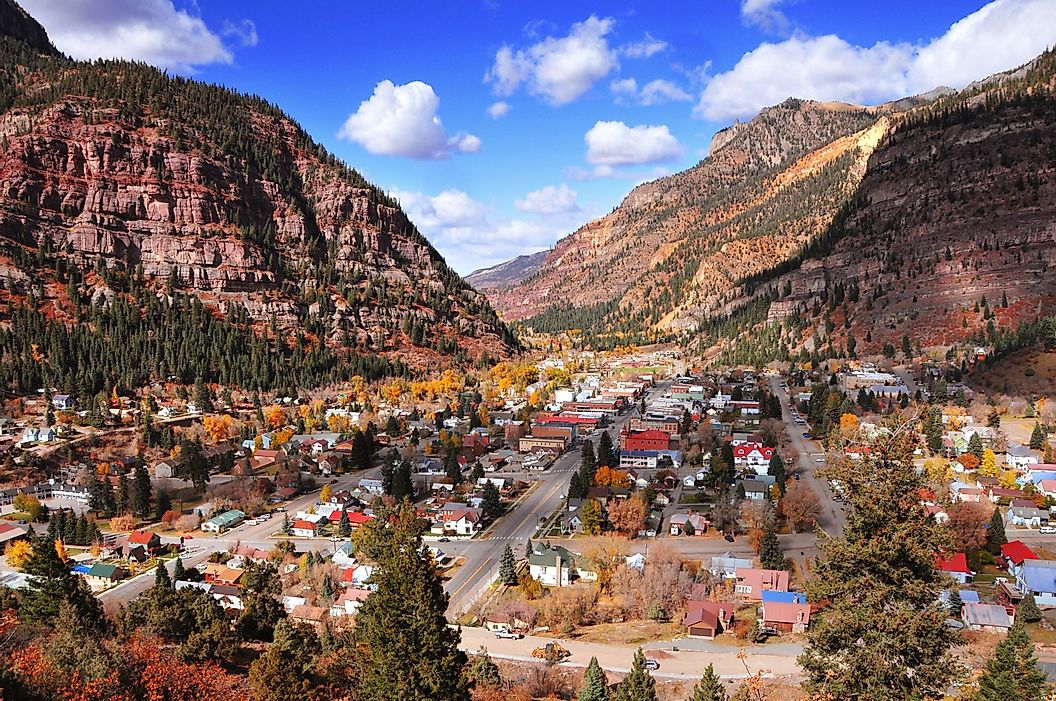
Ouray sits at the bottom of a box canyon so steep and so alpine that the town has marketed itself as the "Switzerland of America" for over a century, and the comparison holds up from any street corner. Victorian storefronts fill the tiny grid, waterfalls pour off the canyon walls, and the town-run Hot Springs Pool steams away at the north end, fed by the same geothermal plumbing that made Ouray famous.
Winter turns the canyon into a temple: the Ouray Ice Park, the world's first dedicated ice climbing park, grows farmed ice up the gorge walls and draws climbers from around the planet, free to climb. Summer sends jeeps and nerves up the Million Dollar Highway toward Silverton, a cliff-hugging drive that ranks among the most scenic and white-knuckled in the country.
Telluride, Colorado

Telluride occupies its own box canyon in the San Juans, with Bridal Veil Falls, Colorado's tallest free-falling waterfall, pouring off the headwall at the end of main street's sightline. The whole mining-era downtown is a National Historic Landmark District, and its most famous transaction happened in 1889, when a young Butch Cassidy robbed the San Miguel Valley Bank here and launched a career.
Modern Telluride's signature move is the gondola: a free public transit system over a 10,500-foot ridge, linking the old town with Mountain Village in 13 airborne minutes, the only ride of its kind in North America that costs nothing. Add the ski resort above and the film festival that takes over each Labor Day weekend, and the old mining camp has aged into one of the most complete small towns in the Rockies.
Durango, Colorado

Durango's claim to fame breathes actual steam. The Durango & Silverton Narrow Gauge Railroad has run this line since the early 1880s, and its coal-black locomotives still haul passengers up the Animas River canyon to Silverton on one of the great heritage train rides on Earth. The depot sits at the foot of Main Avenue, a National Register historic district anchored by the 1887 Strater Hotel, all red brick and Victorian trim.
The calendar peaks in late January with Snowdown, the town's gloriously unserious midwinter festival of costumes, contests, and a light parade. And 35 miles west waits Mesa Verde National Park, where the Ancestral Puebloan cliff dwellings add a UNESCO World Heritage Site to what was already a stacked long weekend.
Taos, New Mexico

Taos holds down the southern end of the Rockies beneath Wheeler Peak, the highest point in New Mexico, and it carries more layered history than towns ten times its size. Taos Pueblo, just north of town, is a UNESCO World Heritage Site whose multi-story adobe buildings have been continuously inhabited for around a thousand years, making it one of the oldest living communities in the United States.
The town that grew beside it became a legend of its own: a Spanish colonial outpost preserved at the Hacienda de los Martinez, then a famous art colony after painters began arriving in the late 1800s, a tradition the galleries around Taos Plaza continue. West of town, the Rio Grande Gorge Bridge hangs some 565 feet above the river, and the high-desert light does the rest of the advertising.
Canmore, Alberta

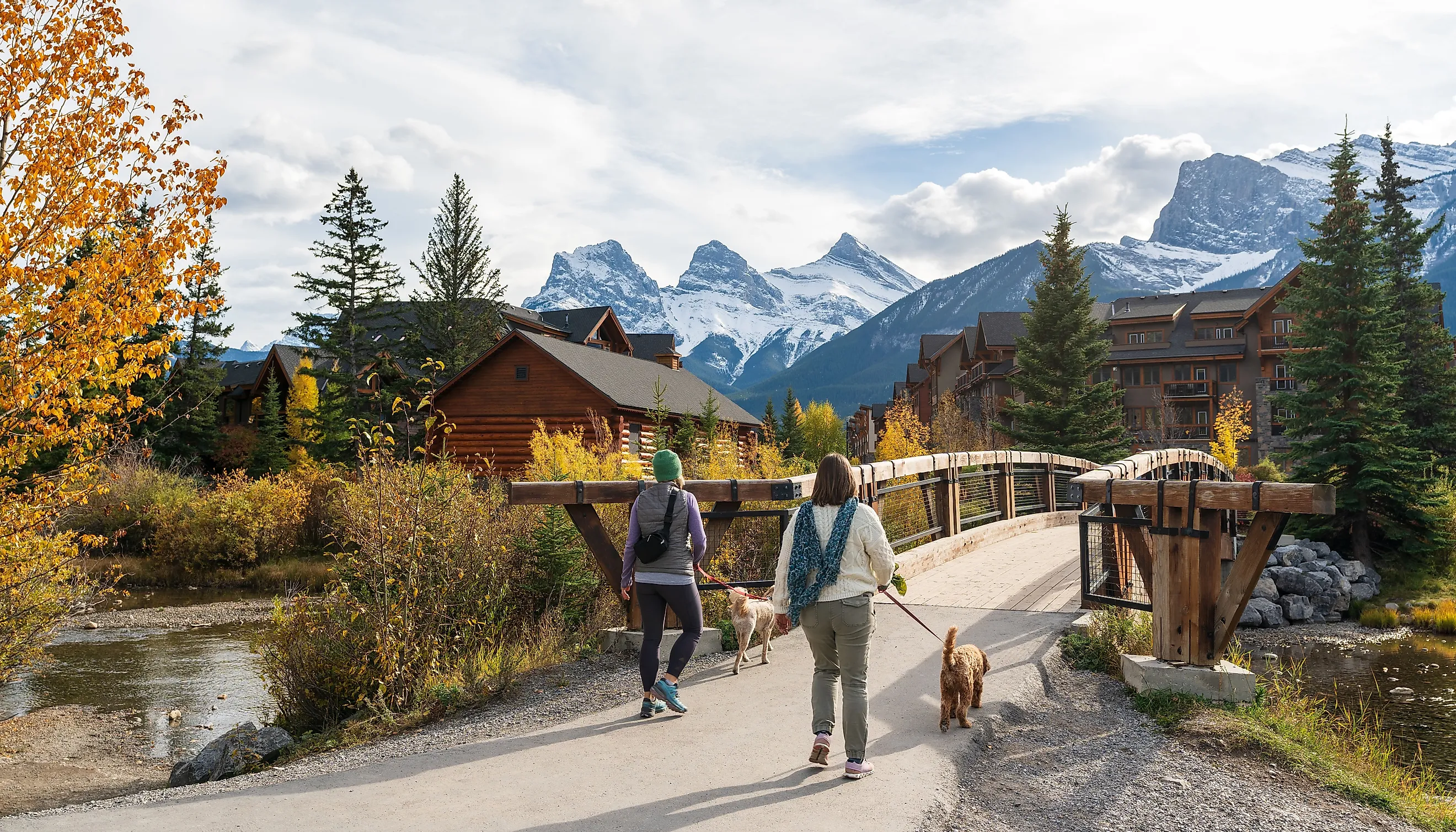
Canmore sits in Alberta's Bow Valley under the Three Sisters, the trio of peaks that stars in half the photographs ever taken of the town, and its name comes from the Gaelic ceann mór, or "big head," after a Scottish king. A coal town until the late 1970s, Canmore reinvented itself when the 1988 Calgary Olympics brought the Nordic skiing events here, and the Canmore Nordic Centre still trains national teams and welcomes anyone with skis or a mountain bike.
The town-day itinerary writes itself: the morning line at the Rocky Mountain Bagel Company, a hike to the impossibly green Grassi Lakes, an underground tour of Rat's Nest Cave for the bold, and the Canmore Museum for the coal-era backstory. All the Rockies, slightly fewer crowds, and the bagels are not optional.
Banff, Alberta

Banff is the town the intro promised: at about 1,383 meters (4,537 feet), it is the highest-elevation town in Canada, it sits entirely inside Canada's first national park, and under federal rules you cannot simply move there. Residency requires working in the park, a need-to-reside rule that keeps the town a working community rather than a trophy-home collection. The result is a genuine main street, Banff Avenue, framed by Cascade Mountain like a postcard that refuses to stop posing.
The surroundings hardly need introduction: the Cave and Basin hot springs where Canada's national park system was born in 1885, the Sulphur Mountain gondola, Lake Minnewanka's cruises, and wildlife that wanders through town on its own schedule. Banff manages the neat trick of being world-famous and still feeling like a town, largely because the law insists on it.
Eleven Towns, One Mountain Spine
The Rockies do not do interchangeable. Helena's main street commemorates a gold gamble, Telluride's commemorates a bank robbery, Taos predates them all by centuries, and Banff legislated its way into staying a real community. Whether the trip leans toward Goldbug's hot pools, Durango's steam whistle, or the sheep parading through Hailey each fall, these eleven towns share one habit: they let the mountains do the bragging and get on with being good company. Pick a valley and go see for yourself in 2026.