10 Of The Quietest Illinois Towns
There is a particular kind of quiet you only find in a town that people once kept loud. You hear it in Galena, where crews loaded lead onto steamboats at a crowded river port, and in Havana, where gamblers worked the riverboat waterfront through the night. That work ended decades ago, and the towns are calmer for it now, better in a lot of ways. Other places on this list were never loud to begin with. Settlers built them around farms, a rail line, or a bend in the river, and they stayed small. In a few, residents worked hard to keep them that way.
Start in the far northwest corner near the Mississippi and finish at the Ohio River in the deep south of the state. Behind every town is a story about how the noise died down, and in every one of them, people are still very much at work.
Galena

In the 1830s, Galena shipped so much lead down the Mississippi that it briefly outgrew Chicago. The ore ran thin, the boats stopped coming, and by the late 1800s the noise was gone for good. Ulysses S. Grant lived here before the Civil War, and residents later gave him an 1865 Italianate house that now stands as the Ulysses S. Grant Home State Historic Site. The rooms hold the family's own furniture, portraits, and everyday objects, so a guided tour feels less like a museum and more like the family stepped out for the afternoon. A few blocks on, Grant Park spreads down toward the Galena River, where shaded footpaths pass Civil War cannons and a stone fountain on the way to the water.
Cross the footbridge and you are on Main Street, in front of the DeSoto House Hotel. It opened in 1855 as the oldest operating hotel in Illinois, and it still rents 55 Victorian-style rooms above a restaurant and a corner pub. Order a sandwich at the pub and you are eating in the same building where Grant once ran a presidential campaign.
Mount Carroll

Drive southeast from Galena for about 40 minutes and the river traffic gives way to brick-paved streets so steep that locals borrowed a nickname, the New England of the Midwest. The town grew up around a mill in the 1840s and never chased anything bigger. At the western edge of downtown, Point Rock Park covers 25 acres along Carroll Creek, which older maps still label the Waukarusha River. A large stone outcropping marks the entrance, and trails climb from the creek up to the Oak Hill Cemetery, where a few graves date to the Revolutionary War. You can also throw a round on the nine-hole disc golf course or drop a line in the water below the bluffs.
A short walk away, the Owen P. Miles Museum occupies an 1873 Italianate home, its rooms full of Victorian furniture, pioneer farm tools, and Civil War relics. When you have had your fill of both, the cooks at Molly's Kitchen and Bar make everything from scratch, including a smash burger and a hanger steak worth the climb back uphill.
Savanna

Savanna once ran on rail yards, river barges, and a nearby Army ordnance depot, and for most of the 20th century that kept it busy. The depot closed in the 1990s, the rail work thinned, and the riverfront grew quiet. Today Marquette Park lies right along the Mississippi River, with open lawns where you can watch a barge push past or spot a bald eagle working the bluffs. Inside the Savanna Museum and Cultural Center, a three-story building downtown, you will find more than a hundred life-sized figures in Civil War uniforms, a detailed model railroad, and shelves of local artifacts.
A few doors down, the owners of Novel Bloom run a flower shop, a bookstore, and a coffee counter under one roof, which is a very Savanna way to do business. If you want to stay the night, The Nest at Palisades Cabins and Lodge keeps three rustic cottages, each with its own hot tub, just outside town.
Fulton

Dutch families settled Fulton along the Mississippi in the 1800s, and their descendants built the town's landmark from scratch. De Immigrant is a working Dutch windmill that stands nearly 100 feet on a levee above the river. Craftsmen in the Netherlands cut and fitted every timber, shipped the pieces across the Atlantic, and traveled to Fulton to raise it by wooden peg in 2000. The sails still turn, and the millstones still grind flour you can buy in the gift shop. Inside the Windmill Cultural Center nearby, a collection of scale-model mills shows how wind once did the work of grinding grain and pumping water across the lowlands.
Fulton has fewer than 4,000 residents and a habit of turning old industrial ground into something gentler. Heritage Canyon, a former limestone quarry, is now a 12-acre outdoor museum laid out as a 19th-century village, complete with a white chapel, a one-room schoolhouse, a blacksmith shop, and log cabins. Cap the day at Don Julio's Mexican Restaurant, where the fajitas arrive sizzling and the margaritas come by the pitcher.
Long Grove

Most towns on this list got quiet by accident. Long Grove did it on purpose. Sitting about 30 miles northwest of Chicago, close enough to have been swallowed by subdivisions, the village wrote strict building rules that hold back chain stores and keep the streets low and old-fashioned. Buffalo Creek Forest Preserve is where residents go to slow down, following gravel trails across 400 acres of tallgrass prairie and marsh where herons and migrating ducks feed. The drive into the village center crosses the Robert Parker Coffin Covered Bridge, one of the last covered bridges in the state.
That same road leads to the Sock Monkey Museum, which holds a Guinness World Record for the largest collection of handmade sock monkeys, more than 2,300 of them across two floors. When the whimsy wears off, Valentino Vineyards and Winery grows more than 20 grape varieties on a 20-acre farm and pours its estate-bottled wines on an open-air lawn.
Monticello

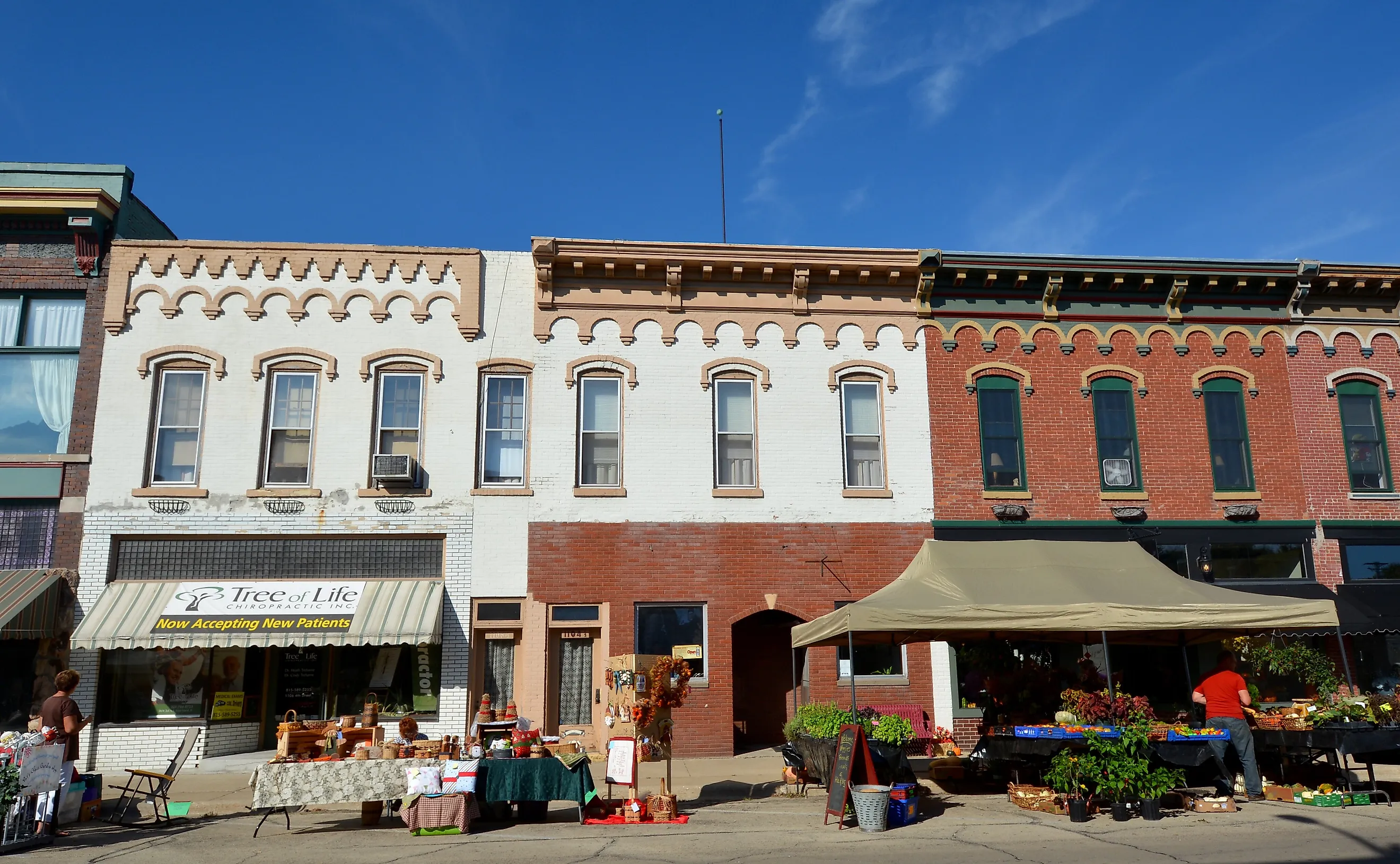
Monticello grew up as a county seat surrounded by prairie farms, and it kept the shape of a turn-of-the-century town instead of spreading into subdivisions. In the Courthouse Square Historic District, 19th-century brick storefronts stand in a ring around the Piatt County Courthouse. One of them houses Prairie Fire Glass, where you can watch an artist gather molten glass on a rod and blow it into a vase or a bowl, then take one home.
Outside the square, the Sangamon River Bridge Trail follows a short paved path through hardwood forest, with an interactive reading trail marking the western end. If you would rather sit than walk, the volunteers at the Monticello Railway Museum offer vintage train rides in season, and the yard is lined with restored locomotives, freight cars, and cabooses that riders can wander before the whistle blows.
Arcola

South of Monticello the farmland turns Amish, and traffic in Arcola slows to the pace of the horse-drawn buggies that share the roads with pickup trucks. The quiet here has a streak of mischief. Downtown, you will find the Hippie Memorial, a 62-foot line of welded scrap metal and junk that local artist Bob Moomaw built as a running commentary on 20th-century America. The same offbeat spirit shows up on the storefronts in the Walldog Murals, 15 large-scale paintings by a visiting team of muralists, tracing the town's railroad past and farm life across brick walls.
For a plain green afternoon, Kelly Moore Memorial Park has ball fields, a splash pad, and shaded pavilions. Come dinner, Monical's Pizza serves the thin-crust, square-cut pies with the tangy sauce that Central Illinois grew up on.
Havana

Havana sits on a wide bend of the Illinois River, and the waterfront is calm now in a way it was not a century ago. In the early 20th century, operators worked gambling rooms along the river that, by local lore, drew visitors as notorious as Al Capone. Today the same riverbank belongs to the birdwatchers. Rockwell Mound rises 14 feet from a two-acre lawn near downtown, an earthen mound built by Middle Woodland people around AD 200 and counted among the largest ever raised in the Illinois River valley. For more open sky, Chautauqua National Wildlife Refuge protects almost 4,700 acres of shallow lakes and floodplain forest, with an observation platform aimed at migrating waterfowl and wintering bald eagles.
Back downtown, the Havana Museum and Cultural Center keeps riverboat-commerce artifacts and Mason County history. A few doors down, the cooks at Babe's on Plum built a following for horseshoe sandwiches, the open-faced Central Illinois specialty, and chicken wings tossed in house-made sauces.
Golconda

At the far southern tip of the state, the sandstone bluffs of the Shawnee National Forest drop straight into the Ohio River, and Golconda sits at the bottom of them. There is hard history under the quiet here. In the winter of 1838, thousands of Cherokee crossed the Ohio at this spot on the Trail of Tears, the point where that forced march entered Illinois. The Alexander Hall Buel House, a restored log home built in 1840, is the district's landmark to that history, kept up by the Pope County Historical Society. The society's own museum picks up the rest of the local story with a mammoth tusk pulled from the Ohio River, an antique wagon, and portraits of early settlers.
Down at the water, boaters put in at Golconda Marina on the Smithland Pool, a 72-mile stretch of the Ohio that anglers work for bass and crappie. To stay over, the owners of the Riverview Mansion Hotel welcome guests into a Victorian estate from the riverboat era, where the 12-seat Levee Lounge pours from a list of more than a thousand wines.
Princeton

Princeton sits right off Interstate 80, but the highway rush never makes it past the exit ramp. The town's loudest morning is a peaceful one: every Saturday from May through October, growers, bakers, and craftspeople set up for the Princeton Farmers Market on the grounds of Soldiers and Sailors Park. Around the corner on Main Street, the Apollo Theater has run since 1883 and still lights its marquee for first-run films.
A short drive from the grid brings you to the Owen Lovejoy Homestead, one of the more important stops on this list. Owen Lovejoy was an abolitionist congressman, and his home worked as a station on the Underground Railroad, with hidden compartments that sheltered people escaping slavery. The house survives with much of his life still on the shelves, from his table silver to his handwritten sermon notes.
The Long Way Down A Quiet State
Follow these ten from the lead bluffs of Galena to the Cherokee crossing at Golconda and you get a fair cross-section of how a place goes quiet. Galena, Savanna, and Havana lost the industry that once kept them up all night. Long Grove passed ordinances to hold its calm on purpose. Mount Carroll, Fulton, Monticello, Arcola, and Princeton never made much noise to lose. What none of them did was empty out. Someone still opens the museum on a Tuesday, tends the park, and unlocks the pizza place by five. The rivers, the prairie, and the century-old brick are all still here, and so are the people who keep them, which is the whole reason a quiet town is worth the drive.