5 Snake-Filled Waters In Northern California
California is home to around 50 native snake species. While the dry, desert-like south may seem like the most snake-filled part of the state, Northern California has plenty as well, thanks to its lakes, rivers, reservoirs, and wetlands. The region is not as naturally lush as it once was, but both native and non-native snakes have adapted to the water that remains. Around Northern California, you might spot water snakes near Lake Natoma, western rattlesnakes swimming in Whiskeytown Lake or Lake Berryessa, and giant garter snakes moving through flooded rice fields in the Sacramento Valley.
Lake Natoma

Lake Natoma is a 500-acre reservoir on the American River in suburban Sacramento. It was dammed in the 1950s along with much larger Folsom Lake, a few miles east. Between the American River and Lake Natoma and Folsom Lake are sprawling wetlands perfect for various snakes. Terrestrial serpents like the gopher snake (Pituophis catenifer) search the lush shores for mice and voles, while semi-aquatic species like the common garter snake (Thamnophis sirtalis) slither in and out of water while pursuing fish and frogs.

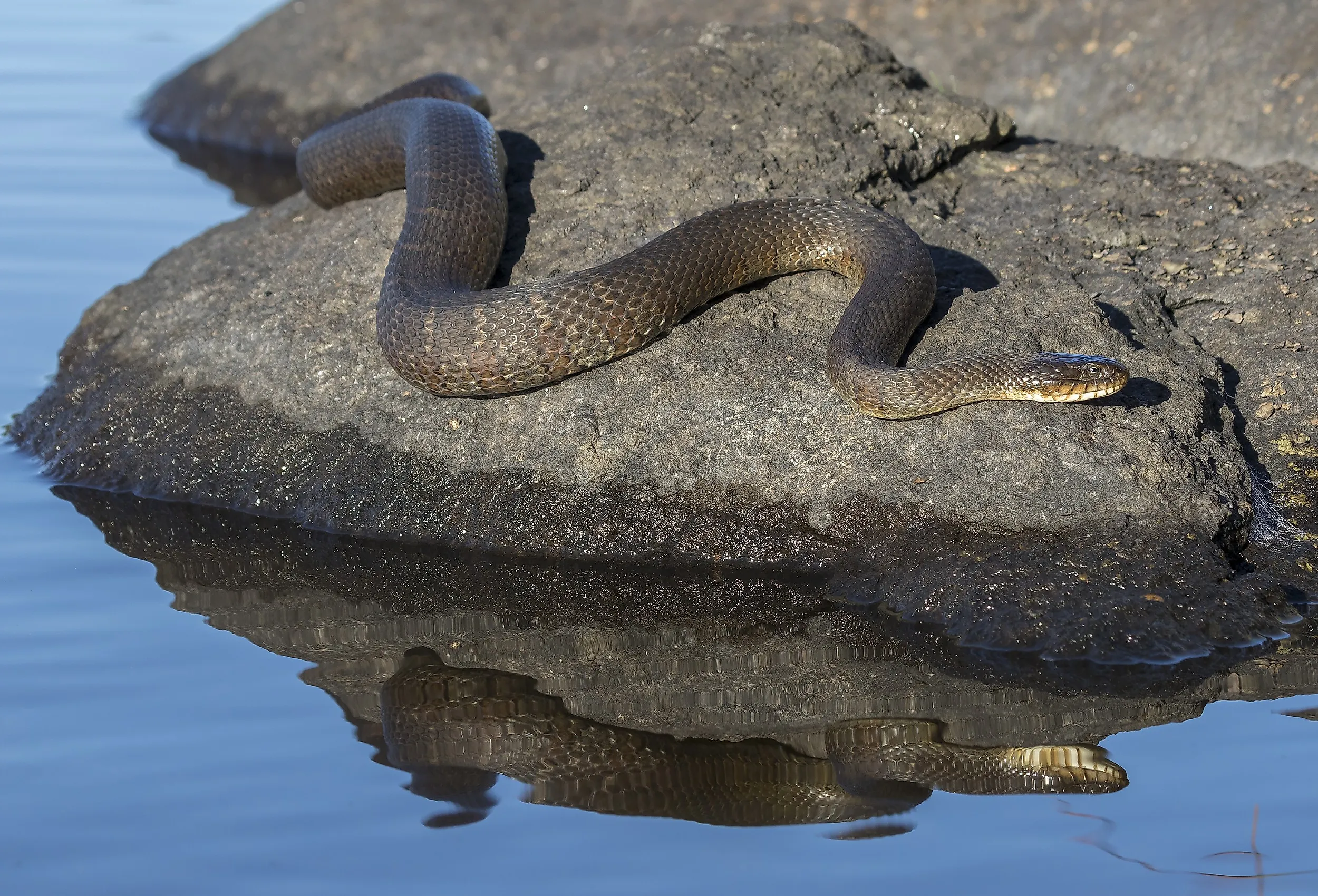
Despite its many terrestrial and semi-aquatic species, California has no native water snakes. "Native" is key, for the marshes around Lake Natoma have long teemed with invasive water snakes. The banded water snake (Nerodia fasciata), which is native to the southeastern US, has been found along Lake Natoma since at least 1992. The common water snake (Nerodia sipedon), which is native to much of the eastern US and southeastern Canada, had become established in Kaseberg Creek northwest of Lake Natoma by 2007. Both populations likely originate from escaped/released pets or accidental stowaways.
Since invasive species are generally harmful to endemic species, California water snakes are subject to eradication efforts. Although such efforts have been quite successful (119 common water snakes were removed in 2011 compared to 3 in 2018), water snakes have invaded other NorCal locales. Most concerning of those is an irrigation canal near Manteca, where a banded water snake was found in 2011. Manteca lies in the historic range of the giant garter snake (Thamnophis gigas), a threatened species that could become more threatened by water snake encroachment.
Whiskeytown Lake

Calling a snake "terrestrial" is a bit of a misnomer. Virtually all snakes can swim, and even the biggest landlubbers take a dip from time to time. One place where slitherers become swimmers is Whiskeytown Lake, a sizeable reservoir in the Whiskeytown National Recreation Area of northern NorCal. To the dismay of locals and vacationers, the most notable serpent swimmer in Whiskeytown is the western rattlesnake (Crotalus oreganus), NorCal's only significantly venomous snake. Yet, since it is much more comfortable on land, a swimming rattlesnake is a safer rattlesnake. Per Whiskeytown biologist Russ Weatherbee, rattlesnakes swim to get from point A to point B and are not looking to strike. As of 2021, when he was quoted in KRCR, Weatherbee had not heard of anyone being bitten in the water by a rattlesnake.

Other species that slither and sometimes swim around Whiskeytown Lake are the common garter snake, aquatic garter snake (Thamnophis atratus), North American racer (Coluber constrictor), and California king snake (Lampropeltis californiae).
Lake Berryessa

Located in Napa County, Lake Berryessa is another NorCal reservoir where rattlesnakes swim. The largest lake in Napa County, the 20,700-acre reservoir stretches about 23 miles long and reaches roughly 275 feet deep. Regarding in-water snake safety, what goes for Whiskeytown Lake goes for Lake Berryessa. Swimming rattlesnakes are not looking to attack. They are traveling, so do not interrupt their journey, especially by blocking or moving them. Moreover, if swimming by yourself, do not grab what looks like a floating branch in case it is actually a snake. Also worth noting is that normally, terrestrial snakes, rattlesnakes included, tend to enter Lake Berryessa and other water bodies during droughts or heat waves. Keep that in mind while vacationing, and remember that fatal snakebites are very rare in NorCal.
Crystal Springs Reservoir

No NorCal snake is more iconic or stunning than the San Francisco garter snake (Thamnophis sirtalis tetrataenia). A subspecies of the common garter snake defined by red-blue stripes and a love for water, it slithers and shimmers through wetlands in the San Francisco Bay Area. However, due to habitat loss and illegal collecting, the San Francisco garter snake is present at fewer locations than it was in the past. One site where the subspecies survives is Crystal Springs Reservoir, which comprises two artificial lakes south of San Francisco in the Santa Cruz Mountains.

But Crystal Springs is not the top San Francisco garter snake stronghold. That title belongs, surprisingly, to a nearby tract of land managed by the San Francisco International Airport. Population estimates in this canal-laden utility corridor have surpassed 1,300 in recent years.
Sacramento Valley Rice Fields

As you probably gleaned from the myriad references to reservoirs and canals, much of California's precious water has been diverted for human use. This has resulted in a roughly 95 percent loss of historical wetlands: critical habitat for the giant garter snake, a five-foot-long semi-aquatic species native to central and northern California. Already extirpated from ~98 percent of its southern range, the giant garter snake found a surprising refuge in Sacramento Valley Rice Fields.
Rice is a common Sacramento-area crop that requires copious water. Thus, rice fields stay flooded for months on end, which has not gone unnoticed by the giant garter snake. For that species and countless others, flooded rice fields have become surrogate wetlands fostering an entire agro-ecosystem. This, in turn, has not gone unnoticed by conservationists, agriculturists, and politicians. In 2025, non-profit organization Save The Snakes, in tandem with the California Rice Commission, successfully lobbied Gavin Newsom to designate the giant garter snake as California's State Snake. "With 95 percent of California’s wetlands now gone, rice fields and the canals that feed them have become valuable habitat for the giant garter snake," explained California Rice Commission CEO Tim Johnson. "Our farmers are working with researchers and water districts to understand how our fields can provide even more habitat to this iconic species."

The giant garter snake should survive so long as rice keeps growing and non-native water snakes do not find the paddies. It is too vulnerable a species to compete for habitat and prey.
Water is precious in Northern California to humans and snakes alike. Though much water has been diverted to humans for hydration, agriculture, and general settlement, snakes survive in this strange melange of nature and artifice. Lake Natoma, Whiskeytown Lake, Lake Berryessa, Crystal Springs Reservoir, and Sacramento Valley Rice Fields are not natural water bodies, but they sustain many kinds of natural snakes and their natural prey. Add snakes that are technically unnatural in NorCal but have been breeding there for decades and you further blur the line. Perhaps "natural" itself is artifice.