Where Do Anacondas Live?
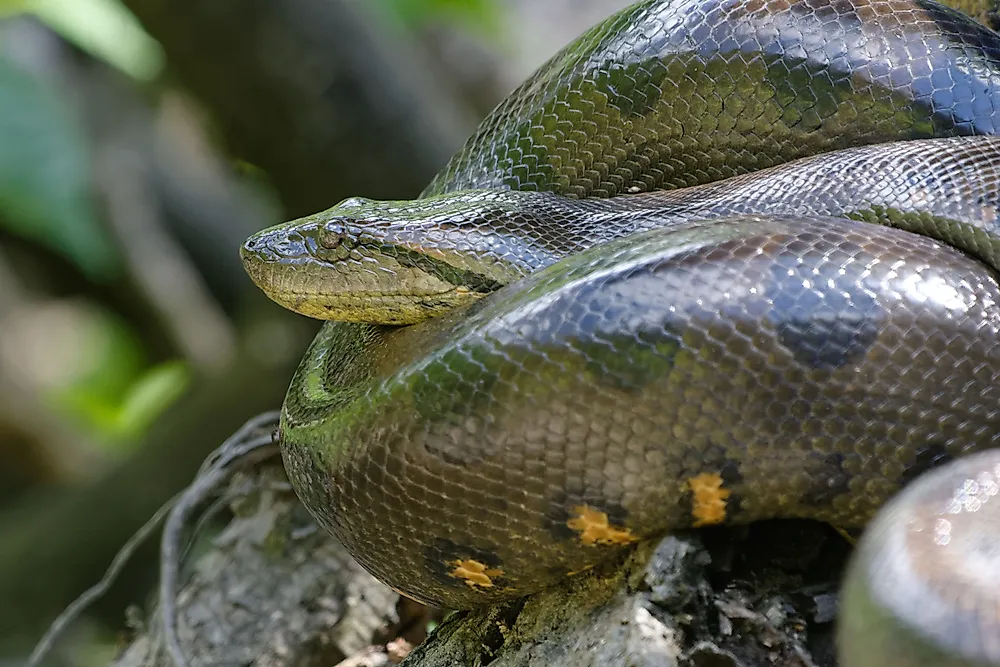
Anacondas (genus Eunectes) are large, semiaquatic boas restricted entirely to tropical South America east of the Andes, where they occupy the slow-moving rivers, swamps, oxbows, and seasonally-flooded grasslands of the Amazon, Orinoco, and Paraná-Paraguay drainage systems. The genus contains four to five recognized species depending on which taxonomic authority is followed (the count was four until a February 2024 study by an international team led by Jesús Rivas of New Mexico Highlands University and Bryan Fry of the University of Queensland split the green anaconda into two distinct species, and the same paper controversially proposed reducing the count by unifying two of the smaller species, a proposal not yet widely adopted). All species are non-venomous constrictors and are restricted to South America; no anaconda species occurs naturally outside the continent. The green anaconda is the heaviest snake in the world (reticulated pythons grow longer but slimmer); the verified maximum size for an anaconda is approximately 6.32 meters (20 feet 9 inches), with the largest scientifically measured specimen, "Ana Julia," documented during a 2024 Ecuadorian Amazon expedition at 6.3 meters and 200 kilograms.
Southern Green Anaconda (Eunectes murinus)

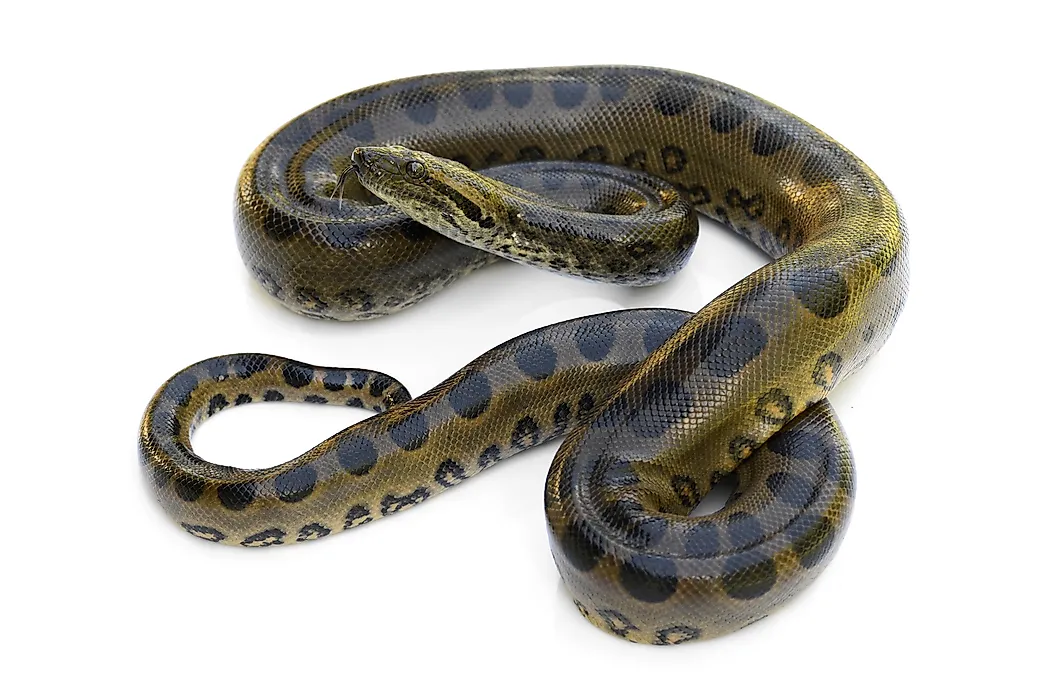
The Southern Green Anaconda, Eunectes murinus (Linnaeus, 1758), is the species formerly considered to be the sole "green anaconda" until the 2024 description of the Northern Green Anaconda as a distinct species. Its current understood range covers Peru, Bolivia, southern Brazil (south of the Amazon mainstem), Paraguay (the upper Paraguay River system), and the island of Trinidad. The species occupies slow rivers, oxbow lakes, swamps, marshes, and seasonally-flooded grasslands such as the Pantanal and the Llanos de Mojos. The snake is olive-green to gray with paired oval black blotches along the length of the body and is dark above with yellow-and-black bellies. Adult females are substantially larger than males (sexual size dimorphism is among the highest of any snake species): mature females average about 4.6 meters and 30 to 70 kilograms, with the largest documented individual measuring 6.32 meters; mature males average closer to 3 meters and well under 50 kilograms. Females may cannibalize males after mating, a behavior observed across multiple field studies and presumed to be a maternal-investment strategy in the energetically expensive period before live birth. Gestation lasts roughly six to seven months, after which the female gives birth to about 20 to 40 live young (anacondas do not lay eggs; they are ovoviviparous). The species is classified as Least Concern by the IUCN.
Northern Green Anaconda (Eunectes akayima)

The Northern Green Anaconda, Eunectes akayima, was formally described as a distinct species in a paper published in MDPI's Diversity journal on February 16, 2024 by a team led by Jesús Rivas, Sarah Corey-Rivas, and Bryan Fry. The species name akayima comes from the indigenous Northern Caribbean language family meaning "great snake" or "spirit of the snake," reflecting the team's deliberate decision to honor regional indigenous knowledge in the formal nomenclature. Genetic divergence between E. akayima and E. murinus is approximately 5.5 percent across key mitochondrial genes (for context, modern humans and chimpanzees differ by roughly 2 percent), and the two species are estimated to have split approximately 10 million years ago, probably as the rise of the Andes and the formation of the Pebas Wetland system isolated populations on either side of the emerging Amazon drainage. The Northern Green Anaconda's range covers the Orinoco River basin and the northern Amazon: Ecuador (where the type specimens were collected from Waorani territory in Yasuní National Park), Colombia, Venezuela, Guyana, Suriname, French Guiana, and northern Brazil. E. akayima and E. murinus are morphologically nearly indistinguishable in the field; the two species are most reliably separated by molecular analysis. The "Ana Julia" record-holding individual (6.3 m, 200 kg) measured during the 2024 expedition is now classified as E. akayima. The species has not yet received an independent IUCN assessment.
Yellow Anaconda (Eunectes notaeus)

The Yellow Anaconda, Eunectes notaeus, occupies the subtropical zone south of the green anacondas' range, in the Paraguay-Paraná river system that drains through Paraguay, Bolivia, northern Argentina, and southern Brazil. The species is smaller than its green relatives: adults are typically 3 to 4 meters and 25 to 35 kilograms, with the largest verified specimens approaching 4.6 meters. The dorsal coloration is yellow or yellowish-tan with paired dark brown to black blotches and a strongly contrasting belly. Yellow anacondas prefer marshes, slow streams, and the seasonally-flooded savannas of the Gran Chaco and the Pantanal, and they hunt birds, fish, caimans, capybaras, and other medium-sized vertebrates. The species has occasionally been introduced into the Florida Everglades through the pet trade and has been documented breeding in the wild there in small numbers, though its invasive footprint is far smaller than that of the Burmese python. The IUCN lists E. notaeus as Least Concern. The species is also the focus of the contested 2024 taxonomic proposal mentioned below, which would absorb both the Bolivian and Dark-Spotted Anacondas into E. notaeus.
Dark-Spotted Anaconda (Eunectes deschauenseei)
The Dark-Spotted Anaconda, Eunectes deschauenseei, is the smallest of the recognized anaconda species. It occupies a comparatively narrow range across coastal French Guiana, Amapá and Marajó Island in northeastern Brazil, and likely adjacent parts of Guyana. The species is found in seasonally-flooded freshwater and brackish wetlands and is named for the American ornithologist Rodolphe Meyer de Schauensee (1901-1984), who collected the holotype. Adults are typically 1.5 to 2.5 meters and rarely exceed 3 meters. The IUCN currently lists E. deschauenseei as Least Concern (updated assessment in 2021); the species had previously been considered Data Deficient for many years because of how little fieldwork had reached its remote range. The 2024 Rivas-Fry paper proposed that E. deschauenseei should be considered a junior synonym of E. notaeus on genetic grounds, but the proposal has not been adopted by the Reptile Database or the IUCN, which still treat the species as distinct.
Bolivian (Beni) Anaconda (Eunectes beniensis)

The Bolivian or Beni Anaconda, Eunectes beniensis, was described in 2002 and is restricted to the Beni and Pando departments of northern Bolivia and adjacent areas of western Brazil. The species inhabits the seasonally-flooded grasslands and gallery forests of the Llanos de Mojos, an enormous tropical savanna system with an annual flood season running roughly December through April. Adults reach about 3 to 4 meters. The species was originally suspected to be a hybrid between green and yellow anacondas, but morphological and (later) genetic evidence supported its description as a distinct taxon. The IUCN lists E. beniensis as Least Concern. As with the Dark-Spotted Anaconda, the 2024 Rivas-Fry paper proposed that E. beniensis should be unified into E. notaeus; the proposal remains contested.
Diet, Hunting, And The Constriction Mechanism
Anacondas of all species take a wide range of prey: fish, birds, small to medium mammals (capybaras, peccaries, deer, agoutis), other reptiles (caimans, turtles, smaller snakes), and occasional larger prey for the biggest individuals (jaguars have been recorded as prey by green anacondas). Hunting is ambush-based: the snake submerges in shallow water with only the nostrils and eyes above the surface and strikes at prey that comes to drink. Once prey is seized in the jaws, the snake throws coils around the body and constricts. The traditional explanation for how constriction kills (slow suffocation, or breaking of bones) is incorrect. A 2015 study by Scott Boback and colleagues at Dickinson College using instrumented prey showed that constricting snakes kill primarily by circulatory arrest: the squeezing pressure exceeds the prey's blood pressure, blood flow to the brain stops, the prey loses consciousness within seconds, and death follows from cardiac arrest in well under a minute. The mechanism is closer to a chokehold cutting off blood flow than to a slow squeeze cutting off air. Once dead, prey is swallowed whole, head-first. Digestion of a large meal takes several weeks, during which the snake usually does not feed.
Conservation
All four IUCN-assessed anaconda species (E. murinus, E. notaeus, E. deschauenseei, and E. beniensis) are classified as Least Concern. The Northern Green Anaconda (E. akayima) has not yet been independently assessed and is therefore not on the IUCN Red List as of this writing. The Least Concern listings reflect the genus's wide distribution and the relative inaccessibility of its core habitat, not the absence of threats. The principal pressures on anaconda populations are deforestation and habitat conversion in the southern Amazon basin and the Gran Chaco (cattle ranching, soy plantation, and infrastructure projects all reduce the seasonally-flooded grassland habitat the snakes depend on), hunting for skins (still significant in parts of Bolivia, Brazil, and Paraguay despite legal restrictions in most range countries), retaliatory killing where snakes are perceived as threats to livestock, and capture for the international pet trade. The 2024 description of E. akayima as a separate species has direct conservation implications: a population previously thought to be a single widely-distributed species is now understood to be two species, each with a more restricted range, and therefore each more vulnerable to localized pressure than the combined species was. Independent population assessments of both green-anaconda species are ongoing.
A Note On The Taxonomy
The genus Eunectes is in active taxonomic flux. The conservative count of four species (E. murinus, E. notaeus, E. deschauenseei, E. beniensis) held from the description of E. beniensis in 2002 until the publication of the Rivas-Fry-Corey-Rivas team's paper in February 2024. That paper made two proposals: first, splitting E. murinus into two species by recognizing the Northern Green Anaconda E. akayima as distinct (a proposal that is now broadly accepted by Britannica, National Geographic, the Reptile Database, and other authorities, though some specialists have raised concerns about the original holotype designation that the team addressed in a follow-up paper in July 2024); and second, unifying E. notaeus, E. deschauenseei, and E. beniensis into a single Yellow Anaconda species (a proposal that has not been broadly adopted as of 2026, with major reference works continuing to recognize the three species as distinct). The taxonomy presented here reflects the current majority view: five species, with the Northern Green Anaconda recognized and the three Yellow Anaconda relatives kept separate, pending further data.