Sun bears are one of the least-studied and most distinctive bear species in the world. They have extremely long tongues, a notable crescent or U-shaped marking on their chest, and they are the smallest living bear species. They are the only bear species specialized for tropical Southeast Asian forests, and their range is one of the few among bears that extends south of the equator. Their nickname, “honey bear,” comes from the way they use their long tongues to reach honey and bee larvae inside beehives. Another common nickname is the dog-faced bear, because of the shape of their muzzle and their facial coloration. Some people think sun bears’ faces resemble those of dogs. According to legends and folklore in Southeast Asia, the markings on their chests represent the rising sun.
Taxonomic Classification
The long tongues and sharp claws of a Malayan sun bear help it forage for food. (Credit: Yatra4289 via Shutterstock)
They are classified in the kingdom Animalia, the phylum Chordata, the class Mammalia, and the order Carnivora. They are scientifically known as Helarctos malayanus and are part of the family Ursidae. The sun bear is the only living member of its genus, Helarctos. The name comes from the Greek words helios, meaning sun, and arktos, meaning bear. There are two commonly recognized subspecies: the Bornean sun bear (H. m. euryspilus) and the Malayan sun bear (H. m. malayanus). The Bornean sun bear lives only on the island of Borneo and is generally smaller than the Malayan sun bear, which occurs on Sumatra and in mainland Southeast Asia.
Physical Appearance
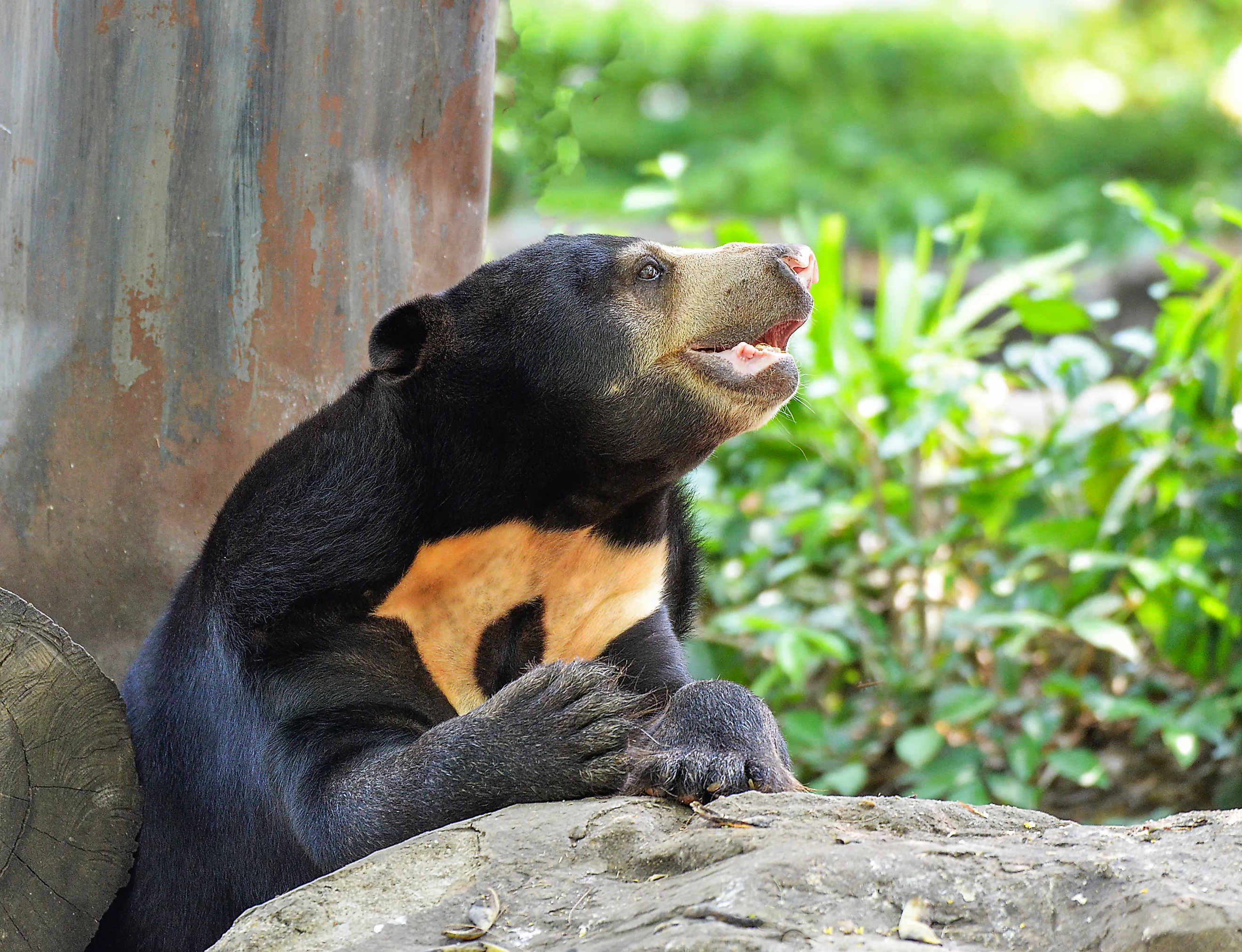
A Sun Bear standing on the forest edge in broad daylight (Credit: plains-wanderer via Shutterstock)
Sun bears normally have dark black fur, although some individuals can have reddish or grayish fur. Their most recognizable feature is the orange, yellow, or cream-colored crescent-shaped patch on their chest. This patch varies from bear to bear, which is one reason they are called sun bears. They are stocky animals with large paws and strong, curved claws that help them climb trees, dig, and tear into rotting logs while searching for food. They use these claws to pull apart plants, logs, and tree trunks when looking for sap, insects, and larvae. They can reach termites in deep crevices of fallen trees and get into narrow parts of beehives, which is part of why they are nicknamed honey bears. Their long tongues can extend up to about 18 inches while feeding, helping them reach insects, honey, and bee larvae. Their thick fur and loose skin give them extra protection while foraging, including from insect stings and bites. Their jaws and canine teeth are strong enough to tear into wood and logs for insects, larvae, and sap. As the smallest living bear species, they usually weigh between 60 and 150 pounds and grow to around four feet in body length. Their tails are only about two inches long. Their muzzles, from their noses to their eyes, often have light tan or grayish fur. Sun bears also have loose, flexible skin, which helps them twist their bodies when threatened. This can make it easier for them to defend themselves if attacked. Males are typically larger than females.
Habitat
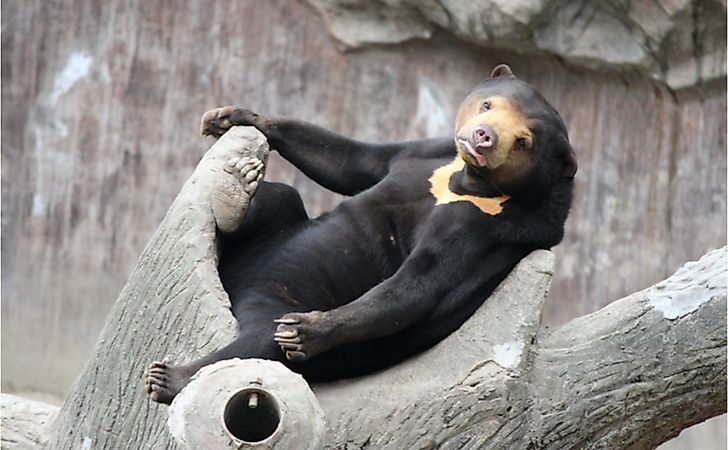
Malayan sun bear resting on a tree (Credit: Lillian Tveit via Shutterstock)
Today, they are found in tropical forests across parts of Southeast Asia and nearby South Asia, including Bangladesh, Thailand, northeastern India, Myanmar, Cambodia, Vietnam, Laos, Borneo, and the island of Sumatra in Indonesia. Sun bears are excellent climbers and are among the most tree-loving bear species. They build nests or platforms in trees to rest, sunbathe, or sleep. These nests are made by breaking and bending branches into a structure that can look like a large bird’s nest. Most bears spend most of their time on the ground, but sun bears use trees more often than many other bear species. They still spend plenty of time on the forest floor, where they forage for insects, plants, and fallen fruit. For rest, they use tree nests as well as sheltered places such as hollow logs, cavities, and other protected spots.
Diet
Close-Up of a Sun Bear Cub with Curious Expression
Unlike bears that live in colder climates, sun bears do not hibernate. They forage throughout the year to meet their energy needs. In Southeast Asia, there are periods known as “mast fruiting,” when many trees produce large amounts of fruit at the same time. This does not happen every year and can occur only sporadically or every few years. Because of this, sun bears need to keep foraging regularly to get enough nutrients. Their powerful sense of smell helps them find food. Their diet includes insects such as beetles, ants, termites, and earthworms, along with fruits like figs and durian, honey, bee larvae, and plant matter. They search rotten logs, decayed wood, termite mounds, and beehives. As mentioned above, their long tongues help them reach food in tight spaces, and their thick fur and skin help protect them while they search for honey and bee larvae. These foods are important sources of protein. Sun bears also eat small rodents, reptiles such as lizards, birds, and bird eggs when available. They will feed on carrion too, though it is not their main source of nutrition.
Behavior and Socialization
Young sun bears
Sun bears are generally solitary animals and usually avoid one another in the wild. Adults spend time together mainly during mating. Females also stay with their cubs for about two to three years, which is the longest period a sun bear normally spends with another bear. Because they live in separate areas, there is less competition for food and other resources. Their strong sense of smell helps them forage and stay alert to possible threats. Sun bears have flexible activity patterns. Some are more active during the day, while others are more active at night, especially in places with more human disturbance. This flexibility likely helps them avoid danger. Sun bears are also highly intelligent. Studies have shown that they can mimic facial expressions during social play, a behavior that surprised researchers because exact facial mimicry is uncommon in many mammals. When two sun bears play together, one bear can mirror the facial expression and mouth shape of the other. In captivity, scientists and caretakers have observed sun bears opening lids and locks with their claws. Their vocalizations include barks, roars, and other sounds used for communication and defense.
Reproduction
Three sun bears
There is no single breeding season for sun bears; mating and reproduction can happen at different times throughout the year. Female sun bears can enter heat at different points. When males and females meet, their interactions can include long periods of play, chasing, play fighting, and wrestling. After mating, pregnancy does not always begin right away because sun bears can experience delayed implantation. This means the fertilized egg does not immediately attach to the uterus. Once implantation occurs, embryonic development lasts about 95 to 110 days, although the total pregnancy period can be longer when delayed implantation is included. When cubs are born, they weigh between 7 and 12 ounces. They are born hairless and blind and cannot survive without their mother’s care. The mother nurses them and keeps them in a safe den or sheltered area. Their eyes open at around 25 days, and their vision becomes clearer at around 50 days. By about two months old, they become more mobile. A juvenile sun bear usually stays with its mother for up to two to three years. During this time, the young bear learns essential survival skills, including how to behave in the wild, forage for food, identify food sources, climb, and find or create resting places. Since mother bears care for their cubs for such a long period of time, their reproductive rates are low. They only have a small number of cubs throughout their lifetime.
Threats
A sun bear in captivity
Adult sun bears have few well-documented natural predators, though large predators such as tigers, leopards, and reticulated pythons can pose a threat in some areas. Cubs are more vulnerable and can be targeted by large carnivores, snakes, and birds of prey. Unfortunately, the sun bear is listed as a vulnerable species, meaning it is considered threatened with extinction. Vulnerable is the conservation category below endangered on the IUCN Red List. Sun bears have declined significantly because of deforestation, habitat destruction, commercial poaching, and illegal animal trading. Habitat loss comes largely from clearing forests for palm oil plantations, agriculture, and logging. Commercial poaching occurs because sun bears are hunted for their bile and gallbladders, which are used in some forms of traditional medicine. Although the bile acid used in medicine can now be produced synthetically, sun bears are still illegally killed for it. They are also killed when farmers view them as threats to crops, and they are hunted for their paws, which are considered a delicacy in some regions. Due to these pressures, their populations are believed to have declined by more than 30% over the last three generations. Protecting them is important because sun bears play a valuable role in keeping their forests healthy.
Why Sun Bears Are Important
Sun bears play a vital role in their ecosystems. They help maintain forest health by dispersing seeds through their scat after eating fruit. This supports plant regrowth and forest regeneration. Their foraging also creates feeding opportunities and small habitats for other species. When they use their strong claws to dig into soil, logs, and tree trunks, they help with decomposition and nutrient cycling. They also assist in pest control by eating insects such as termites, ants, and beetles. Overall, the sun bear is an important part of its tropical forest environment.