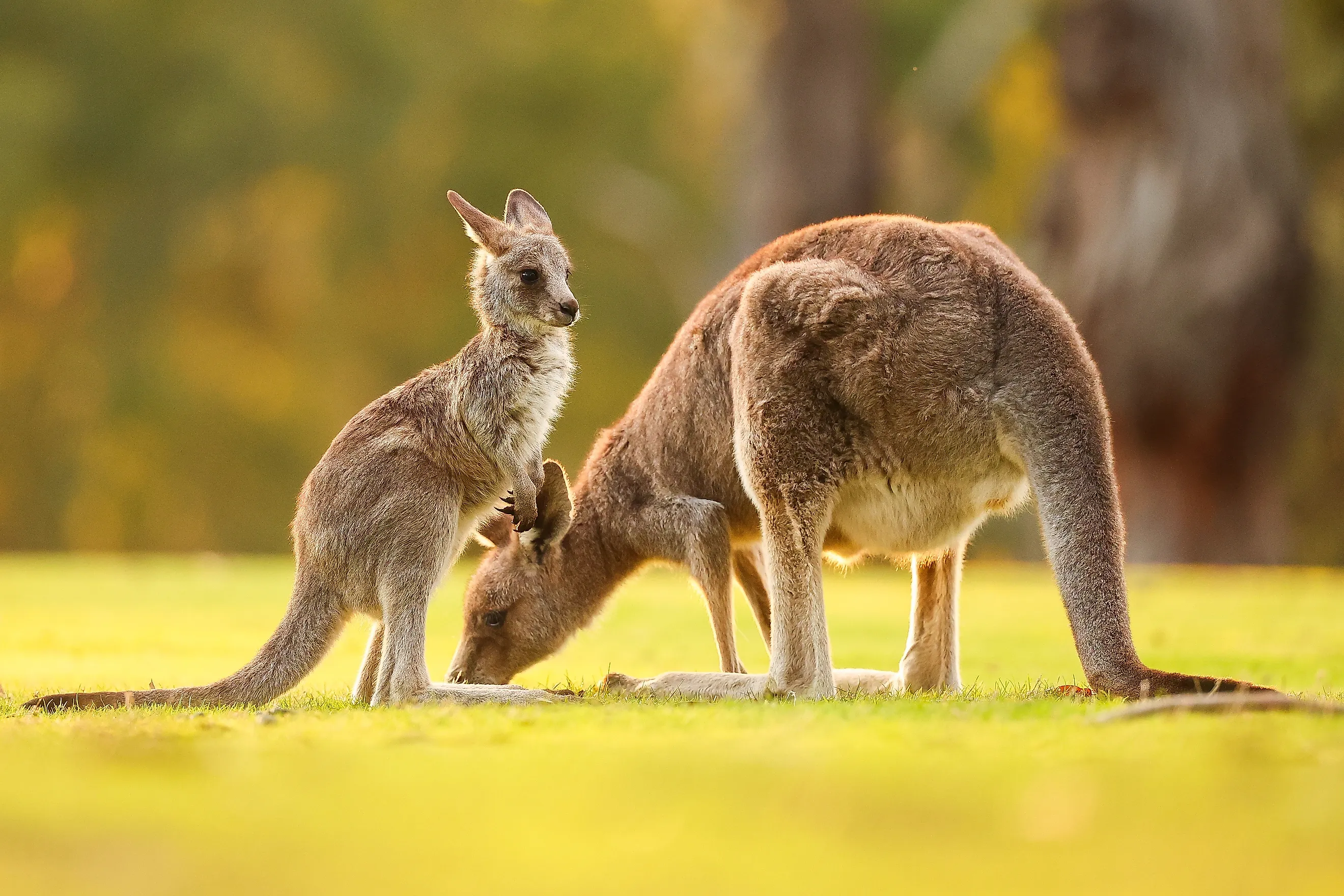
Kangaroo
The world’s largest marsupial, Kangaroos are an iconic Australian animal known for their unique appearance and quirky character. From Skippy the Bush Kangaroo to Kanga and Roo of Winnie the Pooh, these long-legged hoppers have provided inspiration for some of modern culture’s most beloved characters, but the reality is quite different from their cuddly image. Fierce, fast, and feisty, kangaroos are resilient bush foragers who thrive in the arid Australian environment.
Classification and Species

Kangaroos are in the Macropus genus and members of the Macropodidae and Osphranter families. This includes around 60 species, but the term "kangaroo" is most commonly used to describe six species of large Australian marsupials: the red kangaroo (Macropus rufus), the eastern grey kangaroo (M. giganteus), the western grey kangaroo (M. fuliginosus), the antilopine kangaroo (M. antilopinus), the common wallaroo (M. robustus), and the black wallaroo (Osphranter bernardus).
Kangaroos are marsupials, a term derived from the Latin word for pouch (though not all marsupials have pouches). There are over 330 marsupials in the world, and two-thirds of these live in Australia. Kangaroos are the world’s largest marsupials. The largest species is the red kangaroo, which can weigh up to 198 lbs (90 kg) and grow to 6.5ft (2m) tall.
Kangaroos greatly outnumber people in Australia, with an estimated population of 40-60 million. The most common species are red, eastern grey, and western grey kangaroos. In terms of conservation, most kangaroo species are listed as Least Concern on the IUCN Red List, but a notable exception is the black wallaroo, which is listed as Near Threatened.
Range And Habitat

The eastern grey kangaroo is found in open forests in eastern Australia and Tasmania. Western greys inhabit the southern coast and southwest of Western Australia, and both species also appear in New South Wales and Victoria. They prefer forested plains with both tree cover for when they need to take refuge and grasslands for grazing.
Red kangaroos are widespread and prefer flat, open plains. Antilopine kangaroos are found in the tropical woodlands of northern Australia, and, as the name suggests, common wallaroos are widespread in Australia. They are particularly partial to rocky outcrops. The Near Threatened black wallaroo, which likes forest, shrubland, and grassland, lives in the Arnhem Land sandstone regions of the Northern Territory.
Appearance

The Macropodidae family takes its name from the Greek word for "big feet," and kangaroos certainly live up to the moniker. All kangaroos have large feet and long, strong legs that can propel them forward at speeds of up to 37 mph (60 kph). Kangaroos are the largest animals that hop. The biggest kangaroos can leap 25ft (8m) in a single bound.
Aside from their feet, kangaroos have another distinctive feature: their tail. Thick, muscular, and very powerful, a kangaroo’s tail is a useful appendage that they use as an extra limb. They use it for balance, to add more power to their hops, and lift them off the ground when they are ‘boxing’ an opponent.
Kangaroos are short-haired and range in color from red to grey to brown, depending on the species. They have large ears and eyes, giving them excellent perception. They can even swivel their ears to pick up sounds from every direction.
Diet

Kangaroos are herbivores, meaning they eat only plants. They prefer grass but can also consume leaves, ferns, flowers, moss, and fruit. They have a chambered stomach and use foregut fermentation, but are not true ruminants and do not chew cud like cows or sheep. They also have sharp incisors for grazing and strong, grinding molars for chewing. Kangaroos get much of their hydration from plants, but if none are available, they can, on occasion, dig a hole up to 3.2 ft (1m) deep to find water.
Behavior And Reproduction

Most active between dusk and dawn, kangaroos live in groups known as mobs. They travel and feed in these groups and have various ways to communicate with each other. Thumping their hind legs on the ground is typically an alarm that there is danger in the area. Roos will also hiss or growl when alarmed.
Mobs will often change and shift, especially during mating season when they are ruled by the dominant male, known as the ‘old man’ or ‘boomer’. The males will fight to preserve their place in the hierarchy, engaging in violent ‘boxing’ matches where they trade blows. They also use their feet as weapons, delivering strong kicks while tussling for access to females. Kangaroos aren’t afraid of a fight, and they’ll also use their grappling skills to fend off wild dogs and other predators.
Kangaroos can live 12-18 years in the wild. Females have a single baby, a joey, and gestation takes around a month. Joeys are tiny when they are born, measuring just an inch long, but have developed enough to immediately climb into their mother’s pouch. Once there, they suckle on their mother’s milk until ready to leave the pouch at 8 to 10 months old.
Fascinating Facts About Kangaroos

- Kangaroos can’t hop backwards. This forward-only motion has made them a symbol of progress featured on the Australian Coat of Arms.
- Female kangaroos can put their pregnancies on pause in times of scarcity or when another joey is in her pouch. She can then resume the pregnancy when she’s physically able.
- Kangaroos are a beloved sports mascot in Australia, with many teams named after them. The Australian Men’s Basketball Team is known as the ‘Boomers’, the Australian men's football team is called the ‘Socceroos’, and the Women’s Field Hockey Team is the ‘Hockeyroos’.
- If there’s a threat in the environment, young joeys will dive straight into their mother’s pouch. They can even somersault in while fleeing danger at high speeds.
- Roos keep themselves cool in the scorching Australian temperatures by licking their arms. The blood vessels in their arms are close to the skin, so letting the saliva cool the surface cools their blood.
Conservation And Threats

Kangaroos are relatively safe in Australia, but they do have a few natural predators. These include dingoes, wedge-tailed eagles, and foxes. Once hunted for meat and sport, kangaroo populations are currently healthy as a byproduct of human development. More people have meant more pastureland, more water sources, and the removal of predators such as dingoes and the now-extinct Tasmanian tiger.
There are several kangaroo sanctuaries in Australia that rescue orphaned and injured animals. These also focus on raising public awareness and educating people about the animals and their needs. One of the most famous is the Kangaroo Sanctuary in Alice Springs, which featured in the 2013 BBC/National Geographic documentary Kangaroo Dundee.
An Australian Icon

Kangaroos were named by the Guugu Yimithirr people of Far North Queensland, who called them "Gangurru." These mighty marsupials, a symbol of strength, have long held significant cultural importance for the Aboriginal peoples of Australia and have been depicted in rock paintings that date back thousands of years.
Some of the best places to see this unique outback icon in the wild include Cape Hillsborough National Park in Queensland, where they can be seen on the beach at dawn and dusk; Kangaroo Island, home to a large wild population; and the Australian National Botanic Gardens in Canberra.