Ancient Greek Inventions That Are Still Used Today
While many civilizations have come and gone throughout human history, not many made a technological and developmental impact similar to the Greeks. Whether this was through their complex machinery at the time or their ability to comprehend unique yet timeless ideas, Ancient Greeks were known to be some of the best inventors. To this end, many of their inventions, while being thousands of years old, are still in use! Let’s go over some of the most amazing Ancient Greek inventions that have managed to withstand the test of time.
Cartography (Maps)

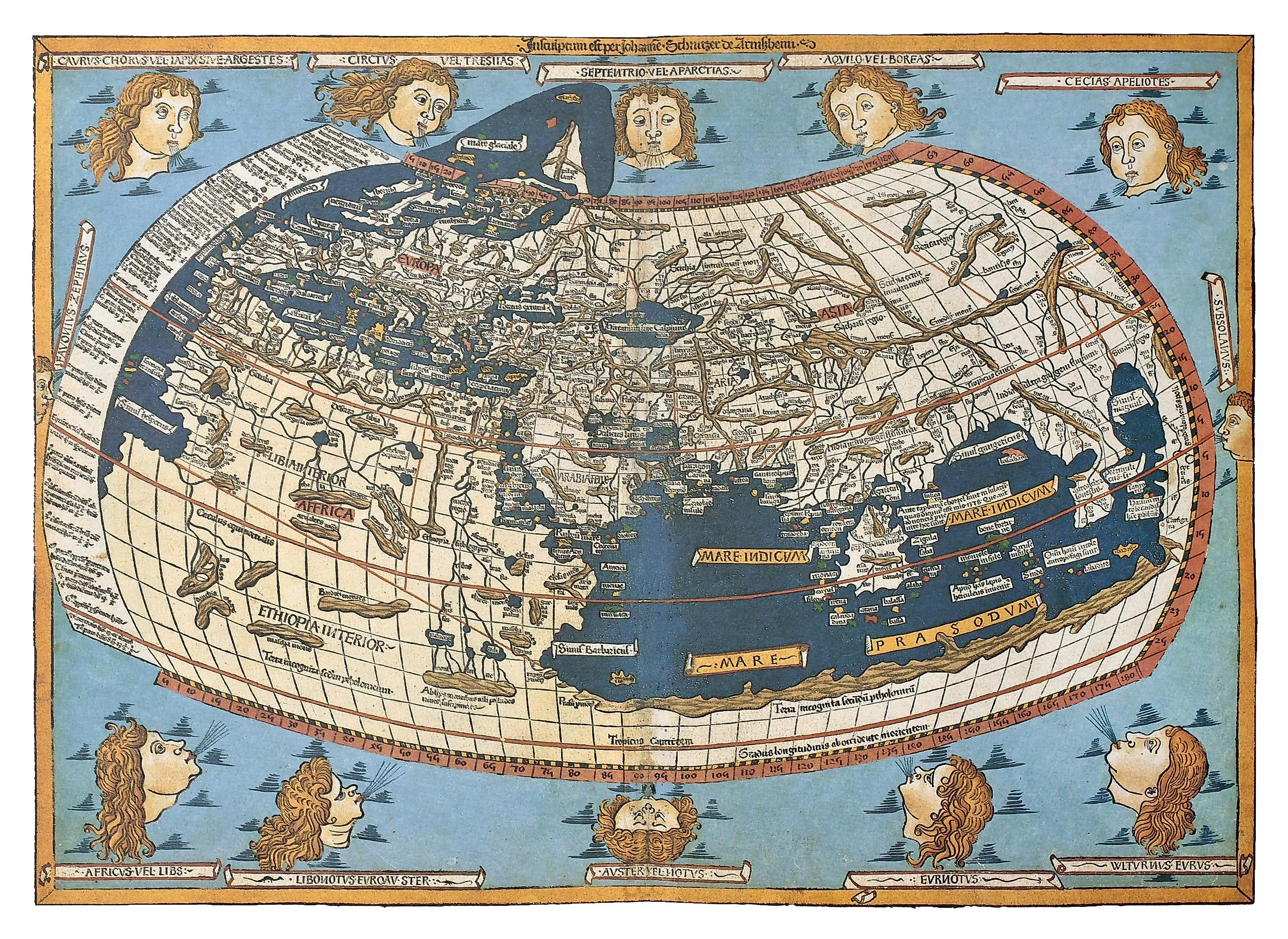
Cartography, the study and practice of map-making, is an essential science that has had a significant impact on the world. It first originated in ancient Babylon, but it wasn't until the Greeks that cartography became a fully developed science with numerous capabilities. Specifically, a man named Anaximander spent most of his life from 610-546 BC as a cartographer and made major advancements in world mapping, astronomy, and even the concepts of latitude and longitude. Thanks to his enormous contributions, maps became widespread, and now we can navigate cities easily with our GPS systems!
The Alarm Clock

One of the hardest parts of going to work in the morning is waking up on time. Luckily, with our dependable alarm clocks, waking up becomes much easier, and you can be confident you’ll get to work on time! We owe this incredible invention to the famous philosopher from Ancient Greece, Plato. Around 400 BC, Plato created an innovative design that used an integrated mechanism to time a machine that would trigger a water organ to play at a specific time. While it is believed to be among the first alarm clocks ever made, many credit Ctesibus, an inventor from Alexandria. Ctesibus improved this design by adding dials to indicate the time and even an elaborate system that would drop pebbles onto a gong at a set moment. Regardless of the specifics, this ancient Greek invention is still in use around the world today.
Odometer

The odometer, a device often overlooked today, is found in many vehicles we use, from bikes to cars. It constantly tracks and displays the distance traveled. Its origins trace back to Ancient Greece, with early descriptions from Roman military engineer Vitruvius. His writings connect the first odometer, known as 'Heron’s Odometer,” to Heron of Alexandria, a Greek mathematician. However, some historians argue that the invention should be credited to Archimedes of Syracuse, another Greek mathematician, during the Punic Wars. Regardless of its precise origins, the odometer remains a notable Greek invention used to this day.
Central Heating Systems

Although it was quite primitive at the time and the Romans truly perfected this invention, the Ancient Greeks were the first to use centralized heating. Invented by the ancient Minoans, they employed an underfloor vent system filled with hot air to keep the floor warm through conduction. This system was often connected to a fire that was maintained by slaves according to heating needs. One of the earliest examples of such a heating system was discovered at the Temple of Artemis. While it may not be as advanced as today, this system was a precursor to the cozy warmth we now enjoy in our homes.
Automatic Doors

The first automatic doors, originally powered by steam instead of electricity, originated in Greece. They were invented by Heron of Alexandria, a renowned Greek mathematician and inventor. These early mechanisms used steam-powered hydraulics, combining fire-heated air with a complex rope system to open doors automatically. Over time, this Greek invention was modernized and is now a common feature in many buildings and urban settings.
The Concept of Democracy

While this may not be a physical invention like the others on this list, it is still an insight into the advanced developments made by the Ancient Greeks. Specifically, democracy, one of the most popular forms of government today where the public elects representatives, was actually invented in Ancient Greece. Specifically, while there are traces of similar forms of government from as early as 5th century BCE, it wasn’t until 508 BCE in Athens that the true concept was formed. During this time, the city-state of Athens formulated a government form which allowed people to elect their leaders; thus, it gained a reputation as ‘the birthplace of democracy.
Vending Machine

Although this may seem like a recent invention to many, vending machines have actually been around for thousands of years. Initially invented by the famous Greek mathemetician who is credited with a plethora of inventions, Heron of Alexandria, the earliest vending machines came up between 10 and 70 AD. Using Greek coins, he created a device that would accept a coin, drop it onto a pan that would pull a lever, and finally open a valve that would dispense holy water. Once the coin falls off, the valve closes and the holy water stops flowing. So, while it may have been a basic design, this shares a striking resemblance in functionality to modern vending machines, although usually with snacks instead of holy water.
Going through all these unique and fascinating inventions, it is evident that Ancient Greek civilization has affected our modern lives immensely. Just imagine if you never had central heating and had to spend winter months heating yourself with fire. Or, what if the alarm clock never existed and you had to hope for the best before bed every night? Thanks to these inventions and advancements by the Ancient Greeks, we can now enjoy many things in life!