Most Significant Libraries of the Ancient World
Libraries existed in the ancient world long before paper. Scribes wrote on clay tablets, papyrus, and parchment. Some collections held thousands of texts. Others held hundreds of thousands. Most ended in fire or sack, and the texts they preserved still shaped the intellectual history of every region they served. The nine libraries below run from Mesopotamia to India across more than 2,000 years.
The Library of Alexandria, Egypt

The Library of Alexandria is the most famous library of the ancient world. The city of Alexandria still exists in Egypt, though the library itself is long gone. Founded around 295 BCE under the early Ptolemies, the larger Mouseion complex included lecture halls, observatories, living quarters, a zoo, and the library’s scrolls. The collection held works attributed to Homer, Plato, and the early Greek philosophers, and Archimedes and Euclid drew on it for their own work.
The exact end of the library is unclear. A fire during Julius Caesar’s siege in 48 BCE caused major damage, but the library may have survived in some form for centuries afterward before final decline.
The Library of Pergamum, Turkey

The Library of Pergamum is less famous now, but it was once the chief rival to the Great Library of Alexandria. Founded in the third century BCE, it eventually amassed roughly 200,000 scrolls before its destruction at an unknown date. The ancient city of Pergamum sits where Bergama, Turkey now stands. Pergamum became closely associated with the production of parchment, which had existed earlier in cruder forms but was refined and scaled there. The word “parchment” comes from the city’s name.
The Imperial Library of Constantinople, Turkey

The ancient city of Constantinople is now Istanbul in Turkey, but it was once the largest city of the Roman Empire. The Imperial Library was built sometime in the fourth century CE and was severely damaged in 1204 during the sack of Constantinople by the forces of the Fourth Crusade after several earlier fires.
At its peak the collection held as many as 120,000 scrolls and codices. Its scholars copied large portions of Greek and Roman literature, and preservation of those texts was the library’s primary purpose.
The Library of Ashurbanipal, Iraq

The Library of Ashurbanipal, built in the 7th century BCE, is the oldest library with a substantially preserved collection. It was located in Nineveh, the capital of the Assyrian Empire, in what is now Iraq. The library had a major impact on the survival of ancient Mesopotamian literature.
Long before parchment, scribes used cuneiform, one of the oldest writing systems, to record their texts. The Epic of Gilgamesh, an ancient Mesopotamian epic written in Akkadian, survives largely because copies were preserved in the library. A 4,000-year-old cuneiform tablet from the epic is on display at the British Museum in London today.
Nalanda Mahavihara, India

Nalanda Mahavihara is the oldest known residential university in India. Founded in the 5th century CE by Kumaragupta I of the Gupta dynasty and operating until around 1200 CE when it was sacked, the complex ran for nearly 800 years. Its ruins are still in the northern state of Bihar.
The surviving architecture is striking, but it represents only a fraction of the original complex. Beyond serving as a center of knowledge, Nalanda was a major religious center for Buddhism. The complex included shrines, temples, monasteries, and a library said to have stood nine stories tall, housing meticulously copied manuscripts that scholars came from across Asia to consult.
The Library of Celsus, Turkey

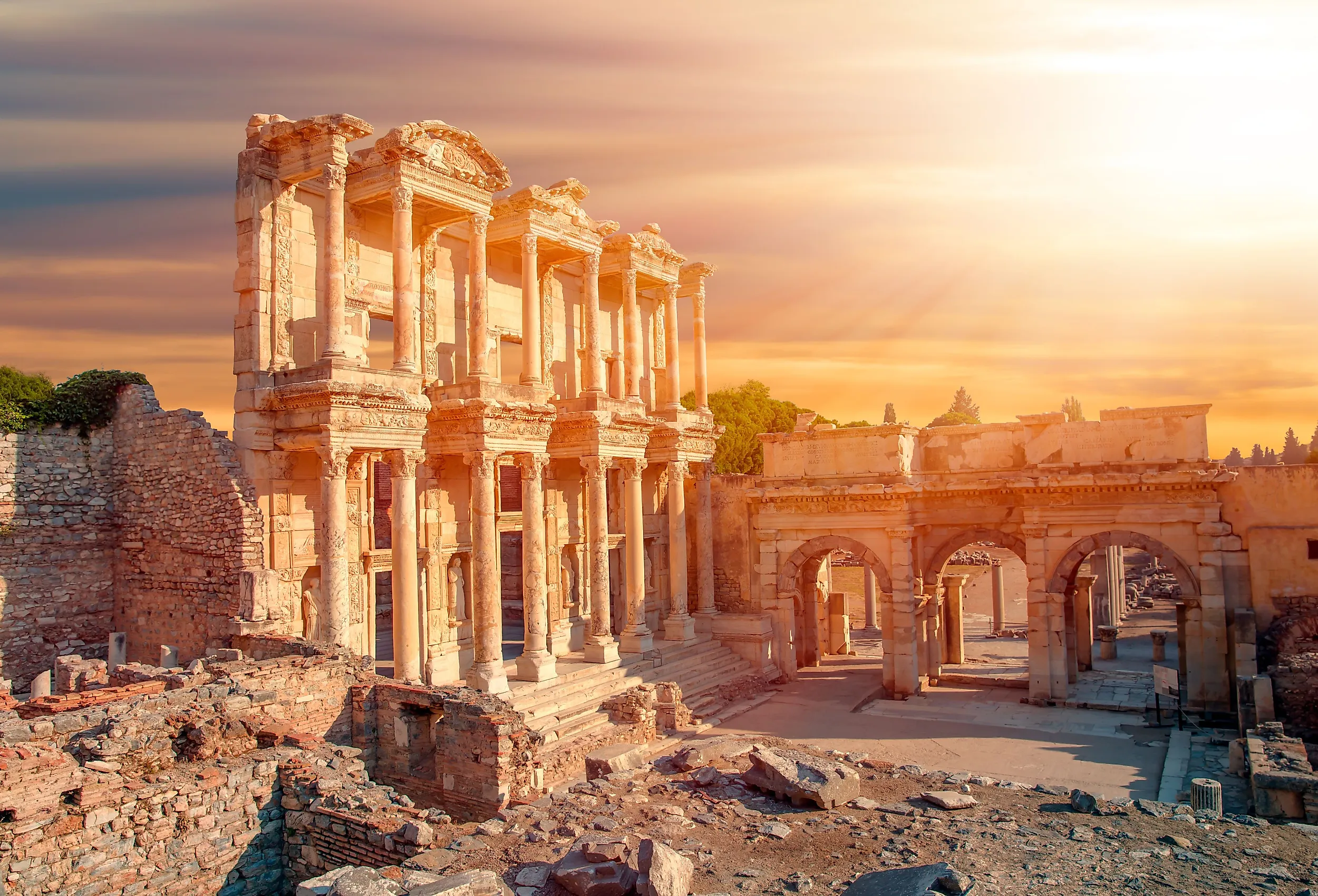
Built around 110 CE in Ephesus, and still standing today, the Library of Celsus served as both a working library and the tomb of Celsus himself. The collection of just over 12,000 scrolls is smaller than the regional giants of its era, but the library was built as a memorial to Celsus’s father and the surviving facade is one of the great pieces of Roman architecture. The columns, niches, and sculptures of the facade still draw visitors, with some original sculptures now housed in museums in Istanbul and Vienna.
The Libraries of Trajan’s Forum, Italy

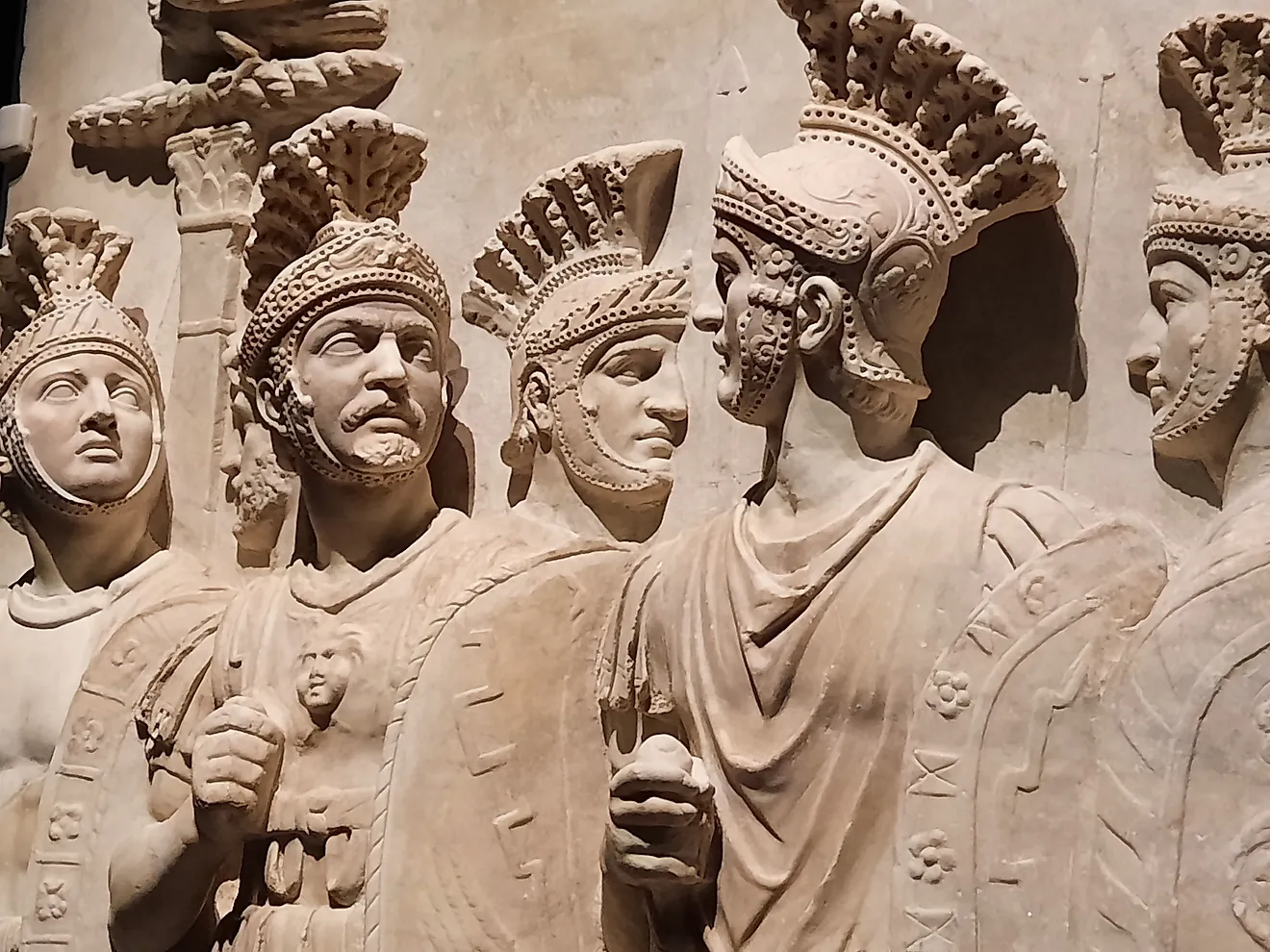
The libraries of Trajan’s Forum held roughly 20,000 scrolls between them and were part of a much larger complex in Rome that ran for over 300 years. The forum included markets, basilicas, and religious temples, with Trajan’s Column standing between two separate library buildings to keep Latin and Greek collections in matching halls on opposite sides. The exact date of the libraries’ end is unknown.
The House of Wisdom, Iraq

Established in the 9th century CE under Caliph al-Ma’mun, the House of Wisdom in Baghdad was a center of translation and scholarship that gathered Indian, Persian, and Greek manuscripts on subjects ranging from mathematics and astronomy to medicine and philosophy. Like many libraries on this list, it ended violently. In 1258, Mongol forces under Hulagu Khan sacked Baghdad and threw the library’s books into the Tigris River, with reports that the water ran black with ink for days.
University of Taxila, Pakistan

The University of Taxila, in modern-day Pakistan, is one of the earliest known centers of higher learning anywhere. The city of Taxila itself dates to the 6th century BCE under Achaemenid Persian rule, and it operated as a major Buddhist center of learning from the 5th century BCE through the 2nd century CE. Scholars came from across South and Central Asia to study religion, philosophy, medicine, and the arts. The Bhir Mound, the oldest section of the site, is now a protected archaeological complex.
The Epicenters of Knowledge
The libraries of the ancient world were centers of intellectual life and architectural achievement, and the texts they preserved (or that were lost when they burned) shaped the cultures that came after them. Modern libraries and universities exist in a line that runs directly back to Alexandria, Nineveh, Nalanda, and Taxila.