The Ottoman Empire: Early Expansion Into Europe And Egypt
The Ottoman Empire ran for 623 years, from roughly 1299 to 1922, and at its 16th-century peak spanned three continents with tens of millions of subjects. It started as a small Turkic frontier principality on the western edge of Anatolia and grew, over five generations, into the dominant power of the eastern Mediterranean and the Balkans. The empire's slow decline began with the failed Siege of Vienna in 1683, but the rise that came before it is one of the more remarkable expansion stories in pre-modern history. This is how it happened.
Osman I and the Anatolian Frontier

The conditions for the Ottoman rise were set by the Mongols. The Battle of Köse Dağ in 1243 broke the Seljuk Sultanate of Rum, which had controlled most of Anatolia, and fragmented the region into more than a dozen small Turkic principalities (beyliks). One of these, on the northwestern Anatolian frontier facing the Byzantine Empire, was led by Osman I, who declared independence from his nominal Seljuk overlords around 1299.
Osman's beylik was small but well-positioned: directly on the Byzantine border, with the Byzantines exhausted from a century of internal civil wars and the Fourth Crusade's 1204 sack of Constantinople. Osman conquered the Byzantine province of Bithynia, defeating a Byzantine force at the Battle of Bapheus in 1302 (the first major Ottoman-Byzantine engagement in the historical record). He died around 1323 or 1324. His son Orhan continued the expansion, capturing Bursa in 1326 and making it the first Ottoman capital. By the mid-1300s the Ottomans had consolidated control over northwestern Anatolia and were ready to push into Europe.
Into the Balkans

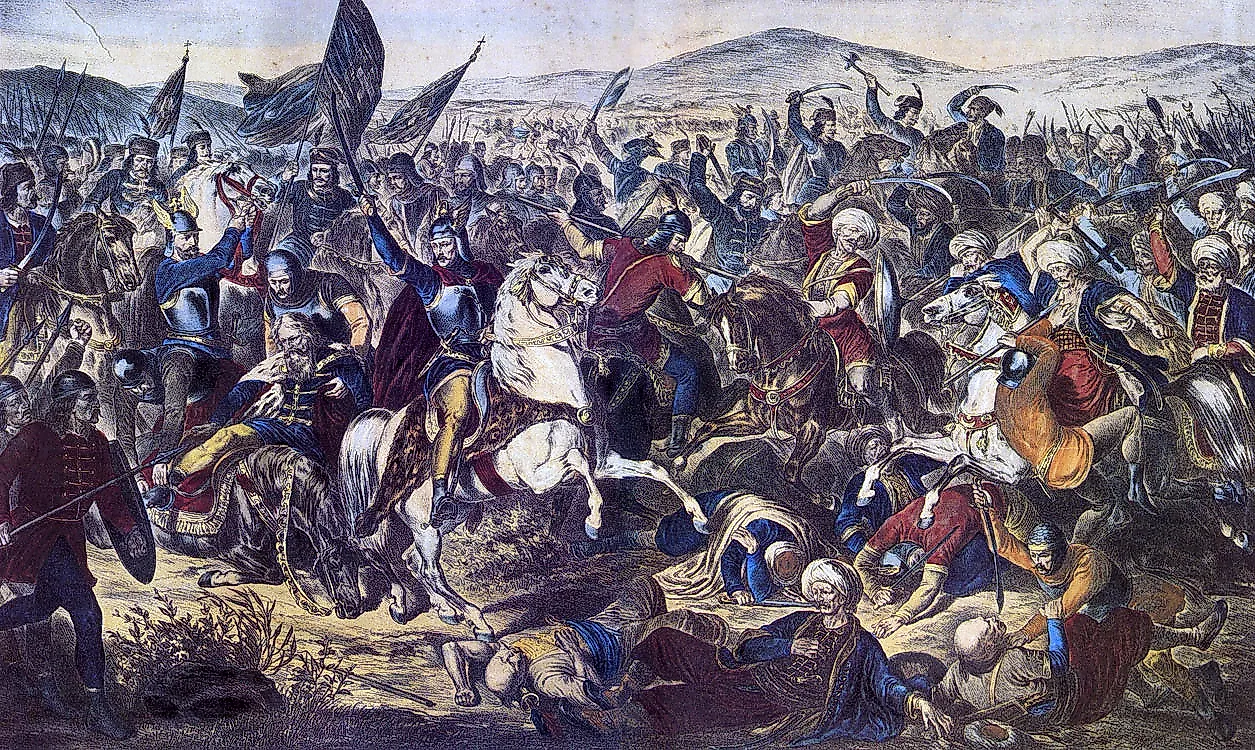
The crossing into Europe began in 1352, when Orhan's son Süleyman seized the Byzantine fortress of Tzympe on the Gallipoli peninsula. A 1354 earthquake destroyed nearby Byzantine defenses, and Ottoman forces took Gallipoli itself, giving them a permanent European foothold. Over the next four decades, the Ottomans took Thrace, Macedonia, most of Bulgaria, and forced Byzantine emperors into vassal status. The Battle of Kosovo in 1389 effectively ended Serbian independence (though Sultan Murad I was killed in the battle), and the Battle of Nicopolis in 1396 destroyed a Crusader army assembled to push the Ottomans back.
Then came the disaster. In 1402, at the Battle of Ankara, the Central Asian conqueror Timur (Tamerlane) crushed the Ottoman army and captured Sultan Bayezid I, who died in captivity the following year. The empire fractured into a civil war among Bayezid's sons known as the Ottoman Interregnum, which lasted from 1402 to 1413. Mehmed I eventually defeated his brothers and reunified the state. His son Murad II spent his reign rebuilding Ottoman power, retaking the Balkans, and defeating a final crusading army at the Battle of Varna in 1444. By the mid-1400s the Ottomans were ready to finish what Osman had started: the conquest of Constantinople itself.
The Fall of Constantinople

Constantinople had withstood more than a dozen sieges over the course of a thousand years, protected by the Theodosian Walls (built in the 5th century under Emperor Theodosius II and considered the most formidable urban fortifications in the medieval world). Previous Ottoman attempts to take the city had failed for that reason. Mehmed II, who became sultan at age 19 in 1451, decided to solve the wall problem with gunpowder.
Mehmed commissioned a Hungarian engineer named Orban to cast siege cannons of unprecedented size. The largest, called the "Basilic," fired stone balls weighing up to 600 pounds and required a crew of 200 to operate. The siege began on April 6, 1453. For seven weeks the cannons battered the Theodosian Walls while Ottoman forces attacked by land and blockaded by sea. The city fell on May 29, 1453. Emperor Constantine XI died in the final assault, the last Roman emperor in an unbroken line stretching back to Augustus. Mehmed (now "the Conqueror") made Constantinople his capital and adopted the Roman imperial title Kayser-i Rûm (Caesar of Rome). He was 21 years old.
The Mamluks

The next obstacle to Ottoman dominance was the Mamluk Sultanate, which controlled Egypt, Syria, and the holy cities of Mecca and Medina. The two Muslim powers had been rivals since Constantinople's fall, competing for the spice trade and for religious legitimacy. Sultan Selim I (reigned 1512-1520, known as Selim the Grim) handled both fronts: first defeating the Safavid Persians at the Battle of Chaldiran in eastern Anatolia in 1514, then turning south against the Mamluks.
The Ottoman professional army (roughly 60,000 men, equipped with firearms and field artillery) overwhelmed the Mamluk forces (smaller, around 15,000-20,000, and reliant on traditional heavy cavalry without firearms) at the Battle of Marj Dabiq in northern Syria on August 24, 1516. Mamluk Sultan al-Ghuri died on the field. The Ottomans took Damascus, then Cairo at the Battle of Ridaniya on January 22, 1517. Within ten months of the war's opening, the Ottomans controlled Syria, Palestine, Egypt, and the Hijaz with its holy cities. Selim I assumed the title of Caliph, claiming spiritual leadership over the global Sunni Muslim community.
Professional Soldiers and the Devşirme

The Ottoman military advantage was not just numerical. From the mid-1300s, the Ottoman state maintained a standing professional army at a time when most European and Islamic rivals still relied on feudal levies and seasonal peasant conscripts. The core of this army was the Janissary corps (Yeniçeri, "new soldier"), established by Sultan Murad I in the late 14th century. Janissaries were full-time paid soldiers, garrisoned year-round, trained in firearms early, and personally loyal to the sultan rather than to any provincial lord.
The Janissaries were recruited through a system called the devşirme (literally "collection" or "gathering"), under which Christian boys from Balkan villages were taken as a form of tax, converted to Islam, trained in Ottoman service, and barred from marriage and from owning property. The system produced administrators as well as soldiers: the most capable graduates filled high state offices, including grand vizier. The arrangement looks brutal from a modern perspective, but it gave the Ottoman state a meritocratic governing class loyal entirely to the sultan, with no inherited aristocratic interests to balance against. In later centuries the Janissaries would become a politically powerful and increasingly ungovernable faction, repeatedly deposing sultans and resisting reform. They were finally destroyed in 1826 by Sultan Mahmud II in an event known as the Auspicious Incident.
The Rise in Perspective
From a frontier beylik in 1299 to the conquest of Constantinople in 1453 to the absorption of the Mamluk Sultanate in 1517: the Ottoman rise covered about 220 years and four major military revolutions (the move to gunpowder, the standing professional army, the devşirme administrative class, and the gunpowder-cavalry combined-arms tactics that defeated both the Mamluks and the Hungarians). The empire would peak under Süleyman the Magnificent (reigned 1520-1566) before beginning its long, slow contraction. But what Osman started on the Anatolian frontier ultimately reshaped three continents, ended the Roman imperial line, brought Islam to southeastern Europe for half a millennium, and produced the longest-lasting Islamic empire in history. The modern Republic of Turkey inherits its institutional and cultural legacy, founded by Mustafa Kemal Atatürk on the ruins of the empire in 1923, a year after the last Ottoman sultan was deposed.