What An Ancient Roman Gladiator Really Looked Like
Ancient Roman gladiators were not the lean, chiseled warriors often seen on screen, but rather bulky, heavily scarred fighters built for endurance over appearance, typically standing around 5 feet 6 inches (168 cm) tall. Feted and fawned over, these hardened fighters captured the imagination of Roman society, from its emperors to the lowliest serf. They packed arenas, adorned art, and came to symbolize bravery.
Gladiators were the celebrities of their day, but they didn’t have the movie star looks to match. An ancient punching bag, they were heavily scarred, bulky, and fleshy, with deformities from old wounds and bad teeth. Read on to separate fact from fiction and delve into the historical evidence to get an accurate picture of these iconic warriors.
What Was Gladiatorial Combat?

How a gladiator looked was directly related to what they did. These famous fighters are known as fierce warriors who would fight to the death, but our idea of gladiatorial combat is a bit of Hollywood mythmaking mixed with reality.
Ancient Rome was a bloodthirsty place where strength ruled. The Romans worked hard, fought hard, and played hard. Their entertainment included brutal games in which fighters fought one-on-one. These fighters, known as gladiators, were drawn from society’s underclass, consisting of slaves, prisoners of war, or criminals.
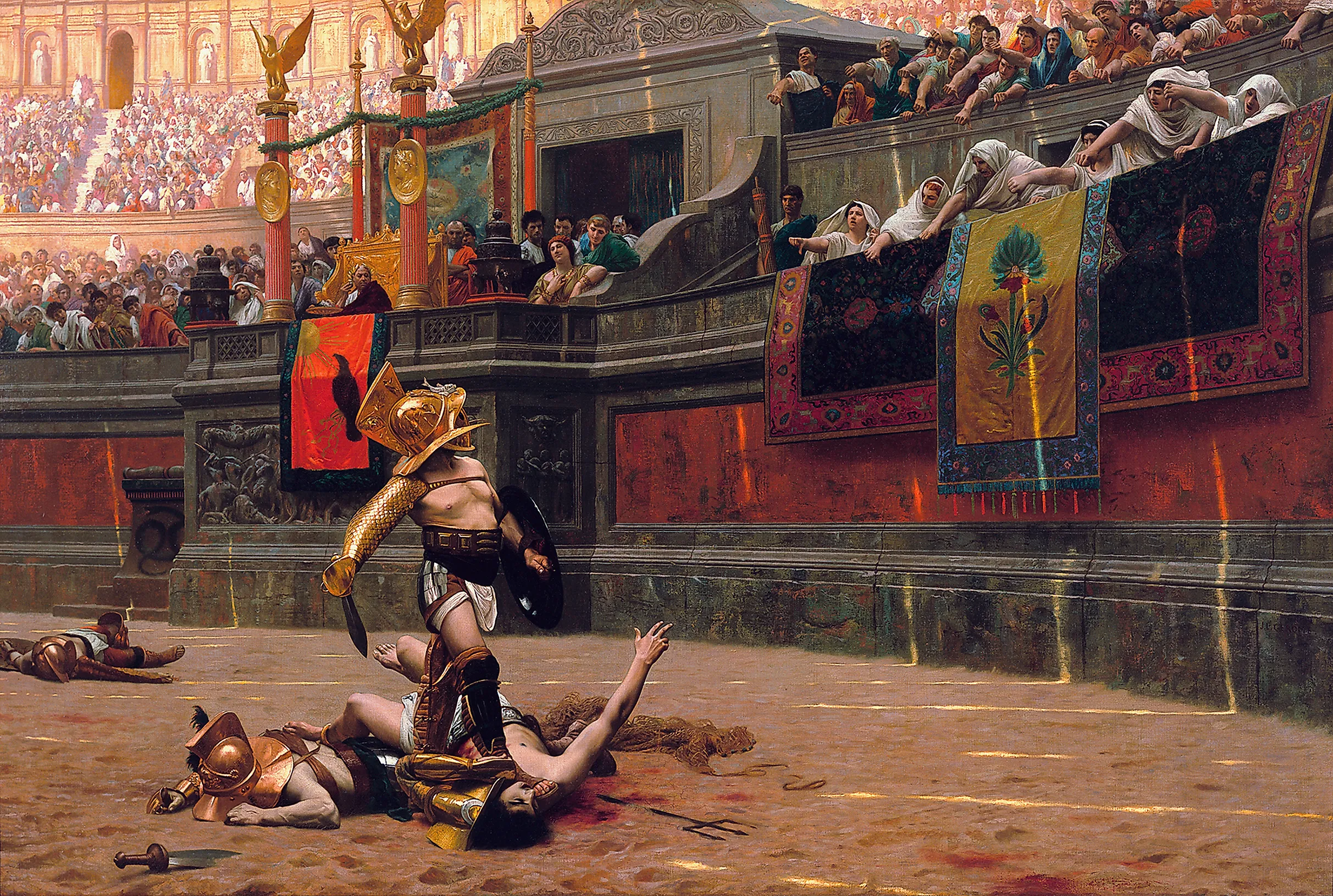
Initially, the games were hosted by the wealthy and ruling classes, but as their popularity grew, they became a form of public entertainment available to all. Under state control, the games became more organised with gladiator schools responsible for training the fighters. There were several different kinds of gladiators, and each would’ve looked slightly different. Murmillo were heavily armored gladiators with large shields and huge helmets displaying a fish-shaped crest. Retiarius wore lighter armor and used a large net and a trident. The Essedarii were mounted gladiators who rode into the fight on chariots.

Contrary to the movies, fights weren’t always to the death. They were highly organised and refereed. Gladiators were considered far too valuable and costly to replace, so battles would often be stopped before they became lethal. They were, however, extremely violent and bloody. The cruel carnage of the gladiator games led to their being discouraged under Rome’s first Christian emperor, Constantine, in 325 AD, and gradually declined over the following decades.
What Gladiators Really Looked Like

Gladiators were men who knew how to take a beating, and their bodies bore the scars. Constant fighting would’ve taken its toll, leaving them with deep, lasting scars. This was confirmed in 1993 when archaeologists uncovered a mass gladiator grave in Ephesus, Turkey, which contained at least 68 bodies.
Analysing these remains, known collectively as the Osseous Evidence, enabled historians to put together a detailed picture of the average gladiator. The bodies were those of males aged between 20 and 30 years, around 5ft 6.1 inches (168cm) tall, which was average height for the time. Injuries found on the skeletons included evidence of head trauma, a healed fracture, and an amputated tibia. Scientists also discovered enlarged muscle markers on the legs and arms that hinted at the intense training gladiators would’ve gone through in the schools.
A Diet For Champions

Well-muscled and heavily scarred, gladiators were also bulky due to their diet. Fighters had to be able to absorb a blow. They would’ve been stabbed and pierced by their opponent’s weapon, and the more subcutaneous fat they had, the less likely the spear or sword would hit their internal organs or an artery. To bulk up, gladiators ate a stodgy diet of barley and beans, with very little animal protein. This mostly vegetarian, high-carb diet would’ve made them look large and fat, but increased the spectacle in the arena as they could endure heavy bleeding from surface wounds and fight on.
Gladiators ate so much barley that it became a bit of a joke. In his book, Natural History, the Roman author Pliny the Elder contemptuously referred to gladiators as ‘hordearii,’ which translates as ‘barley eaters’. All those grains did have some negative side effects. The bones recovered from Ephesus show that gladiators had poor dental health from a high-carb diet and coarse food, and were prone to cavities.
A barley-rich diet also had another, more significant, downside. Relying purely on grains didn’t give the gladiators enough calcium to strengthen their bones. To mitigate this, the fighters drank a kind of ancient sports nutrition smoothie made from plant ash, which supplemented the calcium they needed.
Gladiator Gear

Gladiators were professional fighters. Staying alive in the arena wasn’t just a matter of physical health and strength; you also needed the gear to match. Most wore a helmet to protect their skulls, and armor pieces were strategically placed over the most vulnerable body parts, but the nature of their armor varied widely.
Murmillos, the heavyweight brawlers, wore wide-brimmed, heavy helmets with a crest on top and eyeholes across the front to give them maximum visibility. They also wore a long arm guard to protect the arm not holding their tall, rectangular shield, along with a leg guard. Lighter fighters, such as the Thraex, carried smaller shields and minimal armor to give them the advantage of speed and agility against the brute force of a murmillo.
The Retiarius was the least protected of the fighters. He wore no helmet and very little armor, relying instead on his principal weapons, the net and the trident. This bare-bones look would’ve made him instantly recognizable, unlike the other gladiators whose helmets gave them anonymity from the crowd. The Retiarius was generally paired with a Secutor, nimble fighters who wore smooth helmets with small eyeholes so they wouldn’t get caught in the net or pierced in the eye with a trident.
The unique gladiatorial fashions are captured in many Roman artifacts displaying the warriors mid-fight. These iconic images, which adorn pottery, lamps, figurines, and other items, would’ve been collected in the same way sports fans collect merchandise today, eagerly snapping up memorabilia of their favorite athletes. If you want to see these ancient artworks firsthand, take a trip to the Metropolitan Museum of Art in New York or visit the J. Paul Getty Museum in Los Angeles, both of which have some of the finest collections of Roman art in North America.
Women Warriors

While the overwhelming majority of gladiators were male, it’s worth noting that there were some female fighters who also competed in the arenas. Known as gladiatrices, these fighters were rare and seen more as a spectacle than a sport.
The most compelling evidence for the existence of women warriors is a marble relief dating back to the first century. Housed in the British Museum, the tablet shows two female gladiators, Amazon and Achillia, facing off as if about to fight. Both are dressed similarly to male gladiators but without helmets. There is also documentary evidence and eyewitness accounts of female fighters. The emperor Domitian, who ruled from 81 to 96 AD, reportedly made women fight by torchlight.
Historians know very little about female gladiators, compared to their male counterparts, so it’s impossible to say with certainty what they would’ve looked like or whether, like the men, they’d have eaten a bulky, carb-rich diet. The practice appears to have been short-lived, with Emperor Septimius Severus banning female gladiators in 200 AD.
From Ancient Heroes to Modern Celebrities

The Roman world was tough, and its entertainments reflected the stark realities of living in an empire where survival was a constant battle against enemies from all sides. In this era of bloody sieges, devastating battles, and short life expectancies, it’s no wonder that the public embraced its fighters and flocked to the Colosseum to cheer on their heroes.
Thankfully, society has shed its desire for public bloodletting, but the gladiatorial spirit is still very much alive in modern entertainment. In recent years, we’ve seen a sequel to Gladiator hit the big screen and a revamp of the popular TV series American Gladiators hit the small screen. These feature the classic Gladiator look, which bears little relation to reality but conveys the gladiatorial characteristics of strength, fitness, and power.