The Most Important Battles of the Peloponnesian War
Due to its complexity and length, it is difficult to describe the Peloponnesian War (431 BCE to 404 BCE) in its entirety. As one of the first recorded examples of total war, nearly every aspect of Greek society was touched by it. Five key battles have gone down in history as watershed moments in the conflict, though. This article will look at these history-shaping moments to shed light on a conflict that fundamentally changed the Greek world.
Spartan Invasions of Attica (431 BCE to 421 BCE)

The first major battle was actually a series of Spartan invasions of Attica (the region north of Athens) throughout the first ten years of the war. Sparta did this to destroy the region's farmland, putting major strain on Athenian food supplies. Nonetheless, Athens' control of the sea enabled it to survive via food shipments from elsewhere, primarily the Black Sea and other maritime routes. However, overcrowding in the city due to people fleeing from Attica resulted in a plague from 430 BCE to 426 BCE. 75,000 to 100,000 people died, and the plague also had enormous political and social implications. Athenian leader Pericles, who was largely responsible for the growth of Athenian power in the years leading up to the war, died. Furthermore, the rule of law temporarily broke down within the city. While Athens survived the invasions of Attica, its consequences reverberated throughout the rest of the war.
The Battle of Pylos and Sphacteria (425 BCE)
While Sparta leveraged its land strength in Attica, Athens utilized its naval strength in the Battle of Pylos and Sphacteria. In 425 BCE, Athenian commander Demosthenes fortified a strategic harbor in Pylos. This alarmed the Spartans, who responded by sending a naval and land force to take the island. However, an Athenian fleet then arrived and defeated the Spartan navy, trapping their land force on the nearby island of Sphacteria. Thereafter, the Athenians landed on the island and forced the Spartans to surrender, capturing hundreds of soldiers. This battle was thus a massive boost to Athenian morale and significantly weakened Sparta's reputation by showing that its land forces were beatable.
The Battle of Mantinea (418 BCE)

The Battle of Mantinea marked the beginning of the second phase of the Peloponnesian War, following a brief respite brought by the Peace of Nicias in 421 BCE. It occurred due to the emergence of a new Athenian-supported anti-Spartan alliance of Argos, Mantinea, and Elis. To combat this threat, Sparta mobilised its land forces, and the two sides met near the Arcadian city of Mantinea. Despite an initial moment of Spartan weakness, they recovered and defeated the coalition forces. This resulted in the collapse of the alliance, forcing Argos to make peace with Sparta. More broadly, the victory helped restore Sparta's reputation, which, as previously mentioned, had been damaged by the Battle of Pylos and the Battle of Sphacteria.
The Battle of Syracuse (413 BCE)

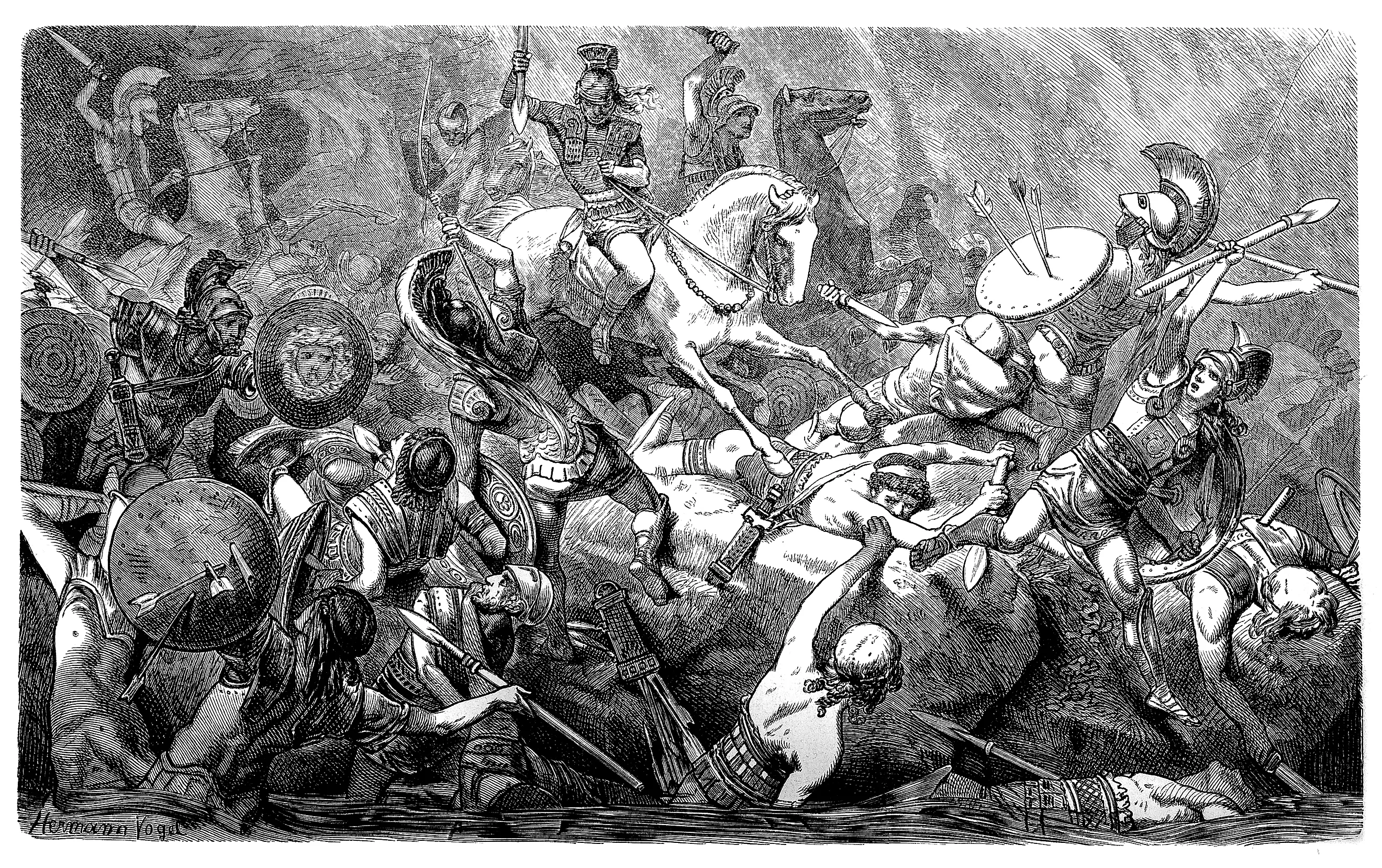
In 415 BCE, Athens launched a campaign to take the island of Sicily, where Syracuse was allied with Sparta. Led by commanders Nicias, Alcibiades, and Lamachus, the goal was to expand Athenian power and influence over western trade and grain routes. However, the campaign experienced some difficulties when Alcidbiades defected to Sparta. It then became outright catastrophic in 413 BCE, when the Athenian navy and land army tried to take Syracuse, the largest and most important city in Sicily. On land, the Athenians failed to siege the city due to its strong defenses. At sea, the Athenian was defeated and largely destroyed in the Great Harbor of Syracuse. The loss of hundreds of sailors and ships permanently weakened the Athenian navy. With the primary basis for its strength now lessened, many of Athens' allies began to revolt. The Battle of Syracuse marked the beginning of the end for Athens in the Peloponnesian War.
The Battle of Arginusae (406 BCE)

If the Battle of Syracuse permanently weakened Athens' navy, the Battle of Arginusae seriously weakened its military leadership. The battle itself was a success for the Athenians, as they defeated the Spartan fleet near the Arginusae islands off the coast of Anatolia. Nonetheless, afterward, a storm prevented the Athenians from rescuing survivors in the water, resulting in thousands of sailors drowning. This caused outrage amongst the Athenian public and led to six of the eight generals involved, who had just led Athens to victory, being executed. By destroying its own top echelon of military leaders, Athens further weakened its already precarious position.
The Battle of Aegospotami and the Fall of Athens (405 to 404 BCE)

This weakness was on full display in the Battle of Aegospotami, which occurred near the Dardanelles. As a crucial waterway between the Mediterranean and the Black Sea, it was Athens' main grain supply route. The battle began in a five-day stand-off, with the Athenian fleet sailing out each morning in an attempt to goad the Spartans into battle. However, under the leadership of Commander Lysander, the Spartans refused to engage, only to launch a surprise attack on the fifth day when the Athenians returned to shore to look for food. Left underguarded, the Athenian fleet was almost completely destroyed, and thousands of sailors were captured or killed.
With its supply lines and navy decimated, Athens itself was now vulnerable. Lysander thus sailed to Athens and began a naval blockade. At the same time, the Spartan army began to besiege the city by land. With no way to fight back, conditions inside Athens rapidly deteriorated. Food ran out, famine spread, and morale collapsed. Athens surrendered in 404 BCE, marking the end of the Peloponnesian War and the beginning of Spartan domination in Greece.