How The Pyramids Of Giza Were Really Built
The question of how the Egyptian Pyramids of Giza were built has puzzled people for millennia. The Great Pyramid alone required more than 2.3 million blocks weighing 2.5 metric tons each on average. Explaining how such structures rose over 4,000 years ago without modern technology takes both the hard facts and a trip into the mindset of an entirely different civilization. Doing so reveals the pyramid’s symbolic significance. The consciousness of the Egyptians may have mattered more than their technology in producing these timeless monuments.
The Administrative Means To Rule Egypt

Nile River flowing past the sand dunes of Aswan, Egypt.
It helps to start with historical context. Ancient Egyptian civilization began sometime around 3,150 BCE when Narmer united Upper and Lower Egypt. It had key advantages over other contemporary civilizations. The Nile River flooded predictably every year, creating fertile farmland around it. This meant that Egypt often had food surpluses, allowing it to survive events like droughts. Its deserts also provided ample protection from invasions.
This stability and abundance of resources facilitated the rise of a strong and centralized government. At the top was the pharaoh, considered both the earthly and divine ruler. This dual authority ensured that few ever challenged him, paving the way for an efficient and sophisticated administrative state. The vizier oversaw bureaucratic elements from judiciary branches to the Egyptian treasury. Forty-two regional governors, called nomarchs, ran Egypt’s administrative districts and handled everything from tax collection to maintaining law and order. The lowest level of government was occupied by scribes, ancient pencil-pushers. These were record keepers, bureaucrats, and administrators responsible for day-to-day operations.
This system created the necessary conditions for massive national projects. Egypt’s abundant resources were effectively put to use via its sophisticated administrative state, backed by the pharaoh’s ultimate authority.
Religion in Ancient Egypt

Statue of Egyptian Sun God Ra.
The Egyptians also needed a specific goal to work toward, and that’s where religion came in. In the early days, religion in Egypt was characterized by thousands of localized animistic cults (animism is the belief that all objects possess a spiritual essence or soul). Under the divine authority of the pharaohs, who acted as intermediaries between divinity and mortals, specific animistic gods gained national prominence. By the time of the Old Kingdom (2,700 to 2,200 BCE), the sun god Ra was the most widely followed deity. A core component of following Ra was the belief that the pharaohs would join him in the afterlife. Pyramids were built to preserve the pharaohs’ bodies and help them transition to life after death. By leveraging the spiritual consciousness of the time, in which religion was central to life, and pharaohs preserved cosmic order, or Maat, Egyptian rulers were able to manage a large workforce extremely efficiently, in the name of preserving divine order.
The Early Pyramids and Building Techniques

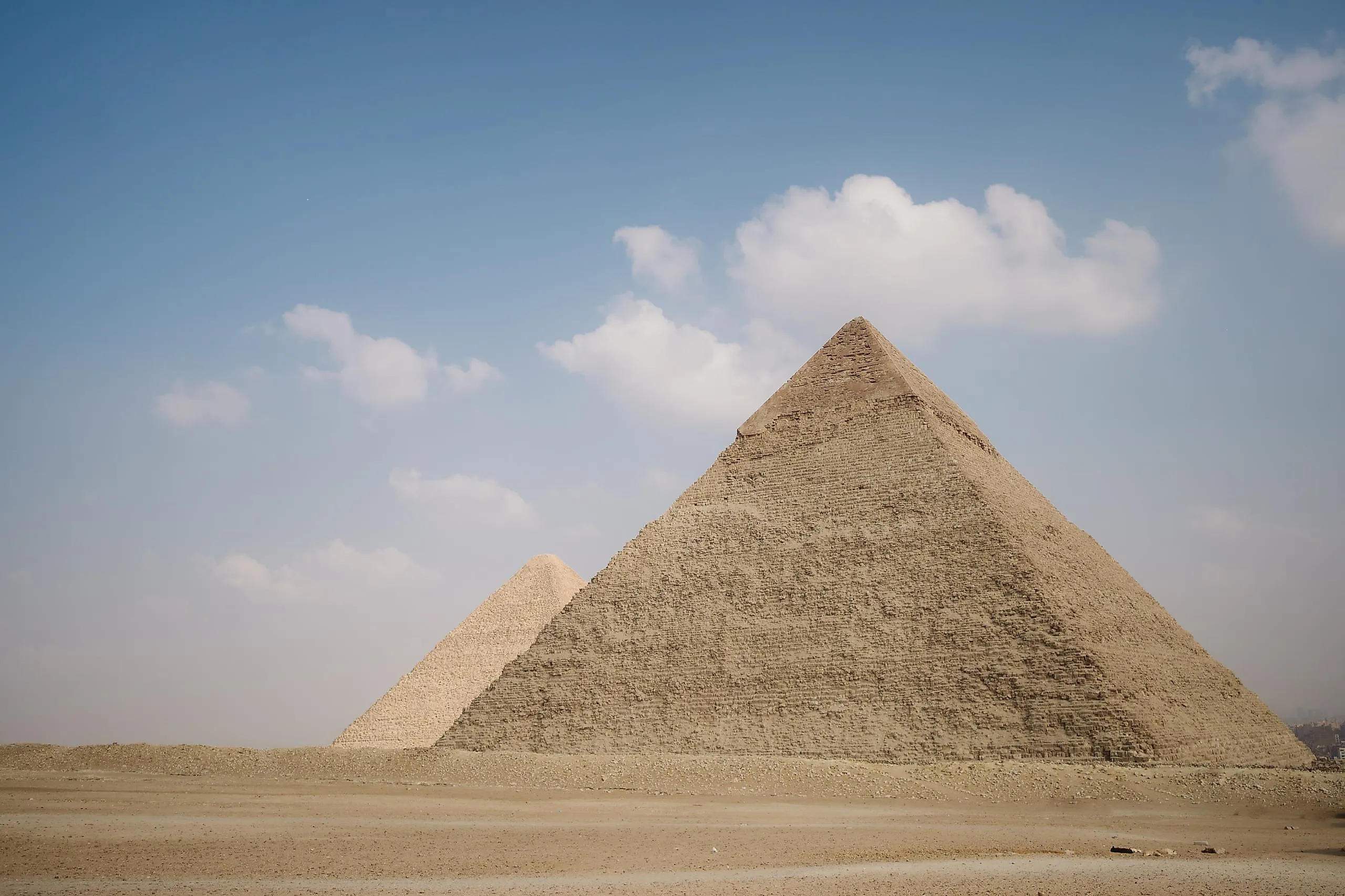
One pyramid of the Giza Plateau.
The first pyramids were built sometime between 2670 and 2650 BCE, and due to their use of mostly hard stone, have stood the test of time. Ordered for construction by the pharaoh Djoser and designed by his architect, Imhotep, they were significantly smaller than the pyramids which followed. Even so, they introduced key innovations, most notably the first recorded wide-scale use of cut stone. Commonly accepted methods for how this was accomplished include copper saws and tools, combined with sand (containing quartz) to increase abrasion, along with round dolerite pounding stones and water-soaked wooden wedges to quarry large chunks. More exotic theories include use of diamond or obsidian drilling, based on examples or cores and finely angled artifacts difficult to attribute to primitive technologies.
The next pharaoh, Sneferu, pushed pyramid building forward through trial and error. He oversaw the construction of the “Bent Pyramid" in Dahshur, in which workers began building the structure at a sharp angle, only for it to start cracking due to its own weight. This forced them to change the angle midway, giving the pyramid a bent shape. The "Red Pyramid", also in Dahshur, used a lower and more stable angle from the start. It was also the first “smooth side” pyramid, in contrast to earlier ones that often resembled jagged staircases to the sky.
Mysteries of The Pyramids of Giza

The “Golden Age of Pyramid Building” occurred from 2560 to 2490 BCE in Giza. Beginning with the construction of the appropriately named “Great Pyramid of Giza”, this period saw the building of the largest pyramids ever. They also contained smooth sides and complex internal chambers, which were further indicative of the now perfected designs. Transporting and lifting millions of massive stones required for the project involved many techniques, some of which are agreed upon, and some of which remain speculative.
Step one was getting quarried rocks to the build site. It is believed that large blocks from distant quarries were floated down the Nile River, aided by a now-dried up tributary, then dragged over land, possibly with the aid of logs place underneath. When in position, an early source, Herodotus, described a method of using short logs as levers to heave stones up one step at a time. The stones were heaviest at the bottom, and grew smaller and lighter towards the top. Another early source, Diodorus, cites the use of earthen ramps. While generally agreed upon for smaller stones (2.5 tons), some stones weighed up to 70 or more tons, and how this was accomplished branches into the realm of mystery. One recent theory posits the use of locks to float stones into position.
What is certain is that the Egyptian state leveraged the full strength of its bureaucracy and resources to build these pyramids in record time. The Great Pyramid is thought to have taken just 20 years to complete. Its limestone blocks were sourced locally, but granite was transported from Aswan, hundreds of miles away, via the Nile. Despite the common belief that the pyramids were built by slaves, they were actually constructed by paid workers who were housed and fed. While costly, the state could afford to do so (at least for the time being) due to the aforementioned abundance of resources.
Gradual Decline

Close up of the pyramid blocks in general disarray.
Egypt’s resources were not infinite, however. Some estimate that the mortar used to fill in gaps between blocks, which had to be dehydrated by heating, required Egypt to strip all of its forests. Any instability among the Egyptian people would have also greatly inhibited construction, which required a smoothly functioning state on all levels. As time wore on, pyramid building declined after 2,500 BCE. Despite continuing in some form for hundreds of years, the pyramids became smaller and poorer in quality. The last pyramid was built by Pharaoh Ahmose I in the 1,500s BCE, but due to its poor quality, it no longer exists. The last surviving pyramid was built by Pharaoh Pepi II between 2284 and 2214 BCE.
Importance of the Pyramids
Millennia have passed since their construction, along with many of the pyramid builder’s secrets. While understanding how the pyramids were built is crucial to comprehending Ancient Egypt, ultimately, much remains speculative. The recipe for building is clear enough. An abundance of resources, a strong administrative state, and the positioning of pyramid-building as a religious imperative all came together. The design and execution, however, becomes at times harder to fathom. Large stone blocks put into exacting geometry, aligned with astronomical precision, still leave us scratching our heads in awe. Perhaps that was the point.