Maps of Ohio
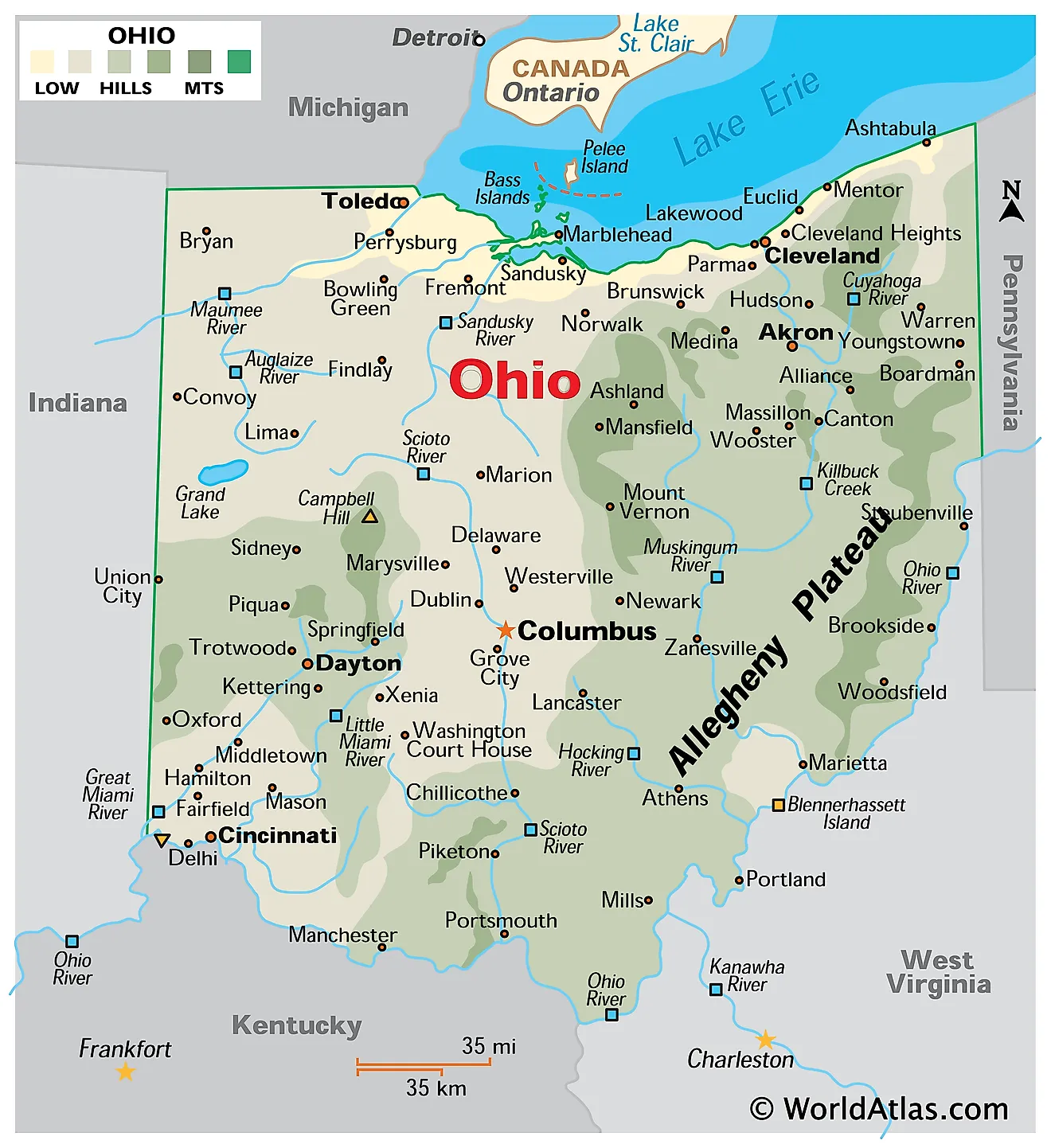
Ohio is a state in the Midwestern United States. It shares its borders with Pennsylvania to the east, Michigan to the northwest, Indiana to the west, Kentucky to the south, and West Virginia to the southeast. Its northern border runs along Lake Erie. The state encompasses a total area of 44,825 square miles (116,096 square kilometers), making it the 34th largest state.

Ohio's landscape is organised by a single line: the southern edge of the ice sheets. Glaciers covered roughly two-thirds of the state, flattening the north and west into some of the most fertile farmland in the country. Where the ice stopped, in the southeast, the land has been left to erode into a dissected plateau of sandstone hills, deep hollows, and narrow valleys. Ohio also sits at an unusual hydrological crossroads, with one edge draining north to the Great Lakes and the St. Lawrence, and the rest draining south to the Ohio and the Gulf of Mexico.
Where Is Ohio?

Ohio measures roughly 220 miles north to south and 220 miles east to west, giving it a compact, nearly square outline. Its boundaries mix water and survey lines: Lake Erie along the north, the Ohio River along the entire southern and southeastern edge, and straight lines elsewhere.
Ohio's relief is gentle. Elevations run from 1,549 feet at Campbell Hill down to 455 feet where the Ohio River leaves the state at the Indiana line. With roughly 11.8 million residents, Ohio is the seventh most populous state, and it is divided into 88 counties.
The Central Lowland

Ohio shoreline at sunset, on the Erie lake.
The Central Lowland covers the western and northern parts of Ohio, where relief is low and the bedrock is largely Silurian limestone and dolomite buried under glacial deposits. It divides into two sections.
The Huron-Erie Lake Plains form a flat belt along the Lake Erie shore, widest in the northwest. This is the bed of a series of glacial lakes that stood higher than Erie does today, and it is the flattest ground in Ohio. The lake itself gives the state about 312 miles of shoreline. The eastern portion is backed by clay bluffs 10 to 18 feet high, the western portion by beaches of sand and clay.
The Till Plains occupy the interior west, a gently rolling surface of glacial till crossed by low ridges called moraines. These are the state's richest soils. Campbell Hill, the highest point in Ohio at 1,549 feet (472 meters), lies here, within the city of Bellefontaine in Logan County, not in the Appalachian Plateau, as is sometimes stated. It is itself a glacial moraine on a bedrock rise called the Bellefontaine Outlier, and ranks 43rd among the 50 state high points.

The northwest corner held the Great Black Swamp, a wetland of roughly 1,500 square miles (4,000 square kilometers) occupying the bed of glacial Lake Maumee and extending into northeastern Indiana. Marsh, wet prairie, and swamp forest of ash, elm, and sycamore covered it, with beech, maple, and oak on higher ground. It was drained during the 19th century for farming, an enormous engineering effort that left behind highly productive but heavily tiled fields. The legacy is ecological: nutrient runoff from that same ground now feeds the toxic algal blooms that recur in western Lake Erie each summer.
The Appalachian Plateau

The Appalachian Plateau covers eastern and southeastern Ohio, underlain by Pennsylvanian and Permian sandstone, shale, and coal. It splits into two halves along the Allegheny Escarpment, a line that marks a sharp change in topography, vegetation, and land use.
The Glaciated Allegheny Plateau, in the northeast, was smoothed by ice. Valleys were partly filled with drift, slopes softened, and soils improved, so farming does reasonably well here.

The Unglaciated Allegheny Plateau, south and east of the escarpment, never received that cover. Streams have carved it into steep, narrow-crested hills separated by tight valleys, with thin, acidic soils that have largely returned to forest. This is the most rugged country in Ohio; the greatest local relief is in Monroe, Belmont, and Jefferson counties in the far east.
The Hocking Hills, southeast of Columbus, are its best-known expression. There, the Black Hand sandstone, a thick and erosion-resistant layer, has been undercut by streams into recess caves, gorges, and waterfalls including Ash Cave and Old Man's Cave. Wayne National Forest, Ohio's only national forest, protects some 244,000 acres of this hill country.
The Bluegrass Section

Ohio's smallest region occupies part of Adams County and a narrow band along the Ohio River through Brown, Clermont, and Hamilton counties. Two clarifications are worth making, because both are commonly garbled.
First, this area belongs to the Interior Low Plateaus, which is a separate physiographic province from the Appalachian Plateaus, not a subsection of it. The Interior Low Plateaus fall within the Interior Plains division and extend from Ohio and Indiana down through Kentucky and Tennessee into Alabama.
Second, Ohio's portion is the Outer Bluegrass, not the Inner Bluegrass. The Inner Bluegrass lies well south, around Lexington, Kentucky.

Limestone lies close to the surface here, producing alkaline soils and karst features such as sinkholes, springs, and entrenched streams. The resulting conditions support rare prairie openings and cedar barrens found nowhere else in the state, first documented by the Ohio botanist Lucy Braun. The Great Serpent Mound sits on the rim of an ancient cryptoexplosion structure, a deformed circle of bedrock roughly five miles across, likely a meteorite impact site.
Rivers and the Continental Divide

A low drainage divide crosses northern Ohio, and it matters more than its modest height suggests. North of it, rivers flow to Lake Erie and eventually the St. Lawrence and the Atlantic; south of it, everything drains to the Ohio, the Mississippi, and the Gulf of Mexico.
The Ohio River forms the state's entire southern and southeastern boundary, roughly 450 miles of it. Contrary to a common phrasing, this gives Ohio a second major navigable outlet, not merely Lake Erie. Barge traffic from Ohio reaches the Gulf through it.

Draining north are the Maumee, the largest river flowing into the Great Lakes by watershed area, along with the Sandusky, the Huron, and the Cuyahoga. The Cuyahoga's lower valley is protected as Cuyahoga Valley National Park, the only national park in Ohio.
Draining south are the Scioto through the centre of the state, the Great Miami and Little Miami in the southwest, the Hocking in the southeast, and the Muskingum, the largest river lying entirely within Ohio.
Lake Erie and the Islands

Lake Erie is the shallowest of the Great Lakes, averaging only about 62 feet deep, which makes it the warmest and the most biologically productive. It is also the most prone to algal blooms and to freezing over in winter.
Its western basin holds a cluster of limestone islands, of which Kelleys Island is the largest in the American portion. The Lake Erie Islands are outcrops of hard dolomite that resisted glacial scour while softer rock around them was carved away.

Kelleys Island also carries the Glacial Grooves, a set of furrows gouged into bedrock by the ice sheet, up to 400 feet long, 35 feet wide, and 10 feet deep. They are among the largest easily accessible glacial grooves anywhere in the world.
Ohio has almost no large natural inland lakes. Grand Lake St. Marys, built in the 1840s to feed the Miami and Erie Canal, was the largest artificial lake in the world at the time and remains among the biggest inland waters in the state.
Climate

Ohio has a humid continental climate over most of its area, edging toward humid subtropical in the far south along the Ohio River. With no terrain to block anything, Canadian cold, Gulf moisture, and dry plains air all reach the state freely.
Precipitation runs about 36 to 44 inches a year, increasing southward and fairly evenly spread across the seasons. Snowfall varies far more: the northeast, in the Lake Erie snowbelt, receives well over 100 inches in places as cold air crosses the relatively warm lake and dumps its moisture on the higher ground inland, while the southwest averages under 25 inches.
Ohio averages roughly 20 tornadoes a year, most in spring and early summer. Flooding along the Ohio River and its tributaries is the other recurring hazard.
Ohio Geography at a Glance
| Feature | Detail |
|---|---|
| Total area | 44,825 sq mi (116,096 sq km), 34th largest state |
| Highest point | Campbell Hill, 1,549 ft (472 m). Bellefontaine, Logan County, Till Plains |
| Lowest point | Ohio River at the Indiana line, 455 ft |
| Bordering states | Pennsylvania, Michigan, Indiana, Kentucky, West Virginia |
| Great Lakes shoreline | Approx. 312 mi on Lake Erie |
| Physiographic provinces | Central Lowland, Appalachian Plateaus, and a small part of the Interior Low Plateaus |
| Glaciated share | About two-thirds of the state |
| Southern boundary | Ohio River, approx. 450 mi |
| Largest river wholly in state | Muskingum River |
| Counties | 88 |
Counties Map
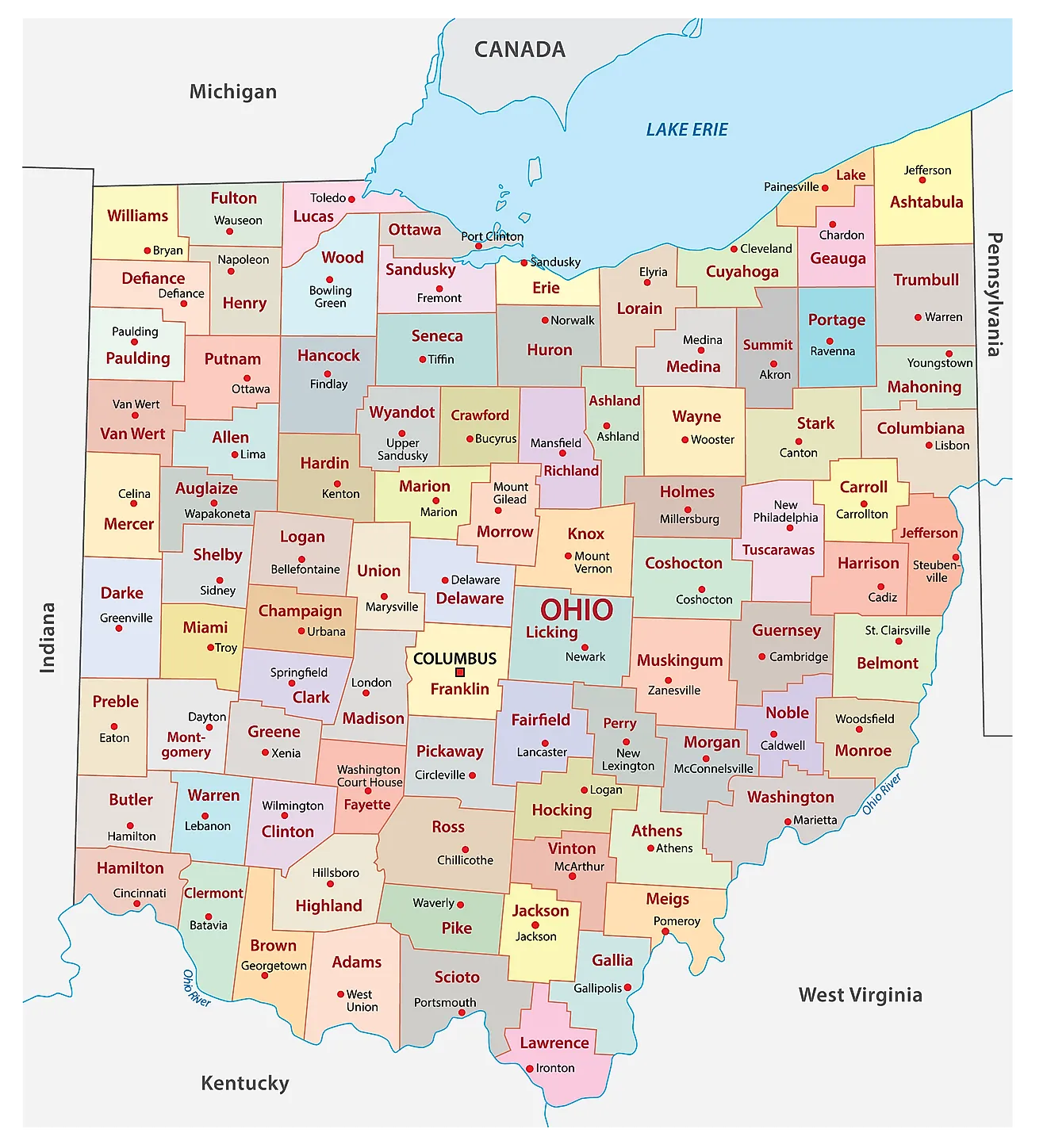
The State of Ohio is divided into 88 counties. In alphabetical order, these counties are: Adams, Allen, Ashland, Ashtabula, Athens, Auglaize, Belmont, Brown, Butler, Carroll, Champaign, Clark, Clermont, Clinton, Columbiana, Coshocton, Crawford, Cuyahoga, Darke, Defiance, Delaware, Erie, Fairfield, Fayette, Franklin, Fulton, Gallia, Geauga, Greene, Guernsey, Hamilton, Hancock, Hardin, Harrison, Henry, Highland, Hocking, Holmes, Huron, Jackson, Jefferson, Knox, Lake, Lawrence, Licking, Logan, Lorain, Lucas, Madison, Mahoning, Marion, Medina, Meigs, Mercer, Miami, Monroe, Montgomery, Morgan, Morrow, Muskingum, Noble, Ottawa, Paulding, Perry, Pickaway, Pike, Portage, Preble, Putnam, Richland, Ross, Sandusky, Scioto, Seneca, Shelby, Stark, Summit, Trumbull, Tuscarawas, Union, Van Wert, Vinton, Warren, Washington, Wayne, Williams, Wood, and Wyandot.
With an area of 116,096 sq. km, Ohio is the 34th largest and the 7th most populous state in the USA. Located in the central part of the state, in Franklin County, is Columbus – the capital and most populous city in Ohio. It is the 15th biggest city in the United States, the 2nd biggest in the Midwest after Chicago, and the nation's 3rd most populated state capital after Phoenix and Austin. The capital city boasts a diverse and robust economy based on education, health care, insurance, food, medical research, defense, fashion, aviation, and technology.
Where is Ohio?
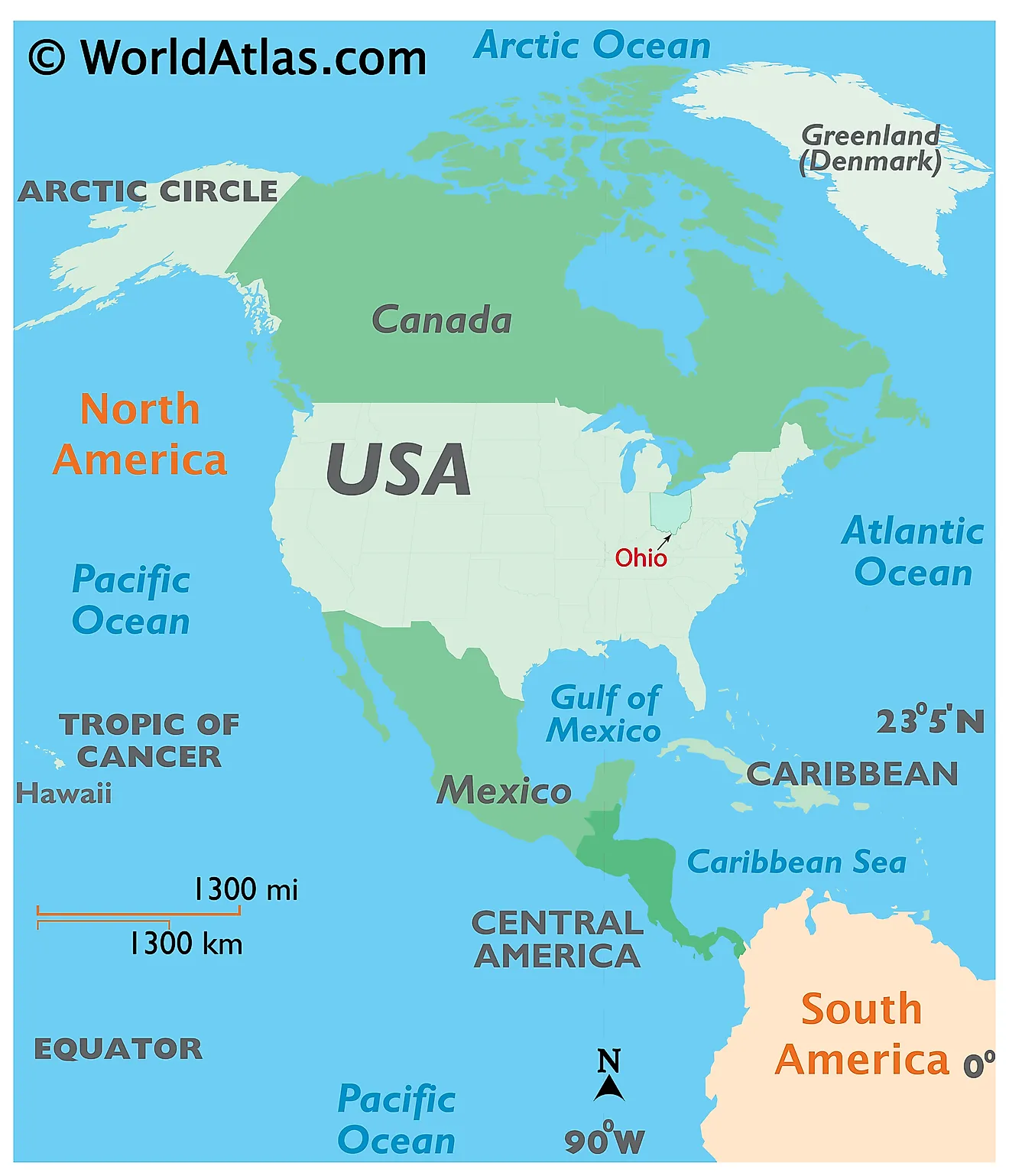
The State of Ohio is located on the northeastern corner of the Midwest region of the United States. Due to its strategic location, Ohio is also known as the "Gateway to the Midwest". Ohio is bordered by the state of Pennsylvania in the east; by the Ohio River and the states of West Virginia in the southeast and Kentucky in the southwest; by Indiana in the west, and by Michigan in the northwest. It is also bounded by Lake Erie in the north.
Regional Maps: Map of North America
Outline Map of Ohio
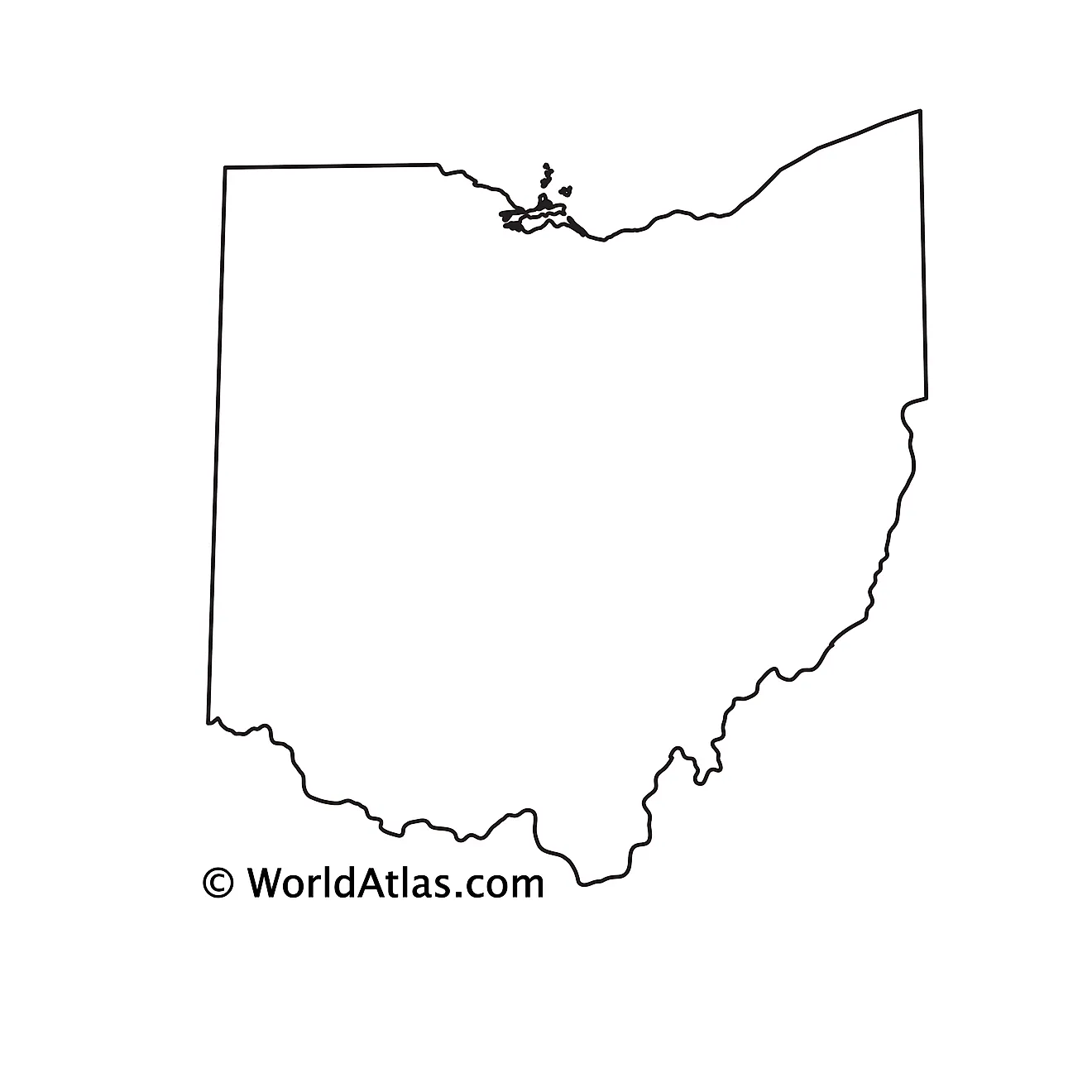
The above blank map represents the State of Ohio, located on the northeastern corner of the Midwest region of United States. The above map can be downloaded, printed and used for geography education purposes like map-pointing and coloring activities.
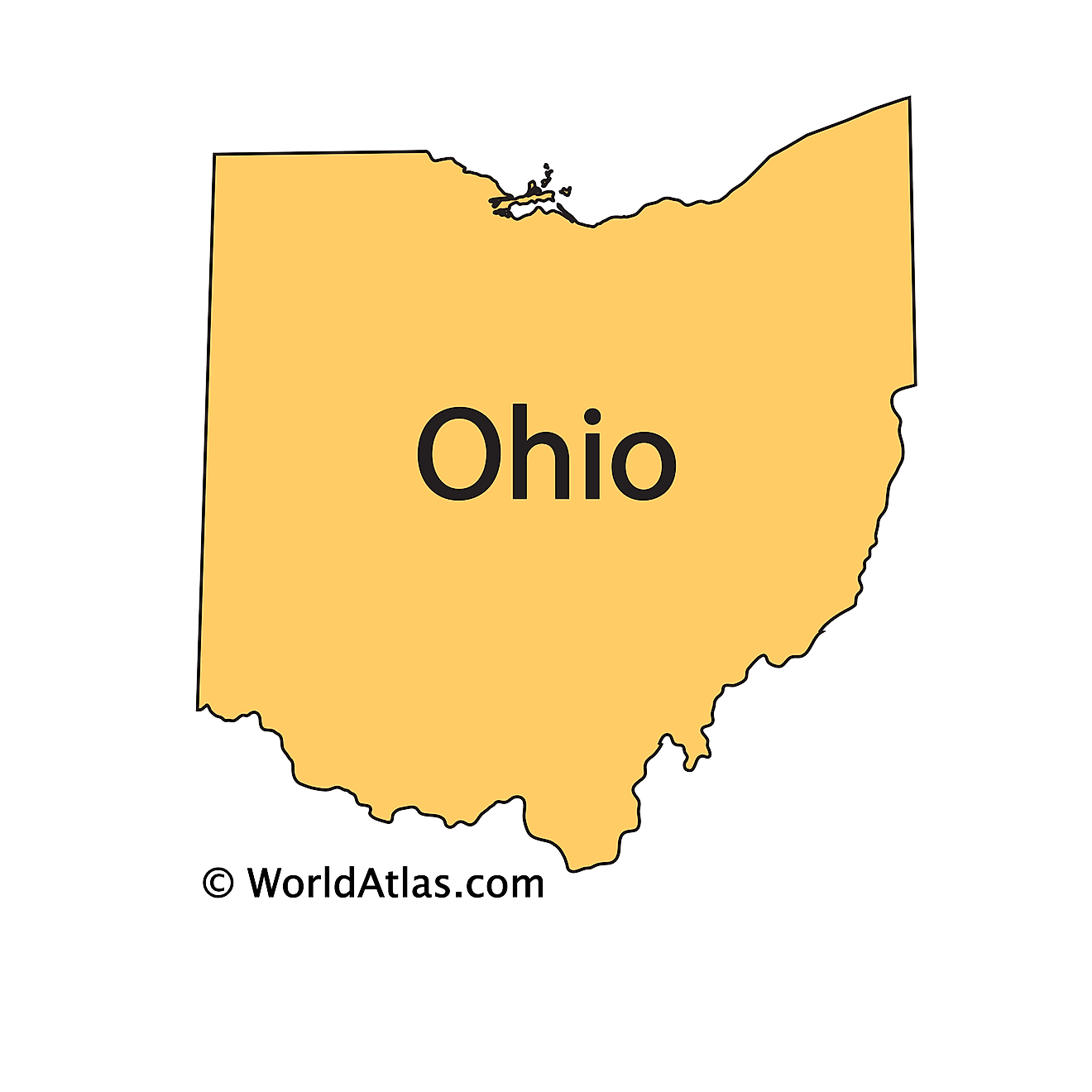
The above outline map represents the State of Ohio, located on the northeastern corner of the Midwest region of United States. Ohio has been nicknamed as the "Buckeye State", for the prevalence of Ohio Buckeye trees (Aesculus glabra) within the state's borders.
Key Facts
| Legal Name | State of Ohio |
|---|---|
| ISO 3166 Code | US-OH |
| Capital City | Columbus |
| Major Cities |
|
This page was last updated on September 20, 2026