8 Underrated Illinois Towns Worth the Drive in 2026
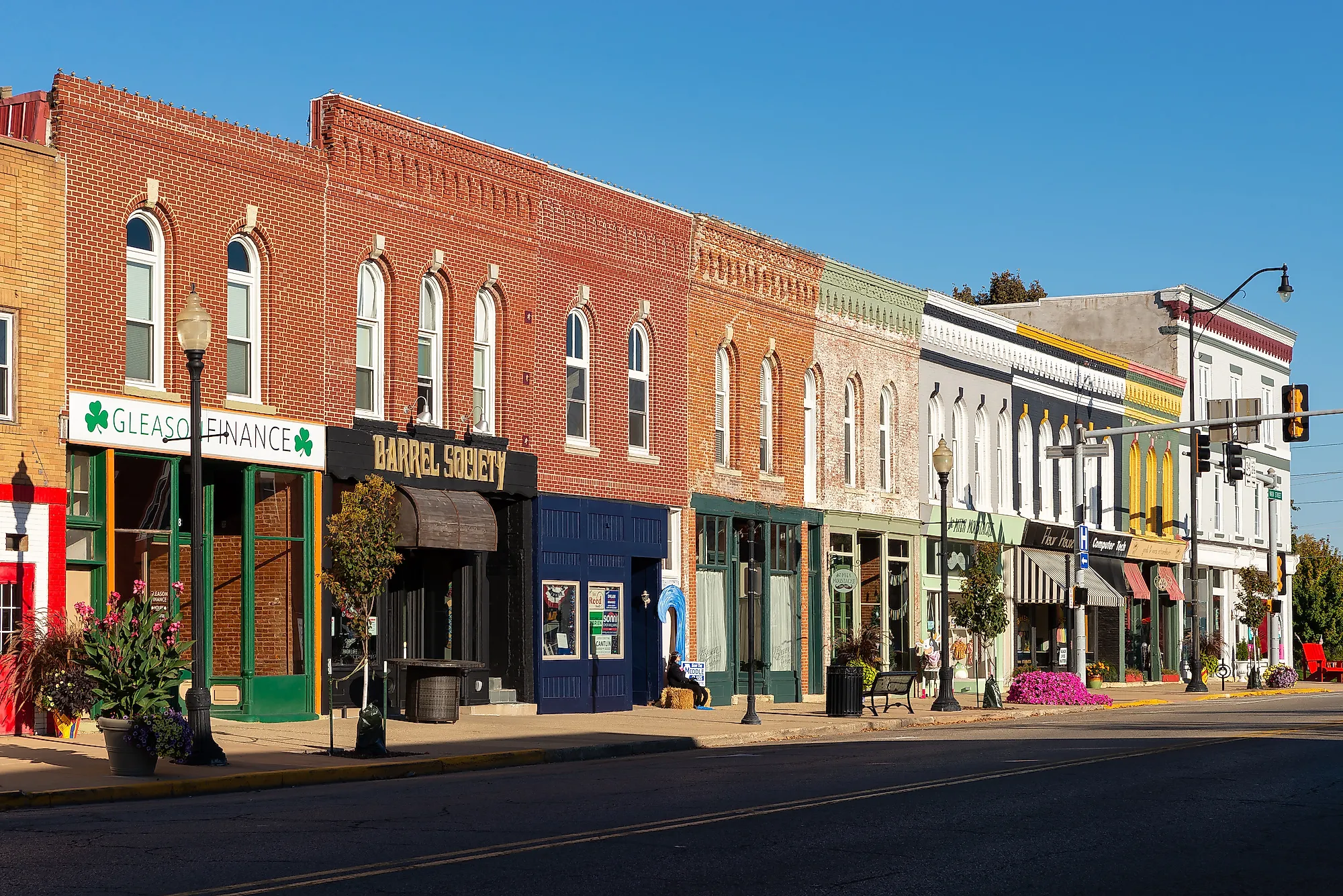
Plenty of Illinois towns get passed on the way to somewhere bigger, and a few of them deserve to be the destination instead. These eight reward the driver who takes the exit, each one holding something a highway sign never hints at. One preserves a film-famous courthouse square. Another turns everyday objects into record-breaking giants. Every one of them sits within a two-hour drive of a major Illinois city or airport, close enough that the detour costs a reader almost nothing and returns a full day.
Woodstock

Woodstock stood in for Punxsutawney in the 1993 film Groundhog Day, and fans still walk the McHenry County town about an hour and a half from Chicago to find the spots where Bill Murray stepped in the puddle and circled the square. That square is the real draw, a preserved 19th-century courthouse district lined with independent shops, restaurants, and Victorian storefronts that gave the movie its look. The Woodstock Opera House anchors one corner. Contractor Simon Brink finished it in 1889 as a combined city hall, library, courtroom, and firehouse, and Orson Welles performed on its stage during his school years in the 1930s. The restored theater now runs concerts, plays, and community performances year-round. Just outside town, hikers can spend an afternoon on the trails of Glacial Park Conservation Area.
Casey

A local businessman named Jim Bolin built a record-breaking wind chime in 2011 to pull travelers off Interstate 70, and Casey has been super-sizing everyday objects ever since. The town of roughly 2,700 residents sits about 75 miles from University of Illinois Willard Airport, and it now holds a cluster of Guinness World Records within a few walkable blocks. The World's Largest Rocking Chair towers over downtown at more than 56 feet, tall enough that setting the record required several grown men to push it into a rock. The World's Largest Mailbox stands nearby, and visitors can climb the steps inside and drop a real postcard through the slot. Bolin's original wind chime still hangs a short walk away, and a pull on its rope sends deep tones down Main Street. The town's "Big Things in a Small Town" map routes visitors past the rest of the giant objects, turning a downtown loop into a scavenger hunt.
Monticello

Robert Allerton spent his summers shaping farmland into an outdoor art gallery and his winters collecting sculptures abroad, and the 1,500-acre estate he left behind sits 30 minutes from Champaign. Monticello gives visitors the run of Allerton Park and Retreat Center, where a Georgian brick mansion completed in 1900 opens for tours and events that trace early 20th-century estate life. The University of Illinois has owned the property since Allerton gifted it in 1946, and overnight guests can book rooms in the mansion and several restored buildings across the grounds. More than 100 sculptures and garden ornaments stand along the formal gardens and the maintained hiking trails, many of them pieces Allerton carried home from his travels. The Fu Dog Garden alone lines up 22 blue porcelain statues on concrete pedestals.
Princeton

Abolitionist and congressman Owen Lovejoy sheltered freedom seekers in his Princeton home during the 1840s and 1850s, and that house still stands just over an hour from Quad Cities International Airport. The Princeton homestead now runs as a museum, open Friday through Sunday from May through September, and its rooms hold the story of the town's role on the Underground Railroad. Two covered bridges sit within a few miles of downtown. The Red Covered Bridge went up in 1863 over Big Bureau Creek and joined the National Register of Historic Places in 1975, though a semi-truck strike in late 2023 closed it to traffic. West of town, the Captain Swift Bridge opened in 2006 as the only two-lane covered bridge in Illinois. The Bureau County History Center fills three buildings with regional artifacts and local records, and staff there take reservations for guided tours of the Clark Norris Museum, the Newell Bryant Museum, and the Sash Stalter Matson Building.
Ottawa

On August 21, 1858, more than 10,000 people packed the public square in Ottawa for the first of the seven Lincoln-Douglas debates, and a monument now marks the spot where Abraham Lincoln and Stephen A. Douglas faced off. The town sits at the meeting of the Fox and Illinois rivers about an hour and a half from Chicago, with some of northern Illinois' most dramatic terrain just outside it. Starved Rock State Park carries 13 miles of trails through sandstone canyons, and waterfalls run in those canyons for a few days after heavy rain. History runs alongside the scenery here too. Crews hand-dug the 96-mile Illinois and Michigan Canal to link the Illinois River with Lake Michigan, a waterway that fed Chicago's early growth, and the Ottawa stretch of the I&M Canal State Trail still follows the old route toward LaSalle.
Arcola

Johnny Gruelle was born in Arcola in 1880 and went on to create Raggedy Ann, and a downtown mural celebrates the hometown cartoonist and his rag-doll characters. The town sits just over 30 minutes from Champaign and serves as the gateway to Illinois Amish Country, where Old Order Amish farms, workshops, and horse-drawn buggies fill the surrounding countryside. A few miles away, near Arthur, the Illinois Amish Heritage Center runs a living-history farm built around the oldest Amish house in Illinois, with programs on the area's settlement and a new visitor center and museum due to open in fall 2026. Arcola keeps a stranger landmark in town as well. Local artist Bob Moomaw built the Hippie Memorial, a long folk-art installation of welded panels, and it has become one of the more unexpected stops on Main Street.
Pontiac

The Illinois Route 66 Hall of Fame and Museum keeps thousands of artifacts and photographs from the Mother Road, and it anchors a Pontiac downtown that leans hard into its highway past. The central Illinois town runs about an hour and a half from Chicago. Veterans and history enthusiasts staff the Livingston County War Museum, where the collection honors local residents who served in the armed forces. Outside, more than 20 murals cover the town's building walls with scenes from local history and Route 66, an open-air gallery that rewards a slow walk. Three swinging pedestrian bridges cross the Vermilion River nearby, and the Pontiac spans give visitors an unusual way to get from one bank to the other.
St. Charles

The Arcada Theatre opened its Spanish Colonial Revival doors in 1926 and still books concerts and live shows, and it marks the center of a St. Charles downtown set along the Fox River about an hour west of Chicago. A short walk away, the Hotel Baker opened in 1928 and remains one of the town's signature riverfront landmarks. Walkers and cyclists can follow the Fox River Trail through St. Charles for river views on both banks, and a paddlewheel riverboat runs sightseeing cruises out of Pottawatomie Park in season. The town sits about 35 miles from downtown Chicago and 22 miles from O'Hare International Airport, close enough for an afternoon and far enough to feel like a trip.
Worth The Detour
These eight towns earn a stop for different reasons. Casey and Pontiac trade in oversized roadside spectacle, Woodstock and St. Charles in preserved downtowns and old theaters, Monticello and Ottawa in estate grounds and river scenery, and Princeton and Arcola in the kind of history that shaped the state. What they share is proximity: every one lies within a two-hour drive of a major Illinois city or airport, which makes any of them a short, low-effort trip for a traveler ready to look past the obvious destinations.