9 Small Towns in New Zealand with the Best Downtowns
New Zealand's best downtowns are rooted in history but not stuck in time. In Oamaru, pale stone storefronts from a two-decade building boom that ended in 1885 still stand in the Victorian Precinct, and each winter the Steampunk NZ Festival brings costumed crowds to their doorsteps. Gold on the Arrow River drew miners to Arrowtown in 1862, and their original buildings survive along Buckingham Street, where the leaves overhead turn amber each autumn. In Russell, the timber shopfronts of the Strand look across the water, while nearby Christ Church still bears musket ball scars from the fighting of 1845. Katikati's painted walls depict Māori and pioneer history, while poems etched into boulders follow the banks of the Uretara Stream in the middle of town. These are some of the best streets for a stroll in New Zealand's small-town centres.
Oamaru

Oamaru's Victorian Precinct on Harbour Street is the best-preserved 19th-century commercial quarter in New Zealand, built almost entirely from creamy-white local limestone between 1865 and 1885. The buildings went up during a brief period of pastoral and agricultural prosperity and were designed to look permanent in a way that most colonial New Zealand towns never bothered to. Today, bookbinders, galleries, a steampunk museum, and artisan workshops occupy spaces that retain their original scale and stonework.
The town has leaned into its Victorian character hard enough to have become the country's steampunk capital, and the annual Steampunk NZ Festival each winter and Victorian Heritage Celebrations in November fill the precinct with costumed visitors. The Oamaru Steam Train runs along the waterfront on Sundays, and a former quarry at the southeastern corner of the harbor shelters a blue penguin colony that comes ashore at dusk within easy reach of the town center.
Arrowtown

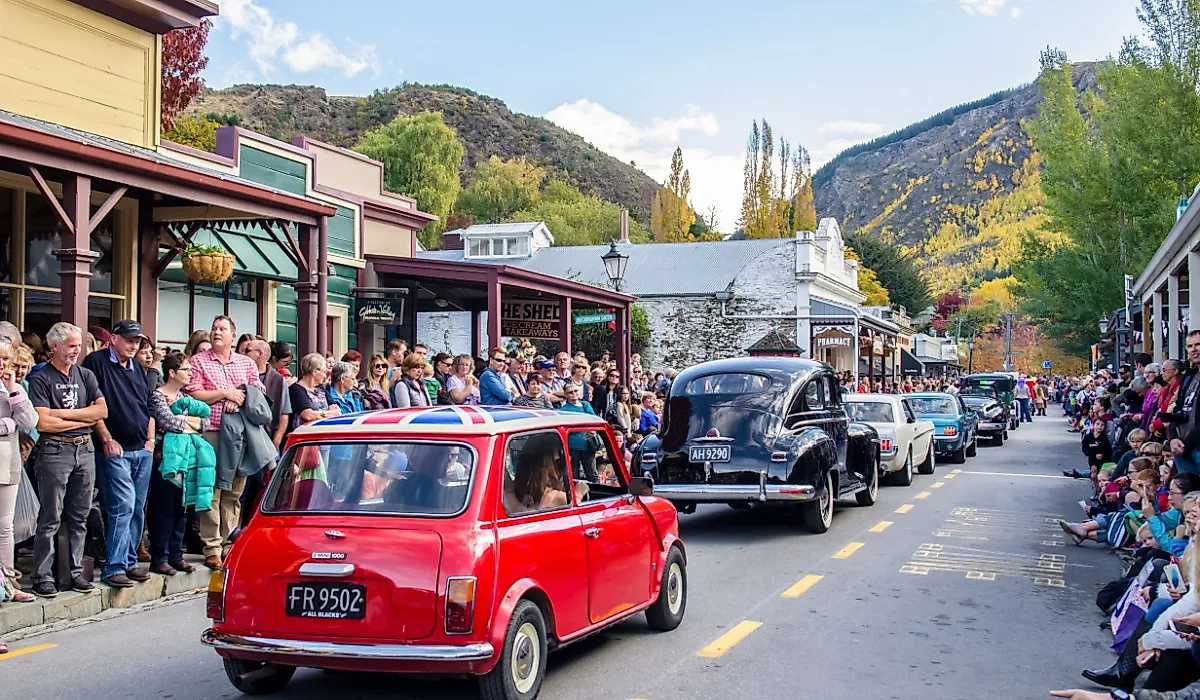
Arrowtown's Buckingham Street is one of the most photographed main streets in New Zealand, not for any single landmark but for the cumulative effect of intact gold rush-era stone-and-timber buildings beneath a canopy of deciduous trees that turns the street amber and gold every autumn. The town was established in 1862 after gold was found in the Arrow River, and the buildings that served the miners have survived largely intact because the town never grew large enough to require their replacement.
The Lakes District Museum on Buckingham Street packs a great deal into a small space, tracing the gold rush era, the Chinese mining community, and the pastoral history of the Otago region in genuine depth. At the edge of the river, the Chinese Settlement preserves the rough stone cottages where Cantonese miners lived under considerable discrimination from the late 1860s until the 1920s, and the site presents that history with unusual candor.
Russell

Russell, known to Māori as Kororāreka, has the longest colonial history of any town in New Zealand and a downtown streetscape that reflects every chapter of it. The Strand, a waterfront walk, is lined with colonial timber buildings dating to the mid-1800s, their verandahs facing a harbor where tall ships still occasionally anchor. Christ Church, a short walk from the waterfront, is New Zealand's oldest surviving church, built in 1835, and its wooden walls still have musket-ball holes from the 1845 Battle of Kororāreka, when Ngāpuhi chief Hōne Heke led an attack on the town during the Flagstaff War. The Pompallier Mission, completed in 1842 and New Zealand's oldest surviving industrial building, operated as a French Catholic printing house and still contains its original printing press. The Russell Museum explores the history of Māori and European contact through waka displays, early maps, and artifacts from the town's days as a rowdy maritime port.
Hokitika

Hokitika's downtown wears the West Coast's frontier history on its shopfronts. The main street is compact and slightly rough-edged, as only genuine working towns are, with pounamu greenstone galleries occupying former trading-post buildings and a local culture built around jade carving that stretches back centuries to Māori. The Hokitika Gorge, a 25-minute drive inland, flows electric blue through a narrow canyon of native bush that draws a steady stream of photographers.
Downtown, the Hokitika Museum documents the town's gold rush origins, its role as a port supplying the West Coast goldfields, and the Māori history of pounamu collection in the rivers above town. Every March, the Hokitika Wildfoods Festival brings an extraordinary assortment of edible oddities to Cass Square, from huhu grubs to whitebait fritters, in a food event that has become a West Coast institution.
Martinborough

Martinborough's downtown is built on a deliberate plan: the town was laid out in 1881 in the shape of a Union Jack, with streets radiating from a central Town Square in a pattern that makes the square the unavoidable center of all movement through the town. That square, shaded by mature trees and surrounded by 19th-century buildings, is now home to wine merchants, cafés, and the kind of unhurried Saturday morning life that attracts visitors from Wellington just over an hour to the southwest.
The surrounding Wairarapa wine country produces some of New Zealand's finest Pinot Noir, and the town's cellar doors and wine bars are within walking distance of the square. The Martinborough Fair, held on the first Saturday of February and the first Saturday of March, fills the town square and surrounding streets with food stalls, live performers, and handmade goods in a community market with a strong following across the lower North Island.
Thames

Thames is the Coromandel Peninsula's largest town, a former gold rush settlement whose Victorian main street has avoided the boutique makeover that has softened similar towns elsewhere. Pollen Street, the main commercial strip, stretches for several blocks of original colonial buildings that now house hardware stores, cafés, op shops, and bakeries alongside a growing number of galleries and artisan businesses that have been drawn by affordable rents and a genuine community.
The Thames School of Mines and Mineralogical Museum preserves the 19th-century institution that trained miners from across New Zealand, and the collection of gold specimens and mining equipment is remarkably thorough. The Hauraki Rail Trail begins in Thames and follows the old railway south through the valley toward Paeroa, an accessible North Island cycling route and a natural extension of a day in the town.
Greymouth

Greymouth is the West Coast's largest town and the western terminus of the TranzAlpine scenic rail journey from Christchurch, and the arrival by train through the Southern Alps into a working coastal port makes for a dramatic entrance. The downtown is defined by the wide Mawhera Quay along the Grey River, the Greymouth Clock Tower near the river mouth, and the Left Bank Art Gallery, housed in a former Bank of New Zealand building whose soaring interior now displays contemporary New Zealand art alongside pounamu carvings and jewelry.
Monteith's Brewing Company, which has been producing beer on the West Coast for over 150 years, offers tours and tastings in a venue that doubles as a popular gathering place. The Shantytown Heritage Park, twenty minutes south, recreates an 1880s gold-mining settlement with a working steam train, gold panning, and period buildings, making it a popular heritage stop on the South Island.
Clyde

Clyde's downtown is one of a kind in New Zealand. Its single compact grid of schist stone buildings from the 1860s and 1870s, their warm golden walls the same color as the surrounding Central Otago hills, is set at the foot of a river gorge where the Clutha River flattens out below the Clyde Dam. At the height of the gold rush, Clyde was one of the largest and most prosperous settlements in the interior Otago goldfields, and the buildings that survived have been painstakingly restored rather than replaced, giving the town an architectural consistency that is almost impossible to find elsewhere.
Olivers, a former provisions store that supplied gold miners in the 1860s, now operates as an upmarket restaurant and bar in a fine example of adaptive reuse in Central Otago. The Otago Central Rail Trail, New Zealand's original Great Ride cycling route, begins in Clyde and follows an old railway line 150 kilometers through the high country to Middlemarch, passing through some of the most remote and beautiful landscapes in the South Island.
Katikati

Katikati is New Zealand's mural town, a Bay of Plenty settlement whose entire downtown has been turned into an open-air gallery over the past three decades. Dozens of large-scale murals cover the walls of buildings along the main street and surrounding blocks, depicting scenes from Māori history, early settler life, local legends, and the natural world of the Tauranga Harbour coastline just minutes from the town center. The project began in 1991 as a community initiative to attract visitors and has since grown into the public art program that earned Katikati its mural-town name.
The Haiku Pathway along the Uretara Stream through the town center pairs haiku poems carved into boulders with native plantings and bird life, giving the town a contemplative quality that the murals alone do not quite capture. The Athenree Hot Springs and Holiday Park, about 12 kilometers north of town toward Waihi Beach, provides thermal pools and camping on the edge of the Tauranga Harbour estuary, making Katikati a natural overnight stop on the road between Auckland and the Bay of Plenty.
New Zealand's Top Downtowns
New Zealand's small town downtowns are at their best when they have not been smoothed over. The limestone and the schist, the colonial timber, the murals, and the steampunk, all of it points toward communities that have found their own way to stay interesting and relevant. These towns are the proof, each one worth a wander.