You Don’t Have to Go to the Highlands to Meet Scotland’s Famous Cows
Highland cows are Scotland's four-legged ambassadors and adorn everything from tea towels to toilet seats (yes, I actually saw one). So you'd be forgiven for thinking you'd have to visit the Highlands to see some. Well, not so fast. On a recent trip to Bonnie Scotland, I discovered I didn't have to trek all the way north to meet some of these cool-looking reddish-orange bovines.
In fact, I got my Highland cow fix in Dumfries and Galloway, just 81 miles southwest of Glasgow. Run by Neale and Janet McQuistin at their farm near New Luce, Kitchen Coos & Ewes puts visitors in a field full of Highland cattle. Brush in one hand, feed bucket in the other, I learned a lot about these fascinating creatures the Scots call "coos."
The "Highland Coo" Coup

The nine-mile route from Stranraer to High Airyolland Farm certainly is scenic, and by the time you get there, you'll have a good sense of the kind of countryside the cows inhabit. Greeted first by the affable Neale, I soon learned that he and Janet have a long and deep connection to the land here.
Neale, it transpires, can trace his Luce Valley family tree back seven generations, though as he joked, he's a newcomer compared to his wife. Janet can trace her Luce Valley roots back through 11 generations of local farmers. And so, when a Highlands fishing trip to the Knoydart Peninsula led to an encounter with a pair of Highland cows, which Neale claims scared the fish away, they knew instinctively that the breed would be perfect for their upland farm in Galloway.

Although the first of the farm's new residents arrived in the early 2000s, the tour idea only came about after the couple noticed people stopping to take photos of the cows when they grazed near the road. Thus inspired, they ran a soft launch in autumn 2019, ordered a bigger trailer, and converted an old cattle shed, or "byre" in this neck of the woods, for tea and treats.
As it did the world over, Covid forced a change of plans. With their May 2020 opening canceled, an ever-resourceful Neale instead live-streamed from the farm's calving field. His instinct was spot on. By the time the farm opened post-pandemic, it had already built a following, ensuring a pent-up demand for their unique offering.
What, Exactly, is a Highland Cow?

The Highland Cattle Society was founded in 1884 and published its first Herd Book in 1885, making the Highland one of the world's oldest registered cattle breeds. There were originally two types. These were the small black Kyloe of Scotland's western islands, and the larger red version on the mainland. Today, they're registered as a single breed in red, black, yellow, dun, brindle, white, and silver.
And that long, hairy coat they're all wrapped in? That's purely functional, rather than for looks. Highlands have a double coat, consisting of a downy undercoat under a long, oiled outer layer. Reaching up to 13 inches long, it's ideal for weatherproofing against the rain and snow the Highlands are known for. The distinctive fringe that hangs over the eyes, known as the "dossan," does the same job.

I also learned that a group of Highland cattle is known as a "fold" rather than a herd. Yes, the Scots have alternative names for just about everything. Our tour also taught us that there's a pecking order, with females in charge. And both sexes wear horns.
While Highlands are predominantly a beef breed, they're also useful for conservation grazing, eating the gorse and rough grass that would otherwise cover the land. Most of the cattle we saw that day at High Airyolland did just that, and they certainly earned their keep.
The Farm Safari

Wrapped in one of the farm's cozy lined waterproof jackets on what was a cool early May day, we climbed aboard the covered trailer for our farm safari. Purpose-built for the job and almost luxurious, the trailer's height meant we all had great views of both the cattle and the countryside. In addition to having comfortable padded seats, it's also equipped with a ramp for wheelchair access.
It wasn't long before a crowd of the farm's fuzzy cows was following us as we made our way to the feeding and grooming part of our Hands-on Coo Tour. Deposited in a fenced outdoor pen and surrounded by several of the farm's younger cows, we were given sturdy brushes and encouraged to pick a cow and groom away.
I soon found out that what they really, really liked was to be brushed firmly and scratched behind the ears. It was a win-win for sure, with both cow and cowhand enjoying the experience.
My Date With a "Supermoodel"

Neither Neale nor Janet ever rushed us, allowing us as much time as we wanted with our new friends. Back on the trailer, the tour's highlight was still to come, meeting a "Supermoodel."
As the tractor approached the rocky outcrop where we were to get our photos, Janet reassured us that nothing the cows do here requires coercion. Whether it was the grooming or the posing, it was something they chose to do, either out of curiosity or, as one of my fellow travelers piped up, possibly vanity.
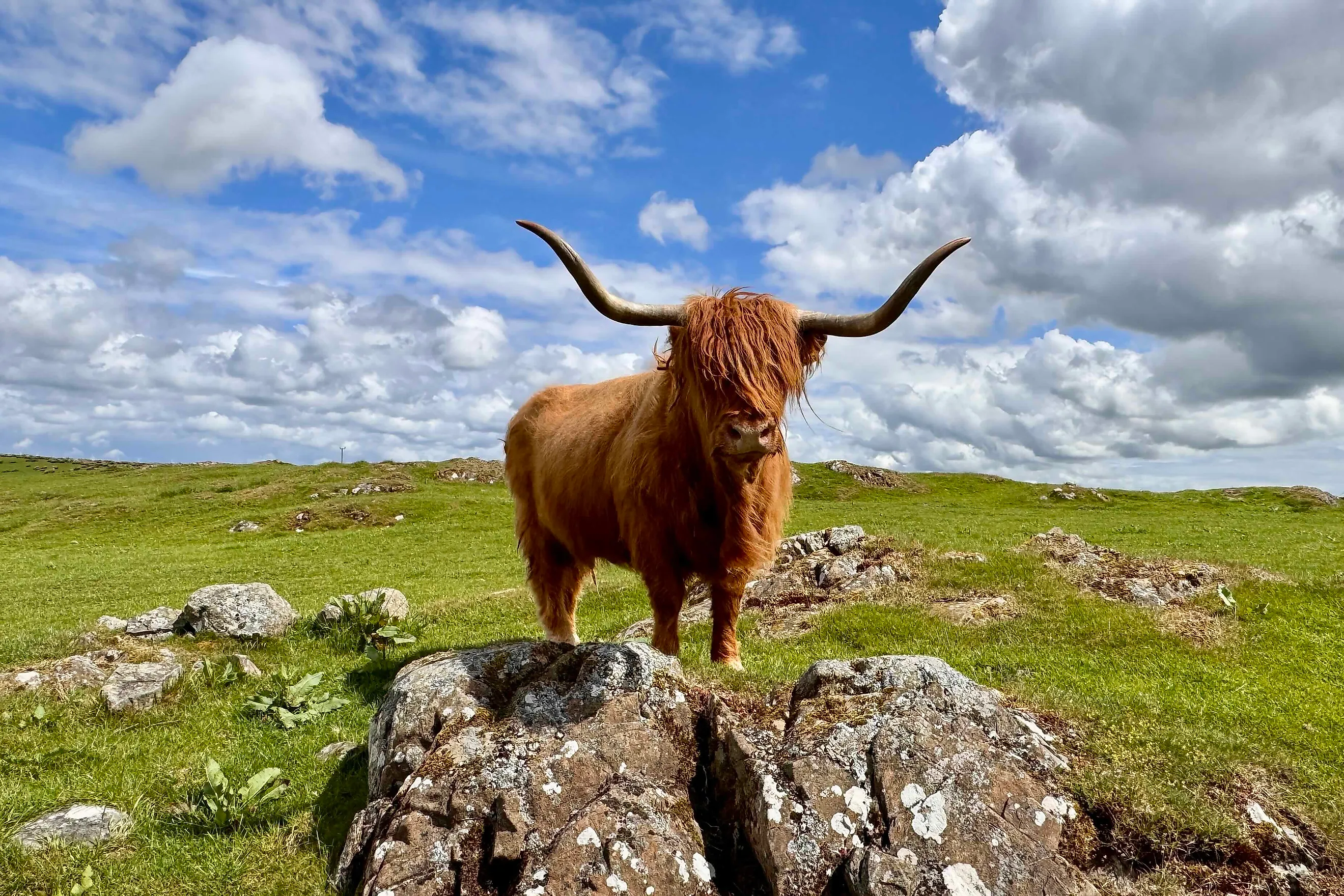
On my tour, the cow who took the job was Cairistiona. Recognizing her moment of stardom had come, she climbed past us onto a rocky outcrop, turned side-on, and held still against the sky. It was the perfect "coo pose," and a truly magical moment.
Cairistiona, we were told, was one of the farm's retired "Golden Girls," a group kept on the farm for life rather than sold once they stopped breeding. And with looks like hers, it was obvious she'd be wooing guests for years to come.
A Day Well Spent
Back in the farmyard, we were rewarded for braving the cold with tea or coffee and treats in the Old Byre. Everything was baked from scratch, and you could tell. Best of all, it's all included in the tour price.
Janet also told us that gluten-free, dairy-free, and vegan treats were available upon request. Demand for her recipes reached the point where she published a recipe book, available on-site and online alongside Highland cow hats, hoodies, slippers, and even toilet seats.

Fed and watered, I went away feeling extremely satisfied with my Kitchen Coos & Ewes experience. Not only was it a fun way to spend a few hours in a beautiful part of southern Scotland, but I also found Neale and Janet an inspiration. So, too, were their cute coos.