10 Gorgeous Illinois Towns To Visit
Elsah is the only village in America listed in its entirety on the National Register of Historic Places, stone cottages and Italianate brick homes lining a few short streets along Piasa Creek bluffs above the Mississippi River. That's the upper bound of preserved-and-handsome small-town Illinois. Galena's downtown climbs between river bluffs in Federal-and-Italianate brick. Nauvoo's reconstructed temple rises 165 feet above the Mississippi at sunset. Woodstock's town square is a near-perfect Victorian commercial district built around a bandstand where Bill Murray once predicted his own future. Ten Illinois towns where the camera roll fills up before lunch.
Galena

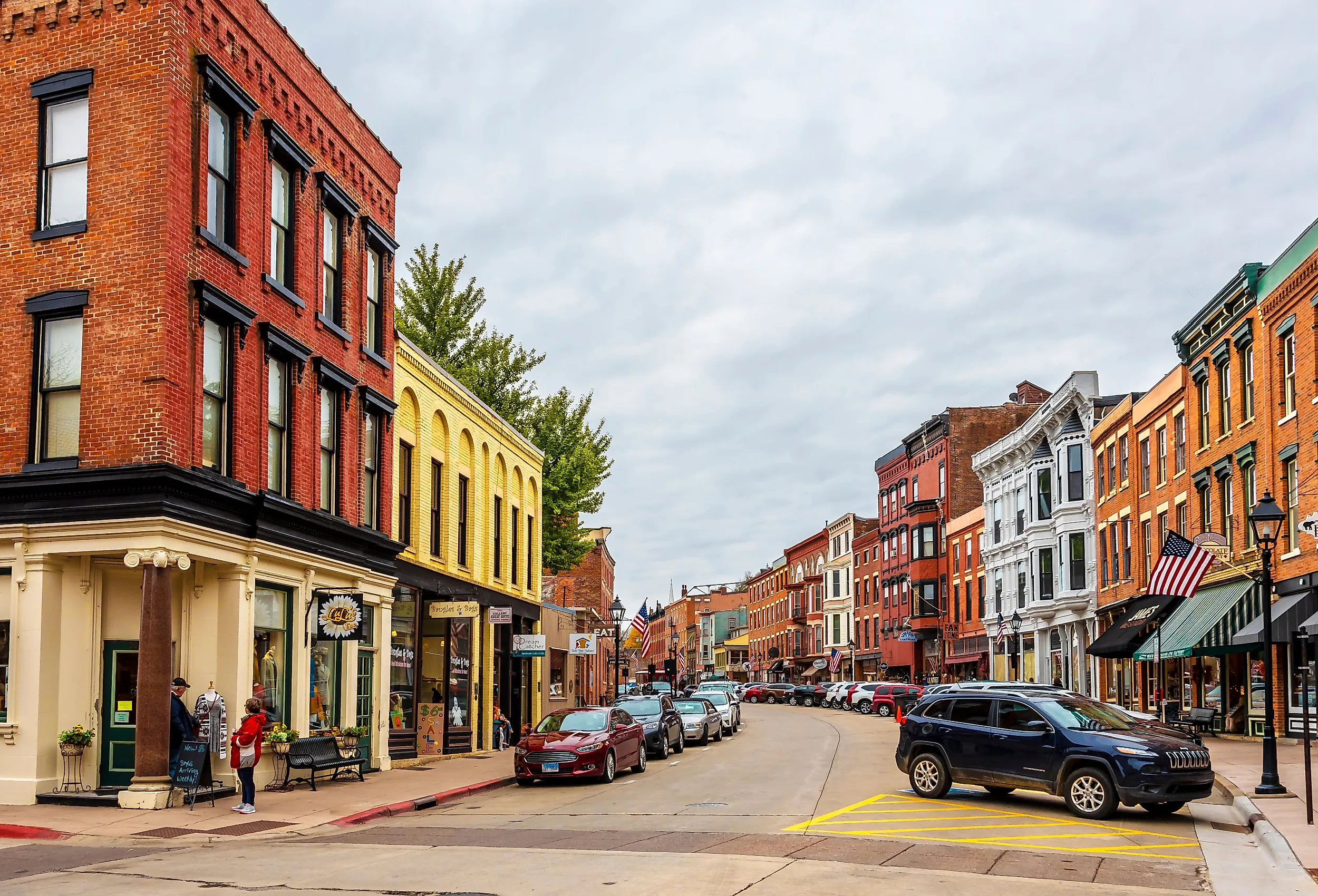
Galena was the lead-mining capital of the American Midwest in the 1820s and 1830s, and the downtown that boom built has barely changed. Main Street climbs between bluffs in a long curving stretch of brick storefronts; locals will tell you more than 85 percent of the buildings in the downtown district are historic. The Ulysses S. Grant Home State Historic Site preserves the modest brick house where the Civil War general was living in 1868 when he was elected president. The Galena and U.S. Grant Museum fills in the rest of the local history, including the lead-mining era that built the place. South of town, the Casper Bluff Land and Water Reserve looks over the Mississippi with intact prehistoric petroglyph and effigy mound sites still on the bluff. The Night of the Luminaria each December lines Main Street with thousands of candle-lit paper bags. It's the cliché shot of small-town Illinois at Christmas, and Galena keeps earning it.
Fulton

The De Immigrant Windmill in Fulton was built in the Netherlands, taken apart, shipped across the Atlantic, and reassembled on the Mississippi River bank in 2000. It still grinds grain. The Windmill Cultural Center next door covers Dutch immigration history through scale-model windmills and rotating exhibits, and the Dutch Days Festival every May fills downtown with klompen dancers, wooden shoes, and Dutch food. The Martin House Museum keeps a small collection focused on local artist George Martin. Fulton also sits on the Great River Trail, a multi-state bike route that hugs the Mississippi, which makes the windmill the only working Dutch-built mill you can roll past on a Schwinn.
Quincy

Quincy on the Mississippi River anchors west-central Illinois with one of the most varied architectural inventories in the state. Villa Kathrine, an early-1900s mansion modeled on a Tunisian palace, sits on a bluff above the river with a swimming pool tiled in intricate mosaic and a recreated minaret. The Quincy Museum occupies the 1891 Newcomb-Stillwell Mansion, a Richardsonian Romanesque house wrapped in turrets. The Dogwood Festival each May fills downtown with parades, pageants, comedy shows, and live bands. The Quincy Art Center on Maine Street runs rotating exhibits. Quincy has more buildings on the National Register of Historic Places than almost any other Illinois town its size, which is part of why a casual driving tour can eat most of an afternoon.
Nauvoo

Nauvoo overlooks a wide bend in the Mississippi and was briefly the largest city in Illinois in 1845, with a population that rivaled Chicago's, before The Church of Jesus Christ of Latter-day Saints leadership and most of its members were forced west in 1846. The Nauvoo Historic District today reconstructs the 1840s town through more than two dozen restored or rebuilt sites, including the Joseph Smith Mansion House, the Red Brick Store, and the Nauvoo House. The Nauvoo Temple, reconstructed in 2002 on the original 1846 foundation, dominates the bluff above town and lights up at night for miles. The Nauvoo Grape Festival every Labor Day weekend celebrates the town's wine-and-cheese heritage with grape stomping, crafts, and live music, and Nauvoo State Park covers Horton Lake on the south side of town for picnicking and walking trails.
Geneva

Geneva sits on the Fox River about 35 miles west of Chicago and runs one of the most intact 19th-century downtowns in the Chicago metro. The Third Street historic district is on the National Register and packs more than 100 specialty shops into restored Victorian storefronts. The town was settled largely by Swedish immigrants in the late 19th century, and Geneva Swedish Days each June (running since 1949) brings parades, music, and a midsummer pole-raising to downtown. The Fabyan Villa Museum and Japanese Garden, on the Fox River south of town, preserves Colonel George Fabyan's estate, where Riverbank Laboratories became the birthplace of modern cryptology in the 1910s. The Geneva History Museum holds the 1893 Chicago World's Fair Viking Ship, a full-scale Viking longship built in Norway, sailed across the Atlantic, and somehow still hanging around in Illinois 130 years later.
Woodstock

Woodstock holds the most photogenic town square in northern Illinois, a near-perfect Victorian commercial district built around a central park with a bandstand. The Woodstock Opera House, built in 1889 and still operating, runs theater, concerts, and classic film series in a 425-seat hall. The town stood in for the fictional Punxsutawney in the 1993 Bill Murray movie Groundhog Day, and the annual Woodstock Groundhog Days Festival every February reenacts scenes from the film right back on the square that the film made famous. Emricson Park covers a paved walking-path network, the Woodstock Water Works aquatic center, and family play areas. Heider's Berry Farm just outside town runs you-pick strawberry and raspberry seasons, and the Square itself hosts a weekly farmers market through the growing season.
Mount Carroll

Mount Carroll in northwestern Illinois has its entire downtown on the National Register of Historic Places, with Italianate and Victorian commercial buildings ringing the 1858 Carroll County Courthouse on the square. Timber Lake Playhouse, just outside town, has run summer professional theater since 1962, mixing musicals, dramas, and family productions. Mississippi Palisades State Park north of town climbs limestone bluffs above the river along the Sentinel Trail and the High Point Trail, looping past overlooks named Lookout Point, Louis's Point, and Ozzie's Point. Oktoberfest each fall fills the courthouse square with live music, brats, and craft vendors, and the leaf-peeping window on the Palisades trails is roughly the same weekend.
Lebanon

Lebanon in southern Illinois grew around McKendree University, founded in 1828 as the oldest college in Illinois and the oldest United Methodist-related college in continuous operation in the country. The original campus buildings and bell tower still anchor the town center. The Mermaid House Hotel, built in 1830 and still standing, hosted Charles Dickens during his 1842 American tour (an episode Dickens describes in his travel book American Notes), which makes a small downtown street in southern Illinois the unlikely setting for a Dickens overnight. The Horner Museum covers local history through artifacts and photographs, and the Lebanon Blues Festival each August brings touring blues musicians to the brick downtown streets along with food and craft vendors.
Elsah

Elsah is one of the smallest towns on this list and one of the most architecturally remarkable. The entire village (population around 600) was the first community in the country listed in its entirety on the National Register of Historic Places, in 1973. Stone cottages and Italianate brick homes line just a handful of streets along the Piasa Creek bluffs above the Mississippi River. Farley Music Hall, an 1885 community building, holds local concerts and meetings. The Sam Vadalabene Bike Trail runs along the Great River Road National Scenic Byway through town with Mississippi River and limestone-bluff views, and the Elsah Spring Festival each May fills the village with art, pottery, jewelry, and food vendors. The whole place takes about twenty minutes to walk top to bottom, and it earns every minute.
Petersburg

Petersburg, about 20 miles northwest of Springfield, anchors the Abraham Lincoln story on its western side. Lincoln's New Salem State Historic Site reconstructs the 1830s frontier village where Lincoln lived from 1831 to 1837, when he worked as a store clerk, postmaster, and surveyor before launching his political career. The reconstructed village holds 23 log buildings (including the Rutledge Tavern, the Lincoln-Berry Store, and a working blacksmith shop) all staffed by costumed interpreters during the visitor season. Oakland Cemetery on the south side of Petersburg holds the grave of poet Edgar Lee Masters, author of Spoon River Anthology (the Spoon River is essentially Petersburg and neighboring Lewistown). Downtown Petersburg keeps its 19th-century square anchored by the Menard County Courthouse, with small independent shops and cafes around it.
Ten Versions Of Pretty
Each of the ten towns above tells a different chapter of the Illinois story, and each one looks the part. Galena and Lebanon both wear their pre-Civil War origins on their sleeve. Nauvoo and Petersburg preserve frontier-era religious and political history. Quincy, Geneva, and Mount Carroll concentrate Victorian commercial architecture into walkable squares. Fulton runs on Dutch immigrant heritage and one transplanted windmill. Elsah is the National-Register-entire-village outlier, and Woodstock leaned hard into a Hollywood moment that still pulls visitors every February. Ten arguments that Illinois has more preserved beauty per mile than its reputation suggests.