Riding the Rails Across Malaysia
Having spent the past two months island hopping in the Philippines, I was keen to explore another part of Southeast Asia in an entirely new way. As I've done many times throughout my scrappy backpacking era, I let the price of pending flights be my north star. A one-way ticket from Cebu to Kuala Lumpur for 35 bucks? "Sign me up!" I thought. No sooner had I bought the ticket than I began researching this hypermodern capital city, and Malaysia as a whole.
Despite traveling to Asia on several occasions, I knew next to nothing about Malaysia. So imagine my surprise when I learned that this hemispheric nation received 42.2 million visitors in 2025 (an 11.2% increase year-to-year), dethroning Thailand in the process. Upon arrival, I could see why this was now the region's top dog. Kuala Lumpur's record-setting skyscrapers rise over clean and colorful streets, immaculate parks, sparkling shopping malls, and friendly pedestrians.
In the coming days and weeks, I learned that the capital is well-connected to the rest of Peninsular (i.e. West) Malaysia by a high-speed railway network, a welcome contrast to the constant flights, ferries, and overstuffed shuttles of the Philippines. Armed with a newfound curiosity and easy access to the colonial cities, ancient caves, and eclectic cultures centered around a novel coastline, I was ready to tackle Malaysia.
Kuala Lumpur: Markets and Skyscrapers

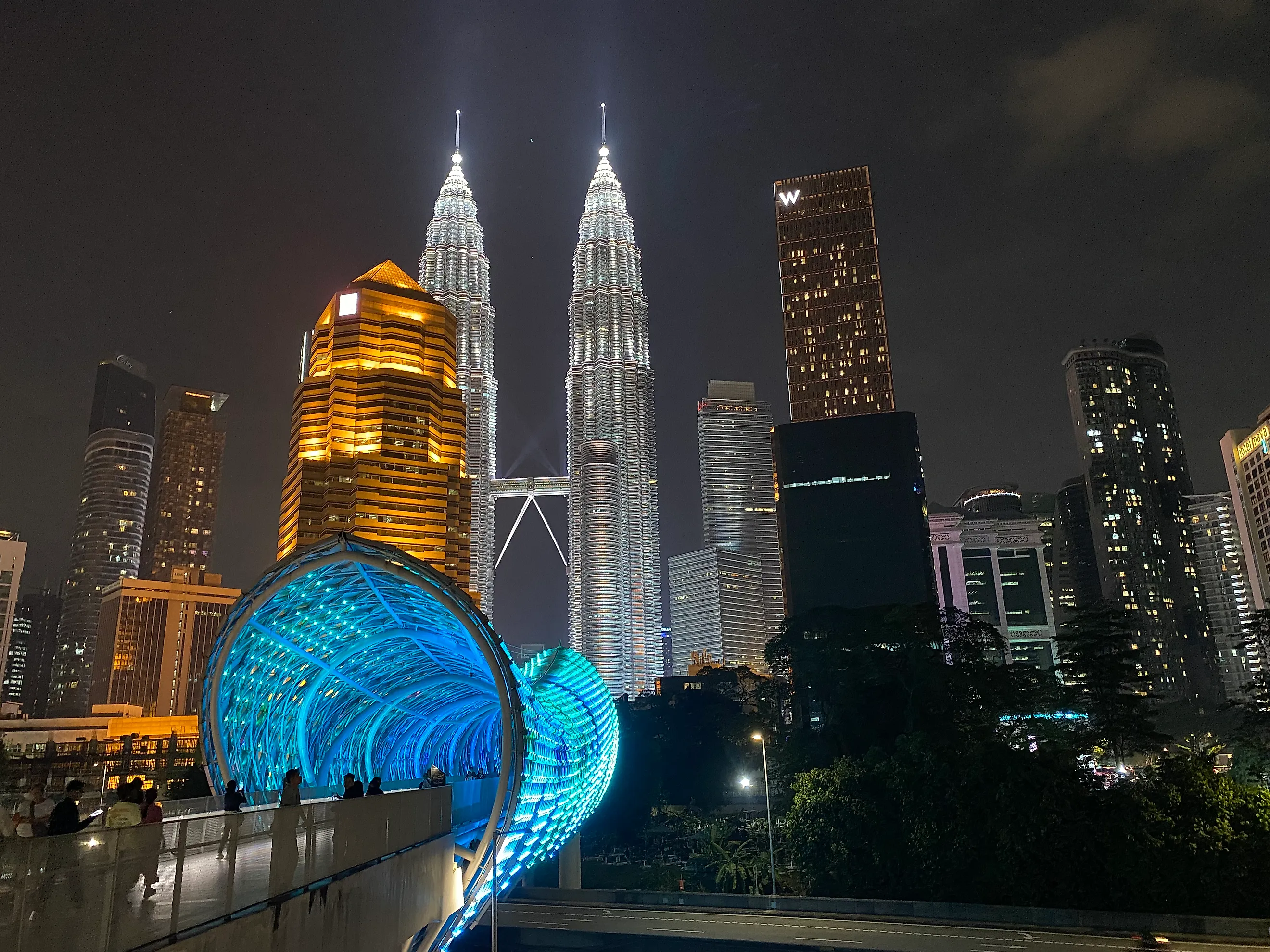
Back in primary school, my class was tasked with making a cardboard model of an iconic building. Mesmerized by the symmetry, connecting bridge, and futuristic exterior, I chose the Petronas Twin Towers. So you can imagine the time-warping dream-state I entered when I stood beneath these 1,483-feet (452-meter), 88-storey icons of Kuala Lumpur in the flesh.
Entranced, I walked laps around KLCC Park, with its mondo track and tree-lined ponds, unable to stop taking pictures of the Petronas Towers. Then, just as I accepted that I had, at long last, captured them from every conceivable angle, darkness fell and the lights turned on. Not just up and down the monoliths, but the choreographed fountains at their base. The camera cycle started anew.

Unable to satiate this skyscraper fixation, I of course had to buy a ticket for the Petronas Towers Experience. The only way for visitors to get up one of these primarily corporate buildings is to join a guided tour. 147 Malaysian ringgits (~$36 USD) granted me ample access to the 41st/42nd-floor Skybridge, the 86th-floor Observation Deck, and the 83rd-floor Sky Cafe. The views are ceaselessly spellbinding, but if you can pull yourself away from the windows for a minute here and there, the interpretive signs and videos are engaging in their own right. Fun fact, when the CTBUH named the Petronas Towers the world's tallest in 1998, they supplanted Chicago's Sears Tower, though not without some controversy (those dang antennae). They held this crown until 2004 and still rank in the global top 20, along with two additional Kuala Lumpur structures.
This triangle of ridiculously tall towers makes it easy to orient yourself within the two-million person city. Though I made good use of the train getting from/to Kuala Lumpur, I found the city itself to be surprisingly walkable. So from the Petronas Towers, I strode southwest toward the all-blue Merdeka 118, the second-tallest building in the world, and then east toward the white-tipped Exchange 106, which sits one spot ahead of the Petronas Towers on the global rankings.

This circuit took place over multiple days, but if you follow it in this order, these are the highlights you can expect to encounter. First, the smell of incense, sandalwood, and spices will flood your nostrils and drain your salivary glands as you pass through Little India. Being there in late January, the neighborhood was buzzing in anticipation of the Hindu festival of Thaipusam (which we'll see more of at Batu Caves). Next, the classy indoor/outdoor market of Pasar Seni works synergistically with the sprawling, old-school Petaling Street Market in nearby Chinatown.
Trending east, I reached Jalan Alor Food Street at the core of Kuala Lumpur. This popular, if polarizing, stretch is a quintessential Asian night market the likes of which I saw in Bangkok and Chiang Mai, only with way more durian. You can easily make an evening of stall-hopping, but if you need a break from the crowds and/or notoriously stinky fruit, slip down to Tong Shin Terrace. This inconspicuous restaurant has the local Nasi Lemak offerings alongside Indonesian fusion dishes, all within a cozy, Hemingwayian venue. There's plenty more to experience in Kuala Lumpur, but as billboarded, let's jump on the train and check out another stimulating part of Malaysia.
A Quick Note on Accommodations:

Just a heads up that in Kuala Lumpur, you'll see quite a few luxurious apartments listed on sites such as Booking.com. Chances are, you'll be baited with images of rooftop pools above sweeping skylines. The problem is, a lot of these end up being pretty scammy. For starters, the prices listed never match what you actually have to pay in cash upon arrival. It sounds more secure to "pay on arrival," but once you see the additional fees and realize that you have to pony up hard currency (even though you might have just arrived from the airport), the vibe quickly changes. Personally, I was able to talk my "host" (i.e. usually an Indian man working many other units) down to the original price. But in order to achieve that, we had to cancel my official booking and then just give him the money directly (which would have happened anyway, now without any third-party guarantees).
Also, even though my unit matched what I reserved, I noticed a long line of bad reviews voicing dissimilar experiences. I then noticed that once a unit racked up a poor aggregate review, a fresh listing would be made either with no reviews or a handful of obviously fake reviews (which explains the pervasive double-booking issues). In short, pay attention to the reviews, clarify pricing before confirming, or just book direct as much as possible. I did not experience these issues in any other Malaysian cities.
Batu Caves: Millions Gather for Thaipusam

The 400-million-year-old limestone cave system known as Batu Caves awaits less than 40 minutes north of Kuala Lumpur via the KTM Komuter Train. Here, Malaysia's Hindu diaspora pay homage to Lord Murugan, who is represented by a 140-foot golden statue, and visit the adorned caverns which he guards. Whether you're a Hindu pilgrim or a curious Western traveler, a certain level of devotion is required to reach the main cave/temple, as it sits atop 272 technicolored steps.
This epic climb is made all the more challenging during the festival of Thaipusam, which takes place during the full moon of the 10th month of the Hindu calendar (i.e. anywhere from mid-January to mid-February). Not only are there thousands of people making the climb at any given time (this year, an estimated 2.5 million people attended Thaipusam at Batu Caves), but many of them are carrying pots of milk, strapping enormous decorative frames onto their shoulders, and piercing their bodies in acts of penance, all in a fasted state.

Visiting Batu Caves was, in a word, overwhelming. I felt like I was walking into the heart of New Delhi. I was perpetually shoulder-to-shoulder (or crotch to ass) with people, drums were banging, colors were swirling, monkeys were bounding about, thousands of pairs of relinquished shoes circled around the base-level temples, and food waste amassed all over, often in great piles. As was the case at the Petronas Towers, I could not stop taking pictures and videos of the wild scene. Every time I reached a new plateau on the rainbow steps, I was struck by a new perspective on the festival (which grew evermore as evening descended).
Exhausted but charged with travel whimsy, I boarded one of the last return trains to KL Sentral, ready for a good sleep and the next cultural adventure.
Ipoh: Ancient Caves and Buddhist Temples

Having witnessed the scene at Batu Caves, it's hard to believe that Hinduism is the smallest (6.1%) of Malaysia's four major religions. Christianity is practiced by approximately 9.1% of the population, Buddhism by 18.7%, and Islam by 63.5% (predominantly Sunni Islam). As a follower of Buddhism, it was this other Indian religion that called to me next. This meant boarding another KTM train to Ipoh: the state capital of Perak.
This old tin-mining town still exhibits Chinese and British traits, the two cultures that shaped Ipoh during the late 19th and early 20th centuries. As such, within the lush karst landscape, repeating Buddhist temples are interspliced with Taoist and, once again, Hindu shrines. My suggestion for new arrivals is to head for Tasik Cermin (i.e. a decommissioned mining tunnel that opens into a grand natural amphitheater) and then visit the cluster of temples in its vicinity. Here, you'll also have a chance to try Ipoh's famous white coffee.

Further south of Ipoh (about 25 km/15 mi by taxi), Tempurung Cave (Gua Tempurung) made for one of the most exceptional features of my entire Malaysian meander. At 4.5 kilometers long (1.9 of which is accessible to the public) and with five stalactite and stalagmite-littered domes, this 400-million-year-old cavern is one of the largest in Peninsular Malaysia. Unlike the other caves thus-far visited, this one has not been exploited for religious purposes, but instead uses minimally-intrusive walkways and lights to accentuate the subterranean splendor. Unfortunately, some visitors have not shown similar mindfulness, as nearly every surface that can be reached over the guardrails is scratched with graffiti (the same was true, bizarrely, of certain Batu Caves sites).
The town of Ipoh wasn't quite as quaint as I was hoping after my previous big-city experience, but it did have its appealing pockets. The pathways along the Kinta River made for a pleasant respite from some of the busier thoroughfares. The Gerbang Malam Night Market had sort of a laissez-faire intrigue about it and highlighted the town's Chinese enclave. And the once-infamous, now-touristic "Concubine Lane" is definitely worth a wander, day or night.
George Town: An Artsy Colonial Town With Great Hiking

Continuing north up Peninsular Malaysia's west coast, the KTM rolled me into Butterworth Station, where I could immediately leapfrog onto the Penang Ferry. A mere three-kilometer float brought me onto the island of Penang, via the historic trading port and UNESCO World Heritage Site of George Town. Whereas Kuala Lumpur exemplified modern Malay culture, Batu Caves illuminated the Indian diaspora, and Ipoh honed in on Chinese and multi-origin Buddhist legacies, George Town, founded in 1786 as part of the East India Company, echoed the British Empire.
Your impression of George Town will depend entirely on where you choose to look. The rows of bars along Chulia Street with neon signs advertising European beers, or the hoards of camera-carrying tourists along Armenian Street/Umbrella Alley might leave you worried you walked right into a tourist trap. But wander its surrounding blocks and you'll find endless historical architecture, lesser-known street art, hipster coffee shops, and Malaysian cafes. My favorite hole-in-the-wall restaurant was called Tiga Bangsa Kopitiam. It was as delicious as it was affordable, as it was friendly. And nobody seemed to know about it.

Backdropping George Town is the Penang Hill Biosphere Reserve. These green mountains can be summited with the help of a funicular railway, or by grunting up its wooded hiking trails. In either case, panoramic viewpoints and families of dusky langurs (aka dusky leaf monkeys) greet all who indulged the 15-minute drive west of downtown George Town. If you decide to tackle the hike (up, down, or both), pack lots of water and be prepared to navigate thousands of asymmetrical steps. Caveats aside, make no mistake, this is an incredibly satisfying climb.

George Town has its share of museums and galleries, but the one I'm glad I stumbled into was Blank Canvas, beside Armenian Street. At the time, they were hosting an exhibition by Sim Chan called The Infinite-land. Inside, the gallery lights were dimmed so that the miniature models could be illuminated individually. This particular exhibition will have since moved on, but given the curation skills I witnessed, I'll bet that whatever works they have currently featured will be well worth the mere 15 RM ($4).
Roll On Slow

Malaysia's wide-reaching rail system lets greenhorns like me experience Southeast Asia in a fresh and relaxed way. Sure, places like Japan and China have long excelled at this game, but having just arrived from the Philippines and previously done other chaotic tours in this region, I must say, I adored the comfort and flexibility afforded by the KTM trains.
Given Malaysia's massive uptick in both foreign and domestic tourism, you'll want to be vigilant about advance bookings around holidays and peak-season weekends. But otherwise, let the station maps set the tone for your journey across the peninsula. Kuala Lumpur's dizzying skyline, Ipoh's expansive caves, and Penang's visually-arresting attractions constitute but a slice of one half of Malaysia. And I, for one, am eager to uncover more of this eclectic country.